Thank you for visiting SNEWPapers!
Sign up free
Editorial
June 12, 1811
The Rhode Island Republican
Newport, Newport County, Rhode Island
What is this article about?
Editorial condemns British impressment of American seamen, highlights escapes and sufferings, blames federalists for weakening U.S. response and encouraging British aggression, urges unity behind the government to secure redress and prevent war.
Clipping
OCR Quality
98%
Excellent
Full Text
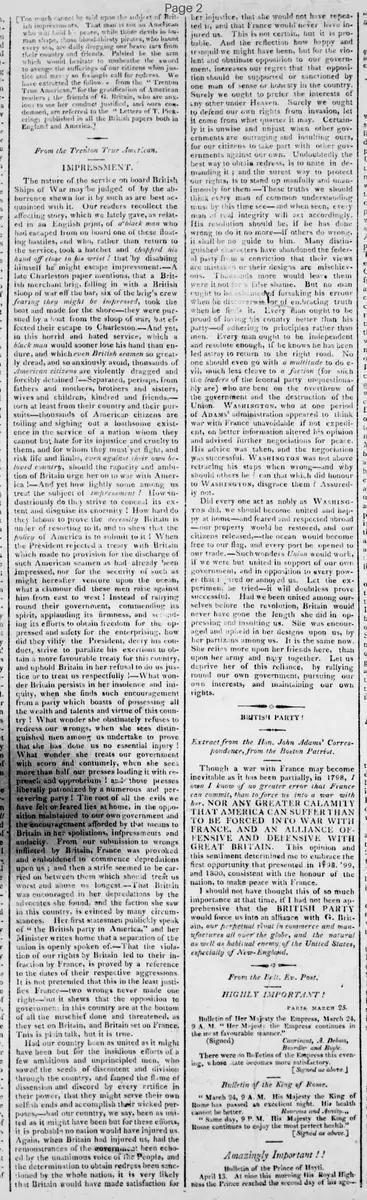
Too much cannot be said upon the subject of British impressments. That man is not an American who will hold his peace, while those devils in human shape, those blood-thirsty pirates, who haunt every sea, are daily dragging our brave tars from their country and friends. Palsied be the arm which would hesitate to unsheathe the sword to avenge the sufferings of our citizens whom justice and mercy so feelingly call for redress. We have extracted the following from the "Trenton True American," for the gratification of American readers; the friends of G. Britain, who are anxious to see her conduct justified, and ours condemned, are referred to the "Letters of T. Pickering: published in all the British papers both in England and America."
From the Trenton True American.
IMPRESSMENT.
The nature of the service on board British Ships of War may be judged of by the abhorrence shewn for it by such as are best acquainted with it. Our readers recollect the affecting story, which we lately gave, as related in an English print, of a black man who had escaped from on board one of these floating bastiles, and who, rather than return to the service, took a hatchet and chopped his hand off close to his wrist! that by disabling himself he might escape impressment.—A late Charleston paper mentions, that a British merchant brig, falling in with a British sloop of war off the bar, six of the brig's crew fearing they might be impressed, took the boat and made for the shore—they were pursued by a boat from the sloop of war, but effected their escape to Charleston.—And yet, in this horrid and hated service, which a black man would sooner lose his hand than endure, and which even British seamen so greatly dread, and so anxiously avoid, thousands of American citizens are violently dragged and forcibly detained?—Separated, perhaps, from fathers and mothers, brothers and sisters, wives and children, kindred and friends,—torn at least from their country and their pursuits—thousands of American citizens are toiling and sighing out a loathsome existence in the service of a nation whom they cannot but hate for its injustice and cruelty to them, and for whom they must yet fight, and risk life and limbs, even against their own beloved country, should the rapacity and ambition of Britain urge her on to war with America! And yet how lightly some among us treat the subject of impressment! How industriously do they strive to conceal its extent and disguise its enormity! How hard do they labour to prove the necessity Britain is under of resorting to it, and to shew that the policy of America is to submit to it! When the President rejected a treaty with Britain which made no provision for the discharge of such American seamen as had already been impressed, nor for the security of such as might hereafter venture upon the ocean, what a clamour did these men raise against him from east to west! Instead of rallying round their government, commending its spirit, applauding its firmness, and seconding its efforts to obtain freedom for the oppressed and safety for the enterprising, how did they vilify the President, decry his conduct, strive to paralyze his exertions to obtain a more favourable treaty for this country, and uphold Britain in her refusal to do us justice or to treat us respectfully! What wonder Britain persists in her insolence and iniquity, when she finds such encouragement from a party which boasts of possessing all the wealth and talents and virtue of this country! What wonder she obstinately refuses to redress our wrongs, when she sees distinguished men among us undertake to prove that she has done us no essential injury! What wonder she treats our government with scorn and contumely, when she sees more than half our presses loading it with reproach and opprobrium! and those presses liberally patronized by a numerous and persevering party! The root of all the evils we have felt or feared lies at home, in the opposition maintained to our own government and the encouragement afforded by that means to Britain in her spoliations, impressments and audacity. From our submission to wrongs inflicted by Britain, France was provoked and emboldened to commence depredations upon us; and then a strife seemed to be carried on between them which should treat us worst and abuse us longest.—That Britain was encouraged in her depredations by the advocates she found, and the faction she saw in this country, is evinced by many circumstances. Her first statesmen publicly speak of "the British party in America," and her Minister writes home that a separation of the union is openly spoken of.—That the violation of our rights by Britain led to their infraction by France, is proved by a reference to the dates of their respective aggressions. It is not pretended that this in the least justifies France—two wrongs never made one right—but it shews that the opposition to government in this country are at the bottom of all the mischief done and threatened, as they set on Britain, and Britain set on France. This is plain talk, but it is true.
Had our country been as united as it might have been but for the insidious efforts of a few ambitious and unprincipled men, who sowed the seeds of discontent and division through the country, and fanned the flame of dissension and discord by every artifice in their power, that they might serve their own selfish ends and accomplish their wicked purposes,—had our country, we say, been as united as it might have been but for these efforts, it is probable no nation would have injured us. Again, when Britain had injured us, had the remonstrances of the government been echoed by the unanimous voice of the People, and the determination to obtain redress been sanctioned by the whole nation, it is very likely that Britain would have made satisfaction for her injustice, that she would not have repeated it, and that France would never have injured us. This is not certain, but it is probable. And the reflection how happy and tranquil we might have been, but for the violent and obstinate opposition to our government, increases our regret that that opposition should be supported or sanctioned by one man of sense or honesty in the country. Surely we ought to prefer the interests of our own country to those of any other under Heaven. Surely we ought to defend our own rights from invasion, let it come from what quarter it may. Certainly it is unwise and unjust when other governments are outraging and insulting ours, for our citizens to take part with other governments against our own. Undoubtedly the best way to obtain redress, is to unite in demanding it; and the surest way to protect our rights, is to stand up manfully and unanimously for them—These truths we should think every man of common understanding must by this time see—and when seen, every man of real integrity will act accordingly. His resolution should be, if he has done wrong to do it no more—if others do wrong, it shall be no guide to him. Many distinguished characters have abandoned the federal party from a conviction that their views are mistaken or their designs are mischievous. Thousands more would leave them were it not for a false shame. But no man ought to be ashamed of forsaking his error when he discovers it or of embracing truth when he finds it. Every man ought to be proud of loving his country better than his party—of adhering to principles rather than men. Every man ought to be independent and resolute enough, if he knows he has been led astray to return to the right road. No one should even go with a multitude to do evil, much less cleave to a faction (for such the leaders of the federal party unquestionably are) who are bent on the overthrow of the government and the destruction of the Union. Washington, who at one period of Adams' administration appeared to think war with France unavoidable if not expedient, on better information altered his opinion and advised further negotiations for peace. His advice was taken, and the negotiation was successful. Washington was not above retracing his steps when wrong—and why should others be? can that which did honour to Washington, disgrace them? Assuredly not.
Did every one act as nobly as Washington did, we should become united and happy at home—and feared and respected abroad—our property would be restored, and our citizens released,—the ocean would become free to our flag, and every port be opened to our trade.—Such wonders Union would work, if we were but united in support of our own government, and in opposition to every power that injured or annoyed us. Let the experiment be tried—it will doubtless prove successful. Had we been united among ourselves before the revolution, Britain would never have gone the length she did in oppressing and insulting us. She was encouraged and upheld in her designs upon us, by her partizans among us. It is the same now. She relies more upon her friends here, than upon her army and navy together. Let us deprive her of this reliance, by rallying round our own government, pursuing our own interests, and maintaining our own rights.
From the Trenton True American.
IMPRESSMENT.
The nature of the service on board British Ships of War may be judged of by the abhorrence shewn for it by such as are best acquainted with it. Our readers recollect the affecting story, which we lately gave, as related in an English print, of a black man who had escaped from on board one of these floating bastiles, and who, rather than return to the service, took a hatchet and chopped his hand off close to his wrist! that by disabling himself he might escape impressment.—A late Charleston paper mentions, that a British merchant brig, falling in with a British sloop of war off the bar, six of the brig's crew fearing they might be impressed, took the boat and made for the shore—they were pursued by a boat from the sloop of war, but effected their escape to Charleston.—And yet, in this horrid and hated service, which a black man would sooner lose his hand than endure, and which even British seamen so greatly dread, and so anxiously avoid, thousands of American citizens are violently dragged and forcibly detained?—Separated, perhaps, from fathers and mothers, brothers and sisters, wives and children, kindred and friends,—torn at least from their country and their pursuits—thousands of American citizens are toiling and sighing out a loathsome existence in the service of a nation whom they cannot but hate for its injustice and cruelty to them, and for whom they must yet fight, and risk life and limbs, even against their own beloved country, should the rapacity and ambition of Britain urge her on to war with America! And yet how lightly some among us treat the subject of impressment! How industriously do they strive to conceal its extent and disguise its enormity! How hard do they labour to prove the necessity Britain is under of resorting to it, and to shew that the policy of America is to submit to it! When the President rejected a treaty with Britain which made no provision for the discharge of such American seamen as had already been impressed, nor for the security of such as might hereafter venture upon the ocean, what a clamour did these men raise against him from east to west! Instead of rallying round their government, commending its spirit, applauding its firmness, and seconding its efforts to obtain freedom for the oppressed and safety for the enterprising, how did they vilify the President, decry his conduct, strive to paralyze his exertions to obtain a more favourable treaty for this country, and uphold Britain in her refusal to do us justice or to treat us respectfully! What wonder Britain persists in her insolence and iniquity, when she finds such encouragement from a party which boasts of possessing all the wealth and talents and virtue of this country! What wonder she obstinately refuses to redress our wrongs, when she sees distinguished men among us undertake to prove that she has done us no essential injury! What wonder she treats our government with scorn and contumely, when she sees more than half our presses loading it with reproach and opprobrium! and those presses liberally patronized by a numerous and persevering party! The root of all the evils we have felt or feared lies at home, in the opposition maintained to our own government and the encouragement afforded by that means to Britain in her spoliations, impressments and audacity. From our submission to wrongs inflicted by Britain, France was provoked and emboldened to commence depredations upon us; and then a strife seemed to be carried on between them which should treat us worst and abuse us longest.—That Britain was encouraged in her depredations by the advocates she found, and the faction she saw in this country, is evinced by many circumstances. Her first statesmen publicly speak of "the British party in America," and her Minister writes home that a separation of the union is openly spoken of.—That the violation of our rights by Britain led to their infraction by France, is proved by a reference to the dates of their respective aggressions. It is not pretended that this in the least justifies France—two wrongs never made one right—but it shews that the opposition to government in this country are at the bottom of all the mischief done and threatened, as they set on Britain, and Britain set on France. This is plain talk, but it is true.
Had our country been as united as it might have been but for the insidious efforts of a few ambitious and unprincipled men, who sowed the seeds of discontent and division through the country, and fanned the flame of dissension and discord by every artifice in their power, that they might serve their own selfish ends and accomplish their wicked purposes,—had our country, we say, been as united as it might have been but for these efforts, it is probable no nation would have injured us. Again, when Britain had injured us, had the remonstrances of the government been echoed by the unanimous voice of the People, and the determination to obtain redress been sanctioned by the whole nation, it is very likely that Britain would have made satisfaction for her injustice, that she would not have repeated it, and that France would never have injured us. This is not certain, but it is probable. And the reflection how happy and tranquil we might have been, but for the violent and obstinate opposition to our government, increases our regret that that opposition should be supported or sanctioned by one man of sense or honesty in the country. Surely we ought to prefer the interests of our own country to those of any other under Heaven. Surely we ought to defend our own rights from invasion, let it come from what quarter it may. Certainly it is unwise and unjust when other governments are outraging and insulting ours, for our citizens to take part with other governments against our own. Undoubtedly the best way to obtain redress, is to unite in demanding it; and the surest way to protect our rights, is to stand up manfully and unanimously for them—These truths we should think every man of common understanding must by this time see—and when seen, every man of real integrity will act accordingly. His resolution should be, if he has done wrong to do it no more—if others do wrong, it shall be no guide to him. Many distinguished characters have abandoned the federal party from a conviction that their views are mistaken or their designs are mischievous. Thousands more would leave them were it not for a false shame. But no man ought to be ashamed of forsaking his error when he discovers it or of embracing truth when he finds it. Every man ought to be proud of loving his country better than his party—of adhering to principles rather than men. Every man ought to be independent and resolute enough, if he knows he has been led astray to return to the right road. No one should even go with a multitude to do evil, much less cleave to a faction (for such the leaders of the federal party unquestionably are) who are bent on the overthrow of the government and the destruction of the Union. Washington, who at one period of Adams' administration appeared to think war with France unavoidable if not expedient, on better information altered his opinion and advised further negotiations for peace. His advice was taken, and the negotiation was successful. Washington was not above retracing his steps when wrong—and why should others be? can that which did honour to Washington, disgrace them? Assuredly not.
Did every one act as nobly as Washington did, we should become united and happy at home—and feared and respected abroad—our property would be restored, and our citizens released,—the ocean would become free to our flag, and every port be opened to our trade.—Such wonders Union would work, if we were but united in support of our own government, and in opposition to every power that injured or annoyed us. Let the experiment be tried—it will doubtless prove successful. Had we been united among ourselves before the revolution, Britain would never have gone the length she did in oppressing and insulting us. She was encouraged and upheld in her designs upon us, by her partizans among us. It is the same now. She relies more upon her friends here, than upon her army and navy together. Let us deprive her of this reliance, by rallying round our own government, pursuing our own interests, and maintaining our own rights.
What sub-type of article is it?
Foreign Affairs
Partisan Politics
War Or Peace
What keywords are associated?
British Impressment
American Seamen
Federal Party
National Unity
Government Support
British Injustice
War Risks
Seamen Escapes
What entities or persons were involved?
Britain
British Ships Of War
President
Federal Party
Washington
Adams
T. Pickering
Trenton True American
Editorial Details
Primary Topic
Opposition To British Impressment And Criticism Of Federalist Support For Britain
Stance / Tone
Strongly Anti Impressment, Pro Government Unity, Anti Federalist
Key Figures
Britain
British Ships Of War
President
Federal Party
Washington
Adams
T. Pickering
Trenton True American
Key Arguments
British Impressment Forcibly Takes American Seamen Into Hated Service
Impressment Separates Citizens From Families And Forces Them To Fight Against America
Federalists Downplay Impressment And Support British Policy
Opposition To Government Encourages British Insolence
Unity Behind Government Would Prevent Injuries From Britain And France
Washington Changed Views To Support Peace Negotiations
Abandoning Federal Party Errors Promotes National Unity
Rallying Around Government Would Free The Seas And Restore Rights