Thank you for visiting SNEWPapers!
Sign up free
Literary
January 19, 1848
The Abbeville Banner
Abbeville, Abbeville County, South Carolina
What is this article about?
An essay from Chamber's Journal exploring arithmetic curiosities through examples like the chessboard grains of corn, horse-shoe nails, herring reproduction, compound interest, henbane growth, a pebble wager, and global population potential, concluding with reflections on human limits and divine providence.
Clipping
OCR Quality
95%
Excellent
Full Text
From Chamber's Journal
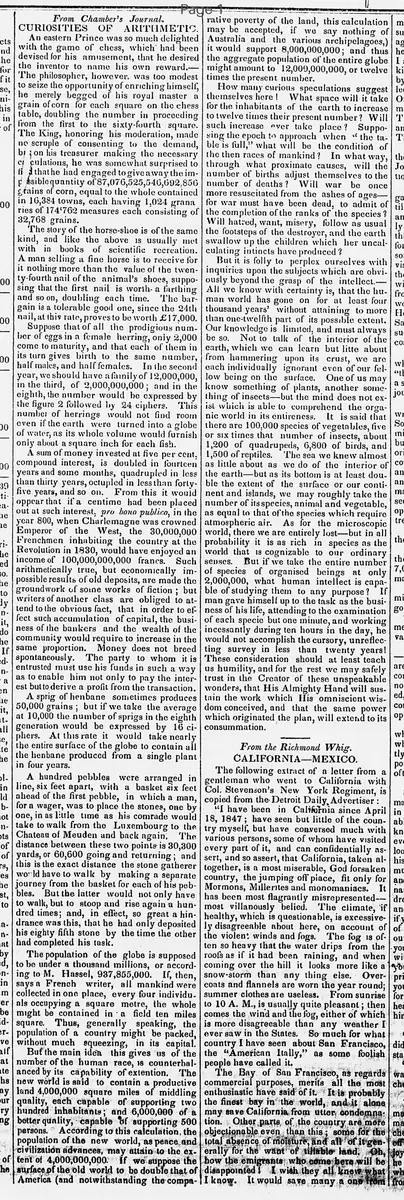
CURIOSITIES OF ARITHMETIC
An eastern Prince was so much delighted with the game of chess, which had been devised for his amusement, that he desired the inventor to name his own reward. The philosopher, however, was too modest to seize the opportunity of enriching himself he merely begged of his royal master a grain of corn for each square on the chess board, doubling the number in proceeding from the first to the sixty-fourth square. The King, honoring his moderation, made no scruple of consenting to the demand. But on his treasurer making the necessary calculations, he was somewhat surprised to find that he had engaged to give away the impossible quantity of 87,076,525,546,692,856 grains of corn, equal to the whole contained in 16,384 towns, each having 1,024 granaries of 174,762 measures each consisting of 32,768 grains.
'The story of the horse-shoe is of the same kind, and like the above is usually met with in books of scientific recreation. A man selling a fine horse is to receive for it nothing more than the value of the twenty-fourth nail of the animal's shoes, supposing that the first nail is worth a farthing and so on, doubling each time. The bargain is a tolerable good one, since the 24th nail, at this rate, proves to be worth £17,000.
Suppose that of all the prodigious number of eggs in a female herring, only 2,000 come to maturity, and that each of them in its turn gives birth to the same number, half males, and half females. In the second year, we should have a family of 12,000,000, in the third, of 2,000,000,000; and in the eighth, the number would be expressed by the figure 2 followed by 24 ciphers. This number of herrings would not find room even if the earth were turned into a globe of water, as its whole volume would furnish only about a square inch for each fish.
A sum of money invested at five per cent, compound interest, is doubled in fourteen years and some months, quadrupled in less than thirty years, octupled in less than forty-five years, and so on. From this it would appear that if a centime had been placed out at such interest, pro bono publico, in the year 800, when Charlemagne was crowned Emperor of the West, the 30,000,000 Frenchmen inhabiting the country at the Revolution in 1830, would have enjoyed an income of 100,000,000,000 francs. Such arithmetically true, but economically impossible results of old deposits, are made the groundwork of some works of fiction; but writers of another class are obliged to attend to the obvious fact, that in order to effect such accumulation of capital, the business of the bankers and the wealth of the community would require to increase in the same proportion. Money does not breed spontaneously. The party to whom it is entrusted must use his funds in such a way as to enable him not only to pay the interest but to derive a profit from the transaction.
A sprig of henbane sometimes produces 50,000 grains; but if we take the average at 10,000 the number of sprigs in the eighth generation would be expressed by 16 ciphers. At this rate it would take nearly the entire surface of the globe to contain all the henbane produced from a single plant in four years.
A hundred pebbles were arranged in line, six feet apart, with a basket six feet ahead of the first pebble, in which a man, for a wager, was to place the stones, one by one, in as little time as his comrade would take to walk from the Luxembourg to the Chateau of Meudon and back again. The distance between these two points is 30,300 yards, or 60,600 going and returning; and this is the exact distance the stone gatherer would have to walk by making a separate journey from the basket for each of his pebbles. But the latter would not only have to walk, but to stoop and rise again a hundred times; and, in effect, so great a hindrance was this, that he had only deposited his eighty fifth stone by the time the other had completed his task.
The population of the globe is supposed to be under a thousand millions, or according to M. Hassel, 937,855,000. If, then, says a French writer, all mankind were collected in one place, every four individuals occupying a square metre, the whole might be contained in a field ten miles square. Thus, generally speaking, the population of a country might be packed, without much squeezing, in its capital. But the main idea this gives us of the number of the human race, is counterbalanced by its capability of extension. The new world is said to contain a productive land 4,000,000 square miles of middling quality, each capable of supporting two hundred inhabitants: and 6,000,000 of a better quality, capable of supporting 500 persons. According to this calculation, the population of the new world, as peace and civilization advances, may attain to the extent of 4,000,000,000. If we suppose the surface of the old world to be double that of America (and notwithstanding the comparative poverty of the land, this calculation may be accepted, if we say nothing of Australia and the various archipelagoes,) it would support 8,000,000,000; and thus the aggregate population of the entire globe might amount to 12,000,000,000, or twelve times the present number.
How many curious speculations suggest themselves here! What space will it take for the inhabitants of the earth to increase to twelve times their present number? Will such increase ever take place? Supposing the epoch to approach when "the table is full," what will be the condition of the then races of mankind? In what way, through what proximate causes, will the number of births adjust themselves to the number of deaths? Will war be once more resuscitated from the ashes of ages-- for war must have been dead, to admit of the completion of the ranks of the species? Will hatred, want, misery, follow as usual the footsteps of the destroyer, and the earth swallow up the children which her uncalculating instincts have produced?
But it is folly to perplex ourselves with inquiries upon the subjects which are obviously beyond the grasp of the intellect.-- All we know with certainty is, that the human world has gone on for at least four thousand years without attaining to more than one-twelfth part of its possible extent. Our knowledge is limited, and must always be so. Not to talk of the interior of the earth, which we can learn but little about from hammering upon its crust, we are each individually ignorant even of our fellow being on the surface. One of us may know something of plants, another something of insects--but the mind does not exist which is able to comprehend the organic world in its entireness. It is said that there are 100,000 species of vegetables, five or six times that number of insects, about 1,200 of quadrupeds, 6,800 of birds, and 1,500 of reptiles. The sea we know almost as little about as we do of the interior of the earth--but as its bottom is at least double the extent of the surface of our continent and islands, we may roughly take the number of its species, animal and vegetable, as equal to that of the species which require atmospheric air. As for the microscopic world, there we are entirely lost--but in all probability it is as rich in species as the world that is cognizable to our ordinary senses. But if we take the entire number of species of organised beings at only 2,000,000, what human intellect is capable of studying them to any purpose? If man gave himself up to the task as the business of his life, attending to the examination of each species but one minute, and working incessantly during ten hours in the day, he would not accomplish the cursory, unreflecting survey in less than twenty years!
These considerations should at least teach us humility, and for the rest we may safely trust in the Creator of these unspeakable wonders, that His Almighty Hand will sustain the work which His omniscient wisdom conceived, and that the same power which originated the plan, will extend to its consummation.
CURIOSITIES OF ARITHMETIC
An eastern Prince was so much delighted with the game of chess, which had been devised for his amusement, that he desired the inventor to name his own reward. The philosopher, however, was too modest to seize the opportunity of enriching himself he merely begged of his royal master a grain of corn for each square on the chess board, doubling the number in proceeding from the first to the sixty-fourth square. The King, honoring his moderation, made no scruple of consenting to the demand. But on his treasurer making the necessary calculations, he was somewhat surprised to find that he had engaged to give away the impossible quantity of 87,076,525,546,692,856 grains of corn, equal to the whole contained in 16,384 towns, each having 1,024 granaries of 174,762 measures each consisting of 32,768 grains.
'The story of the horse-shoe is of the same kind, and like the above is usually met with in books of scientific recreation. A man selling a fine horse is to receive for it nothing more than the value of the twenty-fourth nail of the animal's shoes, supposing that the first nail is worth a farthing and so on, doubling each time. The bargain is a tolerable good one, since the 24th nail, at this rate, proves to be worth £17,000.
Suppose that of all the prodigious number of eggs in a female herring, only 2,000 come to maturity, and that each of them in its turn gives birth to the same number, half males, and half females. In the second year, we should have a family of 12,000,000, in the third, of 2,000,000,000; and in the eighth, the number would be expressed by the figure 2 followed by 24 ciphers. This number of herrings would not find room even if the earth were turned into a globe of water, as its whole volume would furnish only about a square inch for each fish.
A sum of money invested at five per cent, compound interest, is doubled in fourteen years and some months, quadrupled in less than thirty years, octupled in less than forty-five years, and so on. From this it would appear that if a centime had been placed out at such interest, pro bono publico, in the year 800, when Charlemagne was crowned Emperor of the West, the 30,000,000 Frenchmen inhabiting the country at the Revolution in 1830, would have enjoyed an income of 100,000,000,000 francs. Such arithmetically true, but economically impossible results of old deposits, are made the groundwork of some works of fiction; but writers of another class are obliged to attend to the obvious fact, that in order to effect such accumulation of capital, the business of the bankers and the wealth of the community would require to increase in the same proportion. Money does not breed spontaneously. The party to whom it is entrusted must use his funds in such a way as to enable him not only to pay the interest but to derive a profit from the transaction.
A sprig of henbane sometimes produces 50,000 grains; but if we take the average at 10,000 the number of sprigs in the eighth generation would be expressed by 16 ciphers. At this rate it would take nearly the entire surface of the globe to contain all the henbane produced from a single plant in four years.
A hundred pebbles were arranged in line, six feet apart, with a basket six feet ahead of the first pebble, in which a man, for a wager, was to place the stones, one by one, in as little time as his comrade would take to walk from the Luxembourg to the Chateau of Meudon and back again. The distance between these two points is 30,300 yards, or 60,600 going and returning; and this is the exact distance the stone gatherer would have to walk by making a separate journey from the basket for each of his pebbles. But the latter would not only have to walk, but to stoop and rise again a hundred times; and, in effect, so great a hindrance was this, that he had only deposited his eighty fifth stone by the time the other had completed his task.
The population of the globe is supposed to be under a thousand millions, or according to M. Hassel, 937,855,000. If, then, says a French writer, all mankind were collected in one place, every four individuals occupying a square metre, the whole might be contained in a field ten miles square. Thus, generally speaking, the population of a country might be packed, without much squeezing, in its capital. But the main idea this gives us of the number of the human race, is counterbalanced by its capability of extension. The new world is said to contain a productive land 4,000,000 square miles of middling quality, each capable of supporting two hundred inhabitants: and 6,000,000 of a better quality, capable of supporting 500 persons. According to this calculation, the population of the new world, as peace and civilization advances, may attain to the extent of 4,000,000,000. If we suppose the surface of the old world to be double that of America (and notwithstanding the comparative poverty of the land, this calculation may be accepted, if we say nothing of Australia and the various archipelagoes,) it would support 8,000,000,000; and thus the aggregate population of the entire globe might amount to 12,000,000,000, or twelve times the present number.
How many curious speculations suggest themselves here! What space will it take for the inhabitants of the earth to increase to twelve times their present number? Will such increase ever take place? Supposing the epoch to approach when "the table is full," what will be the condition of the then races of mankind? In what way, through what proximate causes, will the number of births adjust themselves to the number of deaths? Will war be once more resuscitated from the ashes of ages-- for war must have been dead, to admit of the completion of the ranks of the species? Will hatred, want, misery, follow as usual the footsteps of the destroyer, and the earth swallow up the children which her uncalculating instincts have produced?
But it is folly to perplex ourselves with inquiries upon the subjects which are obviously beyond the grasp of the intellect.-- All we know with certainty is, that the human world has gone on for at least four thousand years without attaining to more than one-twelfth part of its possible extent. Our knowledge is limited, and must always be so. Not to talk of the interior of the earth, which we can learn but little about from hammering upon its crust, we are each individually ignorant even of our fellow being on the surface. One of us may know something of plants, another something of insects--but the mind does not exist which is able to comprehend the organic world in its entireness. It is said that there are 100,000 species of vegetables, five or six times that number of insects, about 1,200 of quadrupeds, 6,800 of birds, and 1,500 of reptiles. The sea we know almost as little about as we do of the interior of the earth--but as its bottom is at least double the extent of the surface of our continent and islands, we may roughly take the number of its species, animal and vegetable, as equal to that of the species which require atmospheric air. As for the microscopic world, there we are entirely lost--but in all probability it is as rich in species as the world that is cognizable to our ordinary senses. But if we take the entire number of species of organised beings at only 2,000,000, what human intellect is capable of studying them to any purpose? If man gave himself up to the task as the business of his life, attending to the examination of each species but one minute, and working incessantly during ten hours in the day, he would not accomplish the cursory, unreflecting survey in less than twenty years!
These considerations should at least teach us humility, and for the rest we may safely trust in the Creator of these unspeakable wonders, that His Almighty Hand will sustain the work which His omniscient wisdom conceived, and that the same power which originated the plan, will extend to its consummation.
What sub-type of article is it?
Essay
What keywords are associated?
Arithmetic Curiosities
Exponential Growth
Compound Interest
Population Growth
Chessboard Wheat
Henbane Proliferation
Human Knowledge Limits
What entities or persons were involved?
From Chamber's Journal
Literary Details
Title
Curiosities Of Arithmetic
Author
From Chamber's Journal
Subject
Curiosities Of Arithmetic And Their Implications
Key Lines
An Eastern Prince Was So Much Delighted With The Game Of Chess... Equal To The Whole Contained In 16,384 Towns, Each Having 1,024 Granaries Of 174,762 Measures Each Consisting Of 32,768 Grains.
The 24th Nail, At This Rate, Proves To Be Worth £17,000.
This Number Of Herrings Would Not Find Room Even If The Earth Were Turned Into A Globe Of Water...
If A Centime Had Been Placed Out At Such Interest... The 30,000,000 Frenchmen... Would Have Enjoyed An Income Of 100,000,000,000 Francs.
The Aggregate Population Of The Entire Globe Might Amount To 12,000,000,000, Or Twelve Times The Present Number.
These Considerations Should At Least Teach Us Humility...