Thank you for visiting SNEWPapers!
Sign up free
Poem
March 26, 1840
Herald Of The Times
Newport, Newport County, Rhode Island
What is this article about?
A narrative poem depicting a young woman's encounter with a slumbering Father Time in Pleasure's bower. Upon waking him, she rapidly ages, illustrating the transient nature of beauty and the inexorable passage of time.
Clipping
OCR Quality
85%
Good
Full Text
GENERAL EPITHET.
Ye the Herald of the Times,
Think within Beauty
Early themes
Are but the transient pageants of an hour
And early pass away the pleasing hour,
That springs to life, and blossoms but to die.
H. N. Watts.
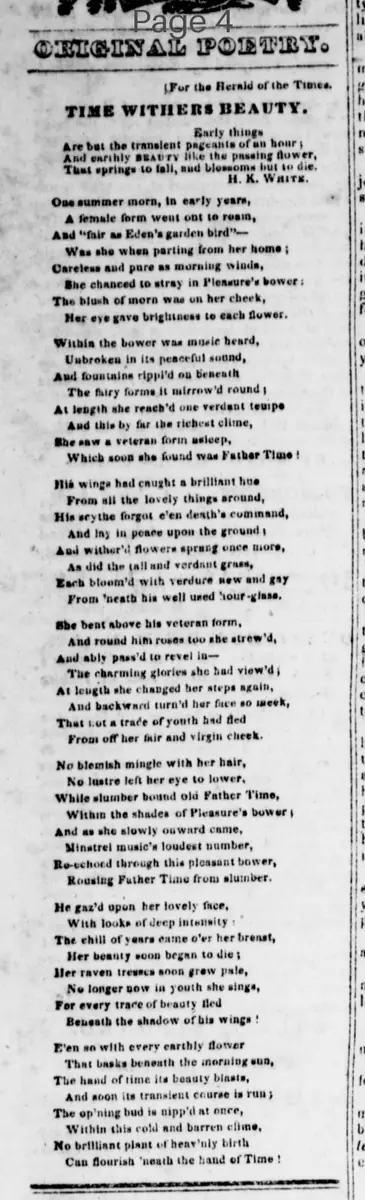
One summer morn, in early years,
A female form went out to roam,
And 'like a Zephyr's sighing bird'
Was she whose parting form from home:
Careless and pure as morning winds,
She chanced to stray in Pleasure's bower:
The blush of morn was on her cheek,
Nor eye gave brightness to each flower.
Within the bower was music heard,
Unbroken in its peaceful sound,
And fountains rippled on the air
The daisy forms it mirrored round.
At length she reached one verdant spot
And this by far the richest closed,
She saw a fleeting form asleep,
Which soon she found was Father Time's repose.
His wings had caught a brilliant hue
From all the lovely things around,
His scythe forgot e'en death's command,
And lay in peace upon the ground.
And wither'd flowers sprang once more,
As did the tall and verdant grass,
Each bloomed with verdure new and gay
From 'neath his well used hour-glass.
She bent above his veteran form.
And round him roses too she strewed,
And gaily passed to revel in—
The charming glories she had viewed;
At length she changed her steps again,
And backward turned her face so meek,
That not a trace of youth had fled
From off her fair and virgin cheek.
No blemish mingle with her hair,
No lustre left her eye to lower,
While slumber bound old Father Time,
Within the shades of Pleasure's bower;
And as she slowly onward came,
Minstrel music's loudest number,
Re-echoed through this pleasant bower,
Rousing Father Time from slumber.
He gazed upon her lovely face,
With looks of deep intensity:
The chill of years came o'er her breast,
Her beauty soon began to die;
Her raven tresses soon grew pale,
No longer now in youth she sings,
For every trace of beauty fled
Beneath the shadow of his wings:
E'en so with every earthly flower
That basks beneath the morning sun,
The hand of time its beauty blasts,
And soon its transient course is run;
The op'ning bud is nipped at once,
Within this cold and barren clime,
No brilliant plant of heavenly birth
Can flourish neath the hand of Time!
Ye the Herald of the Times,
Think within Beauty
Early themes
Are but the transient pageants of an hour
And early pass away the pleasing hour,
That springs to life, and blossoms but to die.
H. N. Watts.
One summer morn, in early years,
A female form went out to roam,
And 'like a Zephyr's sighing bird'
Was she whose parting form from home:
Careless and pure as morning winds,
She chanced to stray in Pleasure's bower:
The blush of morn was on her cheek,
Nor eye gave brightness to each flower.
Within the bower was music heard,
Unbroken in its peaceful sound,
And fountains rippled on the air
The daisy forms it mirrored round.
At length she reached one verdant spot
And this by far the richest closed,
She saw a fleeting form asleep,
Which soon she found was Father Time's repose.
His wings had caught a brilliant hue
From all the lovely things around,
His scythe forgot e'en death's command,
And lay in peace upon the ground.
And wither'd flowers sprang once more,
As did the tall and verdant grass,
Each bloomed with verdure new and gay
From 'neath his well used hour-glass.
She bent above his veteran form.
And round him roses too she strewed,
And gaily passed to revel in—
The charming glories she had viewed;
At length she changed her steps again,
And backward turned her face so meek,
That not a trace of youth had fled
From off her fair and virgin cheek.
No blemish mingle with her hair,
No lustre left her eye to lower,
While slumber bound old Father Time,
Within the shades of Pleasure's bower;
And as she slowly onward came,
Minstrel music's loudest number,
Re-echoed through this pleasant bower,
Rousing Father Time from slumber.
He gazed upon her lovely face,
With looks of deep intensity:
The chill of years came o'er her breast,
Her beauty soon began to die;
Her raven tresses soon grew pale,
No longer now in youth she sings,
For every trace of beauty fled
Beneath the shadow of his wings:
E'en so with every earthly flower
That basks beneath the morning sun,
The hand of time its beauty blasts,
And soon its transient course is run;
The op'ning bud is nipped at once,
Within this cold and barren clime,
No brilliant plant of heavenly birth
Can flourish neath the hand of Time!
What sub-type of article is it?
Ballad
What themes does it cover?
Death Mourning
Moral Virtue
What keywords are associated?
Father Time
Pleasure Bower
Transience Beauty
Mortality
Youth Aging
Moral Allegory
What entities or persons were involved?
H. N. Watts.
Poem Details
Title
General Epithet.
Author
H. N. Watts.
Form / Style
Rhymed Narrative Stanzas
Key Lines
One Summer Morn, In Early Years,
A Female Form Went Out To Roam,
And 'Like A Zephyr's Sighing Bird'
Was She Whose Parting Form From Home:
He Gazed Upon Her Lovely Face,
With Looks Of Deep Intensity:
The Chill Of Years Came O'er Her Breast,
Her Beauty Soon Began To Die;
E'en So With Every Earthly Flower
That Basks Beneath The Morning Sun,
The Hand Of Time Its Beauty Blasts,
And Soon Its Transient Course Is Run;