Thank you for visiting SNEWPapers!
Sign up free
Story
November 27, 1937
United Automobile Worker
Detroit, Wayne County, Michigan
What is this article about?
John Tate's article examines the U.S. housing crisis, highlighting slum conditions, health and crime impacts, and the need for massive new construction under the 1937 Housing Act to aid recovery and workers, contrasting with European efforts.
Clipping
OCR Quality
92%
Excellent
Full Text
By JOHN TATE
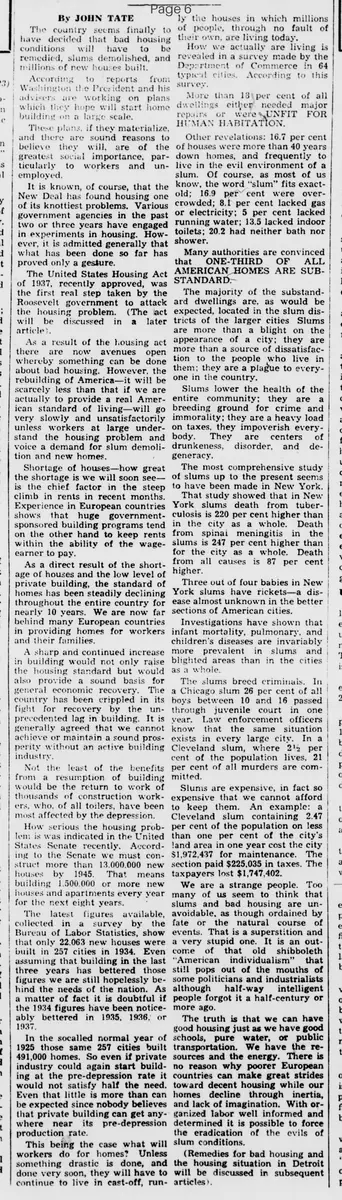
The country seems finally to have decided that bad housing conditions will have to be remedied, slums demolished, and millions of new houses built.
According to reports from Washington the President and his advisers are working on plans which they hope will start home building on a large scale.
These plans, if they materialize, and there are sound reasons to believe they will, are of the greatest social importance, particularly to workers and unemployed.
It is known, of course, that the New Deal has found housing one of its knottiest problems. Various government agencies in the past two or three years have engaged in experiments in housing. However, it is admitted generally that what has been done so far has proved only a gesture.
The United States Housing Act of 1937, recently approved, was the first real step taken by the Roosevelt government to attack the housing problem. (The act will be discussed in a later article).
As a result of the housing act there are now avenues open whereby something can be done about bad housing. However, the rebuilding of America--it will be scarcely less than that if we are actually to provide a real American standard of living--will go very slowly and unsatisfactorily unless workers at large understand the housing problem and voice a demand for slum demolition and new homes.
Shortage of houses--how great the shortage is we will soon see--is the chief factor in the steep climb in rents in recent months.
Experience in European countries shows that huge government-sponsored building programs tend on the other hand to keep rents within the ability of the wage-earner to pay.
As a direct result of the shortage of houses and the low level of private building, the standard of homes has been steadily declining throughout the entire country for nearly 10 years. We are now far behind many European countries in providing homes for workers and their families.
A sharp and continued increase in building would not only raise the housing standard but would also provide a sound basis for general economic recovery. The country has been crippled in its fight for recovery by the unprecedented lag in building. It is generally agreed that we cannot achieve or maintain a sound prosperity without an active building industry.
Not the least of the benefits from a resumption of building would be the return to work of thousands of construction workers, who, of all toilers, have been most affected by the depression.
How serious the housing problem is was indicated in the United States Senate recently. According to the Senate we must construct more than 13,000,000 new houses by 1945.
That means building 1,500,000 or more new houses and apartments every year for the next eight years.
The latest figures available, collected in a survey by the Bureau of Labor Statistics, show that only 22,063 new houses were built in 257 cities in 1934. Even assuming that building in the last three years has bettered those figures we are still hopelessly behind the needs of the nation. As a matter of fact it is doubtful if the 1934 figures have been noticeably bettered in 1935, 1936, or 1937.
In the so-called normal year of 1925 those same 257 cities built 491,000 homes. So even if private industry could again start building at the pre-depression rate it would not satisfy half the need.
Even that little is more than can be expected since nobody believes that private building can get anywhere near its pre-depression production rate.
This being the case what will workers do for homes? Unless something drastic is done, and done very soon, they will have to continue to live in cast-off, run-down homes, and frequently to live in the evil environment of a slum. Of course, as most of us know, the word "slum" fits exactly old; 16.9 per cent were overcrowded; 8.1 per cent lacked gas or electricity; 5 per cent lacked running water; 13.5 lacked indoor toilets; 20.2 had neither bath nor shower.
Many authorities are convinced that one-third of all American homes are sub-standard.
The majority of the substandard dwellings are, as would be expected, located in the slum districts of the larger cities. Slums are more than a blight on the appearance of a city; they are more than a source of dissatisfaction to the people who live in them; they are a plague to everyone in the country.
Slums lower the health of the entire community; they are a breeding ground for crime and immorality; they are a heavy load on taxes, they impoverish everybody. They are centers of drunkenness, disorder, and degeneracy.
The most comprehensive study of slums up to the present seems to have been made in New York. That study showed that in New York slums death from tuberculosis is 220 per cent higher than in the city as a whole. Death from spinal meningitis in the slums is 247 per cent higher than for the city as a whole. Death from all causes is 87 per cent higher.
Three out of four babies in New York slums have rickets--a disease almost unknown in the better sections of American cities.
Investigations have shown that infant mortality, pulmonary, and children's diseases are invariably more prevalent in slums and blighted areas than in the cities as a whole.
The slums breed criminals. In a Chicago slum 26 per cent of all boys between 10 and 16 passed through juvenile court in one year. Law enforcement officers know that the same situation exists in every large city. In a Cleveland slum, where 2.2 per cent of the population lives, 21 per cent of all murders are committed.
Slums are expensive, in fact so expensive that we cannot afford to keep them. An example: a Cleveland slum containing 2.47 per cent of the population on less than one per cent of the city's land area in one year cost the city $1,972,437 for maintenance. The section paid $225,035 in taxes. The taxpayers lost $1,747,402.
We are a strange people. Too many of us seem to think that slums and bad housing are unavoidable, as though ordained by fate or the natural course of events. That is a superstition and a very stupid one. It is an outcome of that old shibboleth "American individualism" that still pops out of the mouths of some politicians and industrialists although half-way intelligent people forgot it a half-century or more ago.
The truth is that we can have good housing just as we have good schools, pure water, or public transportation. We have the resources and the energy. There is no reason why poorer European countries can make great strides toward decent housing while our homes decline through inertia and lack of imagination. With organized labor well informed and determined it is possible to force the eradication of the evils of slum conditions.
(Remedies for bad housing and the housing situation in Detroit will be discussed in subsequent articles).
The country seems finally to have decided that bad housing conditions will have to be remedied, slums demolished, and millions of new houses built.
According to reports from Washington the President and his advisers are working on plans which they hope will start home building on a large scale.
These plans, if they materialize, and there are sound reasons to believe they will, are of the greatest social importance, particularly to workers and unemployed.
It is known, of course, that the New Deal has found housing one of its knottiest problems. Various government agencies in the past two or three years have engaged in experiments in housing. However, it is admitted generally that what has been done so far has proved only a gesture.
The United States Housing Act of 1937, recently approved, was the first real step taken by the Roosevelt government to attack the housing problem. (The act will be discussed in a later article).
As a result of the housing act there are now avenues open whereby something can be done about bad housing. However, the rebuilding of America--it will be scarcely less than that if we are actually to provide a real American standard of living--will go very slowly and unsatisfactorily unless workers at large understand the housing problem and voice a demand for slum demolition and new homes.
Shortage of houses--how great the shortage is we will soon see--is the chief factor in the steep climb in rents in recent months.
Experience in European countries shows that huge government-sponsored building programs tend on the other hand to keep rents within the ability of the wage-earner to pay.
As a direct result of the shortage of houses and the low level of private building, the standard of homes has been steadily declining throughout the entire country for nearly 10 years. We are now far behind many European countries in providing homes for workers and their families.
A sharp and continued increase in building would not only raise the housing standard but would also provide a sound basis for general economic recovery. The country has been crippled in its fight for recovery by the unprecedented lag in building. It is generally agreed that we cannot achieve or maintain a sound prosperity without an active building industry.
Not the least of the benefits from a resumption of building would be the return to work of thousands of construction workers, who, of all toilers, have been most affected by the depression.
How serious the housing problem is was indicated in the United States Senate recently. According to the Senate we must construct more than 13,000,000 new houses by 1945.
That means building 1,500,000 or more new houses and apartments every year for the next eight years.
The latest figures available, collected in a survey by the Bureau of Labor Statistics, show that only 22,063 new houses were built in 257 cities in 1934. Even assuming that building in the last three years has bettered those figures we are still hopelessly behind the needs of the nation. As a matter of fact it is doubtful if the 1934 figures have been noticeably bettered in 1935, 1936, or 1937.
In the so-called normal year of 1925 those same 257 cities built 491,000 homes. So even if private industry could again start building at the pre-depression rate it would not satisfy half the need.
Even that little is more than can be expected since nobody believes that private building can get anywhere near its pre-depression production rate.
This being the case what will workers do for homes? Unless something drastic is done, and done very soon, they will have to continue to live in cast-off, run-down homes, and frequently to live in the evil environment of a slum. Of course, as most of us know, the word "slum" fits exactly old; 16.9 per cent were overcrowded; 8.1 per cent lacked gas or electricity; 5 per cent lacked running water; 13.5 lacked indoor toilets; 20.2 had neither bath nor shower.
Many authorities are convinced that one-third of all American homes are sub-standard.
The majority of the substandard dwellings are, as would be expected, located in the slum districts of the larger cities. Slums are more than a blight on the appearance of a city; they are more than a source of dissatisfaction to the people who live in them; they are a plague to everyone in the country.
Slums lower the health of the entire community; they are a breeding ground for crime and immorality; they are a heavy load on taxes, they impoverish everybody. They are centers of drunkenness, disorder, and degeneracy.
The most comprehensive study of slums up to the present seems to have been made in New York. That study showed that in New York slums death from tuberculosis is 220 per cent higher than in the city as a whole. Death from spinal meningitis in the slums is 247 per cent higher than for the city as a whole. Death from all causes is 87 per cent higher.
Three out of four babies in New York slums have rickets--a disease almost unknown in the better sections of American cities.
Investigations have shown that infant mortality, pulmonary, and children's diseases are invariably more prevalent in slums and blighted areas than in the cities as a whole.
The slums breed criminals. In a Chicago slum 26 per cent of all boys between 10 and 16 passed through juvenile court in one year. Law enforcement officers know that the same situation exists in every large city. In a Cleveland slum, where 2.2 per cent of the population lives, 21 per cent of all murders are committed.
Slums are expensive, in fact so expensive that we cannot afford to keep them. An example: a Cleveland slum containing 2.47 per cent of the population on less than one per cent of the city's land area in one year cost the city $1,972,437 for maintenance. The section paid $225,035 in taxes. The taxpayers lost $1,747,402.
We are a strange people. Too many of us seem to think that slums and bad housing are unavoidable, as though ordained by fate or the natural course of events. That is a superstition and a very stupid one. It is an outcome of that old shibboleth "American individualism" that still pops out of the mouths of some politicians and industrialists although half-way intelligent people forgot it a half-century or more ago.
The truth is that we can have good housing just as we have good schools, pure water, or public transportation. We have the resources and the energy. There is no reason why poorer European countries can make great strides toward decent housing while our homes decline through inertia and lack of imagination. With organized labor well informed and determined it is possible to force the eradication of the evils of slum conditions.
(Remedies for bad housing and the housing situation in Detroit will be discussed in subsequent articles).
What sub-type of article is it?
Social Reform Essay
Policy Analysis
What themes does it cover?
Misfortune
Recovery
Justice
What keywords are associated?
Housing Shortage
Slums
New Deal
Building Program
Roosevelt
Economic Recovery
Worker Housing
What entities or persons were involved?
John Tate
President Roosevelt
Where did it happen?
United States
Story Details
Key Persons
John Tate
President Roosevelt
Location
United States
Event Date
1937
Story Details
Article argues for urgent action on U.S. housing crisis via New Deal's 1937 Housing Act, detailing slum impacts on health, crime, and economy, and need for 13 million new homes by 1945 to aid workers and recovery.