Thank you for visiting SNEWPapers!
Sign up free
The Kentucky Gazette
Lexington, Fayette County, Kentucky
What is this article about?
In the House of Commons on Oct. 6, Mr. Pitt responds to Mr. Fox, expressing satisfaction over unanimous support for the King's peace overtures to France amid the ongoing war. Pitt defends government policies, resources, and negotiations, while Fox clarifies his stance on timing and laws. The address passes unanimously.
Merged-components note: These components form a continuous report of the parliamentary debate in the House of Commons, with Mr. Pitt's speech and Mr. Fox's reply; sequential reading order and text continuation indicate they belong to the same foreign news article. The brief advertisement at the end of the third component is included as parsed but does not alter the dominant foreign news content.
Clippings
1 of 2
OCR Quality
Full Text
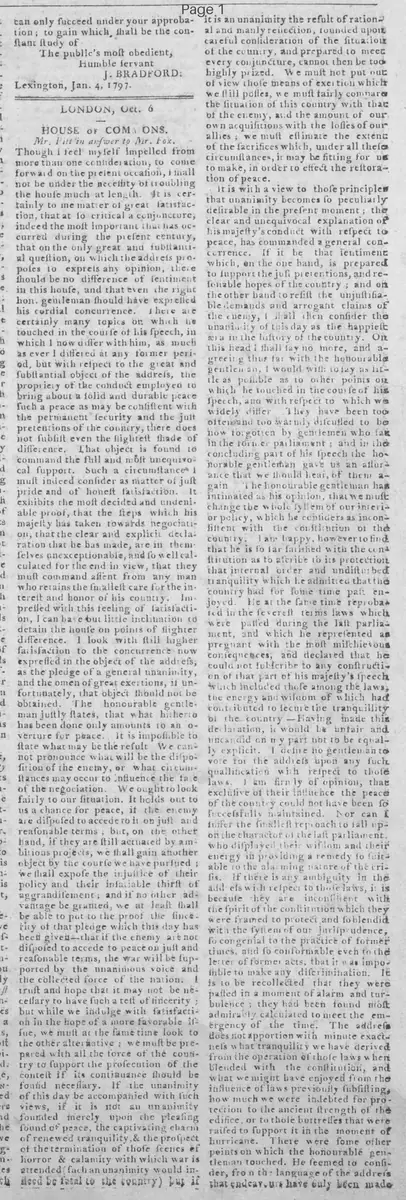
HOUSE OF COMMONS.
Mr. Pitt in answer to Mr. Fox.
Though I feel myself impelled from more than one consideration, to come forward on the present occasion, I shall not be under the necessity of troubling the house much at length. It is certainly to me matter of great satisfaction, that at so critical a conjuncture, indeed the most important that has occurred during the present century, that on the only great and substantial question, on which the address proposes to express any opinion, there should be no difference of sentiment in this house, and that even the right hon. gentleman should have expressed his cordial concurrence. There are certainly many topics on which he touched in the course of his speech, in which I now differ with him, as much as ever I differed at any former period, but with respect to the great and substantial object of the address, the propriety of the conduct employed to bring about a solid and durable peace such a peace as may be consistent with the permanent security and the just pretensions of the country, there does not subsist even the slightest shade of difference. That object is found to command the full and most unequivocal support. Such a circumstance I must indeed consider as matter of just pride and of honest satisfaction. It exhibits the most decided and undeniable proof, that the steps which his majesty has taken towards negotiation, that the clear and explicit declaration that he has made, are in themselves unexceptionable, and so well calculated for the end in view, that they must command assent from any man who retains the smallest care for the interest and honor of his country. Impressed with this feeling of satisfaction, I can have but little inclination to detain the house on points of slighter difference. I look with still higher satisfaction to the concurrence now expressed in the object of the address, as the pledge of a general unanimity, and the omen of great exertions, if unfortunately, that object should not be obtained. The honourable gentleman justly states, that what hitherto has been done only amounts to an overture for peace. It is impossible to state what may be the result We cannot pronounce what will be the disposition of the enemy, or what circumstances may occur to influence the fate of the negotiation. We ought to look fairly to our situation. It holds out to us a chance for peace, if the enemy are disposed to accede to it on just and reasonable terms ; but, on the other hand, if they are still actuated by ambitious projects, we shall gain another object by the course we have pursued ; we shall expose the injustice of their policy and their insatiable thirst of aggrandizement; and if no other advantage be granted, we at least shall be able to put to the proof the sincerity of that pledge which this day has been given—that if the enemy are not disposed to accede to peace on just and reasonable terms, the war will be supported by the unanimous voice and the collected force of the nation. I trust and hope that it may not be necessary to have such a test of sincerity ; but while we indulge with satisfaction in the hope of a more favorable issue, we must at the same time look to the other alternative; we must be prepared with all the force of the country to support the prosecution of the contest if its continuance should be found necessary. If the unanimity of this day be accompanied with such views, if it is not an unanimity founded merely upon the pleasing sound of peace, the captivating charm of renewed tranquility, & the prospect of the termination of those scenes of horror & calamity with which war is attended (such an unanimity would indeed be fatal to the country) but if it is an unanimity the result of rational and manly reflection, founded upon careful consideration of the situation of the country, and prepared to meet every conjuncture, cannot then be too highly prized. We must not put out of view those means of exertion which we still possess, we must fairly compare the situation of this country with that of the enemy, and the amount of our own acquisitions with the losses of our allies; we must estimate the extent of the sacrifices which, under all these circumstances, it may be fitting for us to make, in order to effect the restoration of peace.
It is with a view to those principles that unanimity becomes so peculiarly desirable in the present moment; the clear and unequivocal explanation of his majesty's conduct with respect to peace, has commanded a general concurrence. If it be that sentiment which, on the one hand, is prepared to support the just pretensions, and reasonable hopes of the country ; and on the other hand to resist the unjustifiable demands and arrogant claims of the enemy, shall then consider the unanimity of this day as the happiest era in the history of the country. On this head I shall say no more, and agreeing thus far with the honourable gentleman, I would wish to lay as little as possible as to other points on which he touched in the course of his speech, and with respect to which we widely differ They have been too often and too warmly discussed to be now forgotten by gentlemen who sat in the former parliament ; and in the concluding part of his speech the honourable gentleman gave us an assurance that we should hear, of them again The honourable gentleman has intimated as his opinion, that we must change the whole system of our interior or policy, which he considers as inconsistent with the constitution of the country. I am happy, however to find that he is so far furnished with the constitution as to ascribe to its protection that internal order and undisturbed tranquility which he admitted that the country had for some time past enjoyed. He at the same time reprobated in the severest terms laws which were passed during the last parliament, and which he represented as pregnant with the most mischievous consequences, and declared that he could not subscribe to any construction of that part of his majesty's speech which included those among the laws, the energy and wisdom of which had contributed to secure the tranquillity of the country -Having made this declaration, it would be unfair and uncandid on my part not to be equally explicit. I desire the gentleman to vote to the address upon any such qualification with respect to those laws. I am firmly of opinion, that exclusive of their influence the peace of the country could not have been so successfully maintained. Nor can I suffer the slightest reproach to last upon the character of the last parliament. who displayed their wisdom and their energy in providing a remedy suitable to the alarming nature of the crisis. If there is any ambiguity in the address with respect to those laws, it is because they are inconsistent with the spirit of the constitution which they were framed to protect and sublendid with the system of our jurisprudence, so congenial to the practice of former times. and so conformable even to the letter of former acts, that it was impossible to make any discrimination. It is to be recollected that they were passed in a moment of alarm and turbulence ; they had been found most admirably calculated to meet the emergency of the time. The address does not apportion with minute exactness what tranquility we have derived from the operation of those laws when blended with the constitution, and what we might have enjoyed from the influence of laws previously subsisting. how much we were indebted for protection to the ancient strength of the edifice, or to those buttresses that were raised to support it in the moment of hurricane. There were some other points on which the honourable gentleman touched. He seemed to consider, from the language of the address that endeavors have only been made
of late to procure peace. He ought to recollect that his majesty's speech particularly refers to what has taken place since he last communicated with the parliament. If ever the day shall come when an examination shall be instituted into the steps which have been adopted to secure the re-establishment of the general tranquillity, I am confident that no endeavors for that purpose have been wanting on the part of his Majesty's ministers. But gentlemen must be sensible that what may be admitted as an endeavor to restore peace depends upon a variety of circumstances, and is likely to be differently appreciated by individuals of opposite sentiments. It depends upon a relative state of parties, on the number of allies with whom we may be engaged to act, on the degree of attention we pay to their interests, and on the concert we wish to preserve with them. Taking all these necessary considerations into view, I again pledge myself that it will be found in the result of enquiry that ministers have neglected no opportunity which could have been improved for the purpose of accelerating peace. But the honourable gentleman has told us that we are at last come to the period which he had all along pointed out; that we have now consented to adopt that course which he has uniformly recommended since the commencement of the contest to send a person to Paris and to try the effect of negotiation. He takes to himself all the merit of that policy which we have tardily adopted, and so confident did he feel himself on this ground of self exultation, that he declined all illustration of his victory, and merely made it the subject of one triumphant observation. His assertion was, "you are now taking those measures which if you had listened to my counsels, you might have adopted four years ago." But does it follow that the measure was right then, because it is right now? May not a period of four years produce many events to justify a material change of policy, and to render measures wise and expedient, which at a certain time would neither have been prudent nor reasonable? Because you do not choose to make peace the day after an unprovoked aggression, may you not be justified in holding out pacific overtures after a lapse of four years? The argument of the honourable gentleman amounts to this, that, either you must make peace the day after the aggression, or not make it at all. -With respect to the relative situation of this country and Spain, it would not be consistent with my duty to go into any detail on that subject at the present moment. As to the question of our resources, the honourable gentleman admits them to be extensive and flourishing. They furnish indeed, in a moment like the present, a subject of peculiar congratulation and well grounded confidence. If the revenue, after a four years war, which might have been expected to have injured it so materially in so many branches and after all the additional burdens which have been imposed, still keep up to the rate of last year, that circumstance is surely no slight source of satisfaction.-With respect to the state of commerce I am enabled to speak in a very different train. Notwithstanding all the embarrassments which it has had to encounter it has attained and still continues to enjoy a pitch of unexampled prosperity. Those embarrassments have proceeded from various causes ; the expense of the war abroad, & the high price of the articles of consumption at home; the situation of part of the continent, where the markets have been shut against us; and even the growth of our capital re-acting upon the commerce which occasioned it, so that it was an unequivocal proof, temporary prosperity was itself a cause of temporary distress. Of the continuance of this prosperity we have now the best assurance. The state of our exports during the last six months has been equal to what they have been in the most flourishing years of peace; and our imports have diminished in a very small proportion from what they have been at periods accounted the most prosperous. Under these circumstances, whatever temporary embarrassments may have arisen from the quantity of specie sent out of the country from the want of sufficient circulating medium, from the state of foreign markets, and from the increase of our capital ; and however these difficulties may for a time, have obstructed the ordinary operations of finance, the commercial character of the country has lost neither
its vigor nor importance. it such has been the state of things at a period when the country has had to contend for every thing dear to it; if notwithstanding all the obstacles which have clogged the machinery, the spring has retained so much force and energy, we may presume, that it, by the obstinacy and ambition of the enemy we should be called to still greater exertions, that our resources as yet remain untouched, and that we shall be able to call them forth, with a degree of concert and effect worthy of the character of the British nation, and of the cause in which they will be employed. These resources have in them nothing hollow or delusive. They are the result of an accumulated capital of gradually increasing commerce, of high and established credit. They are the fruits of fair exertion, of laudable ingenuity, of successful industry, they have been produced under a system of order and of justice, while we, under many disadvantages, have been contending against a country which exhibits in every respect the reverse of the picture.-a proof that the regular operation of those principles must triumph over the unnatural and exhausting efforts of violence and extortion. By these resources we are now qualified to take such steps as may tend to conduct us to a solid and durable peace, or, if we do not succeed in that object, to prosecute the contest with firmness and confidence. The honorable gentleman suggested one remark, that the speech contained no recognition of the government of France. He wasted a good deal of ingenuity in attempting to prove that it ought to have contained an express acknowledgment of the French government. It ought to have occurred to him, that a passport having been sent for and granted, some communication must have taken place on the occasion, and as that executive directory had been satisfied with the form of communication, and the mode in which they had been addressed it could not be necessary for him to start a difficulty where they had found none. I can assure him, that no question of etiquette, no difficulty of form, shall be permitted to stand in the way of negotiation, or to obstruct the attainment of the great object of peace. As to the other points, the right honorable gentleman has suggested what lessons we ought to derive from the experience of address. These lessons may be greatly varied according to the situation of parties and the different points of view in which the subject is considered. But, when the right honorable gentleman tells us that the situation of this country is that of adversity, I can by no means agree to the proposition. How far it deserves to be ranked under that description, let those pronounce who are best acquainted with the state of our resources. It cannot surely be termed a state of adversity from any losses of our trade, the diminution of our capital, or from the reduction of any of our foreign possessions. We have not been greatly impoverished by the events of the war in the East Indies. We cannot be much weakened in our national strength, by having our navy, in consequence of repeated triumphs over very hostile squadron, raised to a greater degree of glory and of fame, than it had ever before attained Where, then, are we to look for symptoms of this adversity ? Are we to look for them in the losses and disasters of our allies ? But does the hon. gentleman appeal to these as a criterion of adversity, when in the same breath, I hear him hold out as a source of complaint, that you are not, under your present circumstances, sure of a triumphant peace? And why can you not command such a peace ?—because you will not separate your own greatness, and your own commerce, from the interest and from the fate of your allies ; because you refuse to purchase peace for yourselves on any other terms than those which will secure the tranquility of Europe, and consider the situation of Great Britain as chained to that of the continent, by the bonds of a liberal and comprehensive policy. If what has been lost on the continent is a subject of regret, it is at least a topic on which we have no reason to reproach ourselves. If even the prospect in that quarter continued as gloomy as it was some time since, and if the extremity had not roused the armies of the emperor to those gallant, and spirited exertions, which have been crowned with such brilliant and unprecedented success, no share of blame could be attached to us. While the violence of France has been over-running a great part of Europe, and everywhere carrying desolation in its progress, your naval exertions have enabled you to counterbalance their successes, by acquisitions in different parts of the globe, and to pave the way for the restoration of peace to your allies, on terms which their own strength might have been able to procure. If you look indeed to the geographical situation of the seat of war, the emperor has not regained by his recent victories all that he had formerly lost. But do you count for nothing the destruction and ruin of those armies, by whom all the previous successes of the enemy had been achieved ? do you count for nothing the glorious and immortal testimony that has been exhibited to mankind, that disciplined valor must finally triumph over those principles that the war was undertaken to oppose, & which owed all their extraordinary and unaccountable successes to the violence in which they originated, and the successes with which they were accompanied. A memorable warning has also been afforded with respect to the true consequences which have resulted to those foreign powers, who in opposition to their true interest have courted the alliance of that enemy, and expected to find security and disgraceful tranquility. Recent events have served also to exculpate the characters of those who were calumniated as desirous to embrace their principles, and receive their laws, and in Germany they have left behind them nothing but the memory of their wrongs, and a feeling of eternal resentment. Are such effects to be considered as of small importance; or to be put in competition with the reduction of a fortress, or the possession of a district ? of the virtues to be acquired in the school of adversity, the honorable gentleman only mentions those of moderation and forbearance. Moderation I should consider as that virtue which is adapted to the dawn of prosperity ; there are other virtues of no less importance which are to be acquired under a reverse of fortune, and which are equally becoming in those who are called to suffer: there are the virtues of adversity endured, & adversity resisted, of adversity encountered, and adversity surmounted. The recent example of Germany has furnished an illustrious instance of fortitude & perseverance, their fortitude & perseverance have had the merited reward. These were lessons which I trust this country has not to learn. England has never shewn itself deficient in firmness and magnanimity ; it is unrivalled in resource: it has always been foremost in the career of honorable exertion. and it has only to maintain its accustomed vigor and perseverance to effect the restoration of general tranquility upon terms consistent with the dignity of its own character, and the security and interest of Europe.
Mr. Fox said a few words in explanation, in which he complained that the chancellor of the exchequer had misrepresented his argument respecting the propriety of the time for negotiation. He did not argue that because it was right to negotiate now, that it was right to negotiate at a former period. What he contended was, and he had not altered his opinion from any thing that he had heard, that if it was prudent and wise to send an ambassador to Paris, now when the French have carried their arms into the heart of Germany, and are in possession of Italy, it would not been dastardly and pusillanimous to have adopted that measure, when they had not one foot of that territory. He allowed that it might be sometimes pusillanimous to negotiate, but he was convinced that those who had been in the habit of applying this term during the war to any proposition for negotiation, had now renounced that opinion. He still retained his opinion respecting the new laws,& when he voted for the address, he did not include them in his construction of that part of it in which mention is made of the wisdom and energy of the laws. The question upon the address was then put and carried nemine contradicente, Adjourned till to-morrow.
PRIVATE ENTERTAINMENT FOR MAN AND HORSE
On Main street, next door to Doctor Downing's,
By WILLIAM ALLEN.
Blank Bonds for sale at this Office
What sub-type of article is it?
What keywords are associated?
What entities or persons were involved?
Where did it happen?
Foreign News Details
Primary Location
London
Event Date
Oct. 6
Key Persons
Outcome
the address was put and carried nemine contradicente.
Event Details
Mr. Pitt addresses the House in response to Mr. Fox, highlighting unanimous agreement on the address supporting the King's efforts for a solid peace consistent with Britain's security. He discusses the overture for peace, potential enemy responses, national resources, commerce prosperity despite war, and defense of past laws and policies. Pitt refutes Fox's criticisms on negotiation timing, internal policies, and adversity claims, emphasizing Britain's strength and alliances. Mr. Fox explains his position on negotiation prudence and laws. The session adjourns.