Thank you for visiting SNEWPapers!
Sign up free
Plymouth Weekly Banner
Plymouth, Marshall County, Indiana
What is this article about?
The assault on Senator Sumner by Mr. Brooks is revealed through congressional testimony to have caused only minor flesh wounds, exaggerated by Sumner and allies for political gain, deceiving the public about his condition in Washington.
Merged-components note: Merging the split components covering the introduction, main article, and testimony continuation on the Sumner affair, as they form a single coherent story.
Clipping
OCR Quality
Full Text
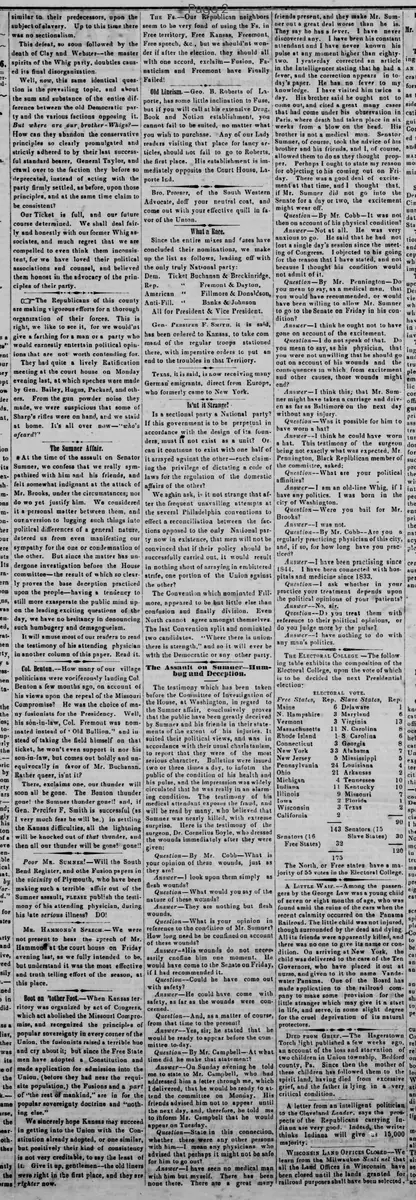
At the time of the assault on Senator Sumner, we confess that we really sympathised with him and his friends, and felt somewhat indignant at the attack of Mr. Brooks, under the circumstances; nor do we yet justify him. We considered it a personal matter between them, and our aversion to lugging such things into political differences of a general nature, deterred us from even manifesting our sympathy for the one or condemnation of the other. But since the matter has undergone investigation before the House committee--the result of which so clearly proves the base deception practiced upon the people--having a tendency to still more exasperate the public mind upon the leading exciting questions of the day, we have no hesitancy in denouncing such humbugery and demagogueism.
It will amuse most of our readers to read the testimony of his attending physician in another column of this paper. Read it.
The Assault on Sumner--Humbug and Deception.
The testimony which has been taken before the Committee of Investigation of the House, at Washington, in regard to the Sumner affair, conclusively proves that the public have been greatly deceived by Sumner and his friends in their statements of the extent of his injuries. It suited their political views, and was in accordance with their usual charlatanism, to report that they were of the most serious character. Bulletins were issued two or three times a day, to inform the public of the condition of his health and his pulse, and the impression was widely circulated that he was really in an alarming condition. The testimony of his medical attendant exposes the fraud, and will be read by many, who believed that Sumner was nearly killed, with extreme surprise. Here is the testimony of the surgeon, Dr. Cornelius Boyle, who dressed the wounds immediately after they were given:
Question--By Mr. Cobb--What is your opinion of these wounds, just as they are?
Answer--I look upon them simply as flesh wounds.
Question--What would you say of the nature of these wounds?
Answer--They are nothing but flesh wounds.
Question--What is your opinion in reference to the condition of Mr. Sumner? How long need he be confined on account of these wounds?
Answer--His wounds do not necessarily confine him one moment. He would have come to the Senate on Friday, if I had recommended it.
Question--Could he have come out with safety?
Answer--He could have come with safety, as far as the wounds were concerned.
Question--And, as a matter of course from that time to the present?
Answer--Yes, sir; he stated that he would be ready to appear before the committee to-day.
Question--By Mr. Campbell--At what time did he make that statement?
Answer--On Sunday evening he told me to state to Mr. Campbell, who had addressed him a letter through me, which I delivered, that he would be ready to attend the committee on Monday. His friends advised him not to appear until the next day, and therefore, he told me to inform Mr. Campbell that he would appear on Tuesday.
Question--State in this connection, whether there were any other persons with him--I mean any physicians who advised that perhaps it might not be safe for him to go out?
Answer--I have seen no medical man with him but myself. There has been none there. There are a great many friends present, and they make Mr. Sumner out a great deal worse than he is. They say he has a fever. I have never discovered any. I have been his constant attendant and I have never known his pulse at any moment higher than eighty-two. I yesterday corrected an article in the Intelligencer stating that he had a fever, and the correction appears in to-day's paper. He has no fever to my knowledge. I have visited him twice a day. His brother said he ought not to come out, and cited a great many cases that had come under his observation in Paris, where death had taken place in six weeks from a blow on the head. His brother is not a medical man. Senator Sumner, of course, took the advice of his brother and his friends, and I, of course, allowed them to do as they thought proper. Perhaps I ought to state my reason for objecting to his coming out on Friday. There was a good deal of excitement at that time, and I thought that, if Mr. Sumner did not go into the Senate for a day or two, the excitement might wear off.
Question--By Mr. Cobb--It was not then on account of his physical condition?
Answer--Not at all. He was very anxious to go. He said that he had not lost a single day's session since the meeting of Congress. I objected to his going for the reason that I have stated, and not because I thought his condition would not admit of it.
Question--By Mr. Pennington--Do you mean to say, as a medical man, that you would have recommended, or would have been willing to allow Mr. Sumner to go to the Senate on Friday in his condition?
Answer--I think he ought not to have gone on account of the excitement.
Question--I do not speak of that. Do you mean to say, as his physician, that you were not unwilling that he should go out on account of his wounds and the consequences in which, from excitement and other causes, those wounds might end?
Answer--I think this: that Mr. Sumner might have taken a carriage and driven as far as Baltimore on the next day without any injury.
Question--Was it possible for him to have worn a hat?
Question--What are your political affinities?
Answer--I am an old-line Whig, if I have any politics. I was born in the city of Washington.
Question--Were you bail for Mr. Brooks?
Answer--I was not.
Question--By Mr. Cobb--Are you a regularly practicing physician of this city, and, if so, for how long have you practiced?
Answer--I have been practising since 1844. I have been connected with hospitals and medicine since 1833.
Question--I ask whether in your practice your treatment depends upon the political opinions of your patients?
Answer--No, sir.
Question--Do you treat them with reference to their political opinions, or do you judge more by the pulse?
Answer--I have nothing to do with any man's politics.
What sub-type of article is it?
What themes does it cover?
What keywords are associated?
What entities or persons were involved?
Where did it happen?
Story Details
Key Persons
Location
Washington
Story Details
Testimony before a House committee reveals that the injuries Senator Sumner sustained from Mr. Brooks' assault were minor flesh wounds that did not require confinement; Sumner's friends exaggerated his condition for political sympathy, issuing alarming bulletins despite no fever or serious issues.