Thank you for visiting SNEWPapers!
Sign up free
Story
December 27, 1833
Richmond Enquirer
Richmond, Richmond County, Virginia
What is this article about?
1833 article in Washington defends Treasury Secretary Taney against Senator Clay's Senate charges of dishonesty in citing Crawford's letter on bank deposit authority, revealing Clay's knowledge of the document and misrepresentation of facts.
Clipping
OCR Quality
95%
Excellent
Full Text
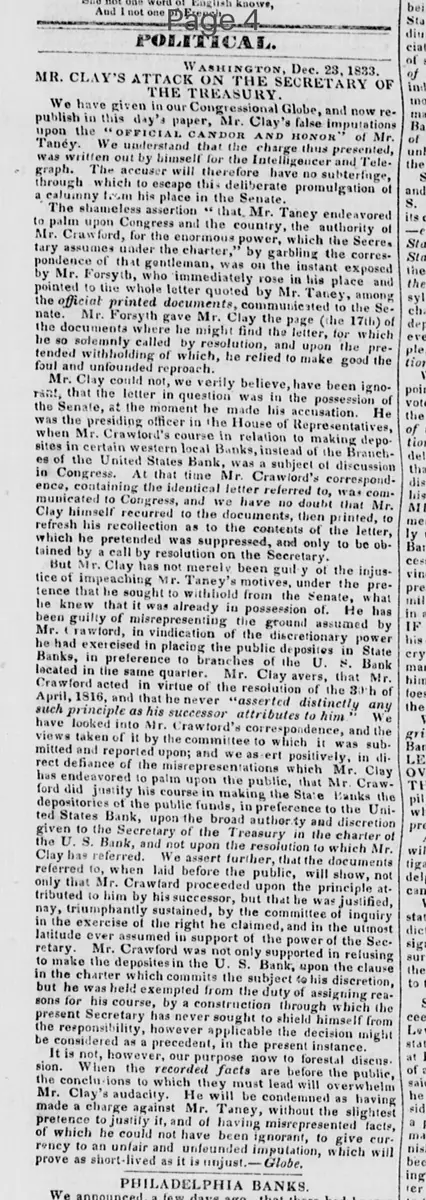
POLITICAL
Washington, Dec. 23, 1833.
MR. CLAY'S ATTACK ON THE SECRETARY OF THE TREASURY.
We have given in our Congressional Globe, and now republish in this day's paper, Mr. Clay's false imputations upon the "OFFICIAL CANDOR AND HONOR" of Mr. Taney. We understand that the charge thus presented, was written out by himself for the Intelligencer and Telegraph. The accuser will therefore have no subterfuge, through which to escape this deliberate promulgation of a calumny from his place in the Senate.
The shameless assertion "that Mr. Taney endeavored to palm upon Congress and the country, the authority of Mr. Crawford, for the enormous power, which the Secretary assumes under the charter," by garbling the correspondence of that gentleman, was on the instant exposed by Mr. Forsyth, who immediately rose in his place and pointed to the whole letter quoted by Mr. Taney, among the official printed documents, communicated to the Senate. Mr. Forsyth gave Mr. Clay the page (the 17th) of the documents where he might find the letter, for which he so solemnly called by resolution, and upon the pretended withholding of which, he relied to make good the foul and unfounded reproach.
Mr. Clay could not, we verily believe, have been ignorant, that the letter in question was in the possession of the Senate, at the moment he made his accusation. He was the presiding officer in the House of Representatives, when Mr. Crawford's course in relation to making deposits in certain western local Banks, instead of the Branches of the United States Bank, was a subject of discussion in Congress. At that time Mr. Crawford's correspondence, containing the identical letter referred to, was communicated to Congress, and we have no doubt that Mr. Clay himself recurred to the documents, then printed, to refresh his recollection as to the contents of the letter, which he pretended was suppressed, and only to be obtained by a call by resolution on the Secretary.
But Mr. Clay has not merely been guilty of the injustice of impeaching Mr. Taney's motives, under the pretence that he sought to withhold from the Senate, what he knew that it was already in possession of. He has been guilty of misrepresenting the ground assumed by Mr. Crawford, in vindication of the discretionary power he had exercised in placing the public deposites in State Banks, in preference to branches of the U. S. Bank located in the same quarter. Mr. Clay avers, that Mr. Crawford acted in virtue of the resolution of the 30th of April, 1816, and that he never "asserted distinctly any such principle as his successor attributes to him." We have looked into Mr. Crawford's correspondence, and the views taken of it by the committee to which it was submitted and reported upon; and we assert positively, in direct defiance of the misrepresentations which Mr. Clay has endeavored to palm upon the public, that Mr. Crawford did justify his course in making the State Banks the depositories of the public funds, in preference to the United States Bank, upon the broad authority and discretion given to the Secretary of the Treasury in the charter of the U. S. Bank, and not upon the resolution to which Mr. Clay has referred. We assert further, that the documents referred to, when laid before the public, will show, not only that Mr. Crawford proceeded upon the principle attributed to him by his successor, but that he was justified, nay, triumphantly sustained, by the committee of inquiry in the exercise of the right he claimed, and in the utmost latitude ever assumed in support of the power of the Secretary. Mr. Crawford was not only supported in refusing to make the deposites in the U. S. Bank, upon the clause in the charter which commits the subject to his discretion, but he was held exempted from the duty of assigning reasons for his course, by a construction through which the present Secretary has never sought to shield himself from the responsibility, however applicable the decision might be considered as a precedent, in the present instance.
It is not, however, our purpose now to forestall discussion. When the recorded facts are before the public, the conclusions to which they must lead will overwhelm Mr. Clay's audacity. He will be condemned as having made a charge against Mr. Taney, without the slightest pretence to justify it, and of having misrepresented facts, of which he could not have been ignorant, to give currency to an unfair and unfounded imputation, which will prove as short-lived as it is unjust.—Globe.
Washington, Dec. 23, 1833.
MR. CLAY'S ATTACK ON THE SECRETARY OF THE TREASURY.
We have given in our Congressional Globe, and now republish in this day's paper, Mr. Clay's false imputations upon the "OFFICIAL CANDOR AND HONOR" of Mr. Taney. We understand that the charge thus presented, was written out by himself for the Intelligencer and Telegraph. The accuser will therefore have no subterfuge, through which to escape this deliberate promulgation of a calumny from his place in the Senate.
The shameless assertion "that Mr. Taney endeavored to palm upon Congress and the country, the authority of Mr. Crawford, for the enormous power, which the Secretary assumes under the charter," by garbling the correspondence of that gentleman, was on the instant exposed by Mr. Forsyth, who immediately rose in his place and pointed to the whole letter quoted by Mr. Taney, among the official printed documents, communicated to the Senate. Mr. Forsyth gave Mr. Clay the page (the 17th) of the documents where he might find the letter, for which he so solemnly called by resolution, and upon the pretended withholding of which, he relied to make good the foul and unfounded reproach.
Mr. Clay could not, we verily believe, have been ignorant, that the letter in question was in the possession of the Senate, at the moment he made his accusation. He was the presiding officer in the House of Representatives, when Mr. Crawford's course in relation to making deposits in certain western local Banks, instead of the Branches of the United States Bank, was a subject of discussion in Congress. At that time Mr. Crawford's correspondence, containing the identical letter referred to, was communicated to Congress, and we have no doubt that Mr. Clay himself recurred to the documents, then printed, to refresh his recollection as to the contents of the letter, which he pretended was suppressed, and only to be obtained by a call by resolution on the Secretary.
But Mr. Clay has not merely been guilty of the injustice of impeaching Mr. Taney's motives, under the pretence that he sought to withhold from the Senate, what he knew that it was already in possession of. He has been guilty of misrepresenting the ground assumed by Mr. Crawford, in vindication of the discretionary power he had exercised in placing the public deposites in State Banks, in preference to branches of the U. S. Bank located in the same quarter. Mr. Clay avers, that Mr. Crawford acted in virtue of the resolution of the 30th of April, 1816, and that he never "asserted distinctly any such principle as his successor attributes to him." We have looked into Mr. Crawford's correspondence, and the views taken of it by the committee to which it was submitted and reported upon; and we assert positively, in direct defiance of the misrepresentations which Mr. Clay has endeavored to palm upon the public, that Mr. Crawford did justify his course in making the State Banks the depositories of the public funds, in preference to the United States Bank, upon the broad authority and discretion given to the Secretary of the Treasury in the charter of the U. S. Bank, and not upon the resolution to which Mr. Clay has referred. We assert further, that the documents referred to, when laid before the public, will show, not only that Mr. Crawford proceeded upon the principle attributed to him by his successor, but that he was justified, nay, triumphantly sustained, by the committee of inquiry in the exercise of the right he claimed, and in the utmost latitude ever assumed in support of the power of the Secretary. Mr. Crawford was not only supported in refusing to make the deposites in the U. S. Bank, upon the clause in the charter which commits the subject to his discretion, but he was held exempted from the duty of assigning reasons for his course, by a construction through which the present Secretary has never sought to shield himself from the responsibility, however applicable the decision might be considered as a precedent, in the present instance.
It is not, however, our purpose now to forestall discussion. When the recorded facts are before the public, the conclusions to which they must lead will overwhelm Mr. Clay's audacity. He will be condemned as having made a charge against Mr. Taney, without the slightest pretence to justify it, and of having misrepresented facts, of which he could not have been ignorant, to give currency to an unfair and unfounded imputation, which will prove as short-lived as it is unjust.—Globe.
What sub-type of article is it?
Historical Event
Deception Fraud
What themes does it cover?
Deception
Justice
What keywords are associated?
Political Attack
Bank Deposits
Senate Accusation
Taney Defense
Clay Misrepresentation
What entities or persons were involved?
Mr. Clay
Mr. Taney
Mr. Forsyth
Mr. Crawford
Where did it happen?
Washington
Story Details
Key Persons
Mr. Clay
Mr. Taney
Mr. Forsyth
Mr. Crawford
Location
Washington
Event Date
Dec. 23, 1833
Story Details
Mr. Clay accuses Mr. Taney of garbling Mr. Crawford's correspondence to justify discretionary power over bank deposits. The article refutes this, stating the letter was already available to the Senate and Crawford justified his actions based on the bank's charter discretion, supported by a committee.