Thank you for visiting SNEWPapers!
Sign up free
The Arvada Enterprise
Arvada, Morrison, Jefferson County, Colorado
What is this article about?
A traveler from Arvada describes his visit to Canterbury, England, highlighting the cathedral, St. Martin's Church, historical sites, and plans to depart for Paris on April 7 after touring France and Spain.
Merged-components note: Image illustrates the letter describing a flock of sheep in Canterbury, merging image with the foreign news article.
Clipping
OCR Quality
Full Text
Telling of the Scenery, Customs and Many Other Interesting Features Of That Country.
Continued from last week.
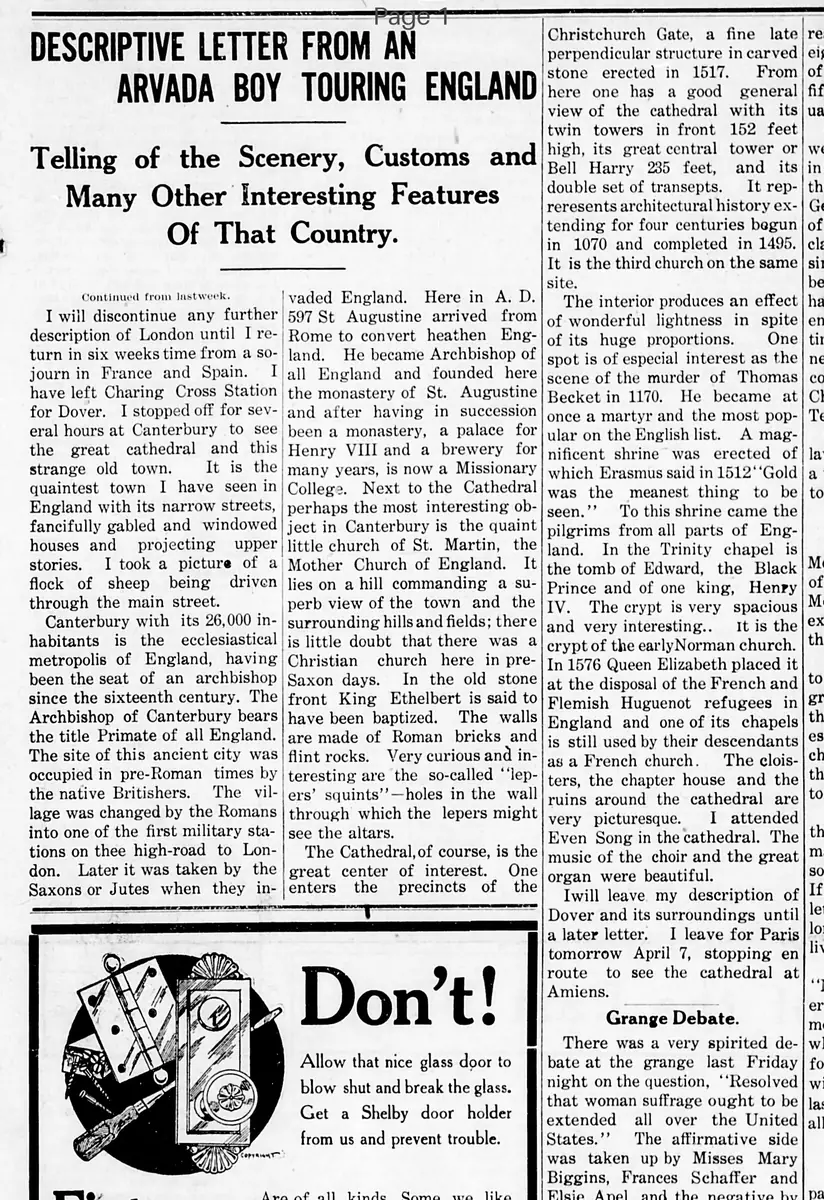
I will discontinue any further description of London until I return in six weeks time from a sojourn in France and Spain. I have left Charing Cross Station for Dover. I stopped off for several hours at Canterbury to see the great cathedral and this strange old town. It is the quaintest town I have seen in England with its narrow streets, fancifully gabled and windowed houses and projecting upper stories. I took a picture of a flock of sheep being driven through the main street. Canterbury with its 26,000 inhabitants is the ecclesiastical metropolis of England, having been the seat of an archbishop since the sixteenth century. The Archbishop of Canterbury bears the title Primate of all England. The site of this ancient city was occupied in pre-Roman times by the native Britishers. The village was changed by the Romans into one of the first military stations on the high-road to London. Later it was taken by the Saxons or Jutes when they invaded England. Here in A. D. 597 St Augustine arrived from Rome to convert heathen England. He became Archbishop of all England and founded here the monastery of St. Augustine and after having in succession been a monastery, a palace for Henry VIII and a brewery for many years, is now a Missionary College. Next to the Cathedral perhaps the most interesting object in Canterbury is the quaint little church of St. Martin, the Mother Church of England. It lies on a hill commanding a superb view of the town and the surrounding hills and fields: there is little doubt that there was a Christian church here in pre-Saxon days. In the old stone front King Ethelbert is said to have been baptized. The walls are made of Roman bricks and flint rocks. Very curious and interesting are the so-called "lepers squints"-holes in the wall through which the lepers might see the altars. The Cathedral, of course, is the great center of interest. One enters the precincts of the cathedral through Christchurch Gate, a fine late perpendicular structure in carved stone erected in 1517. From here one has a good general view of the cathedral with its twin towers in front 152 feet high, its great central tower or Bell Harry 235 feet, and its double set of transepts. It represents architectural history extending for four centuries begun in 1070 and completed in 1495. It is the third church on the same site. The interior produces an effect of wonderful lightness in spite of its huge proportions. One spot is of especial interest as the scene of the murder of Thomas Becket in 1170. He became at once a martyr and the most popular on the English list. A magnificent shrine was erected of which Erasmus said in 1512 'Gold was the meanest thing to be seen.' To this shrine came the pilgrims from all parts of England. In the Trinity chapel is the tomb of Edward, the Black Prince and of one king, Henry IV. The crypt is very spacious and very interesting. It is the crypt of the early Norman church. In 1576 Queen Elizabeth placed it at the disposal of the French and Flemish Huguenot refugees in England and one of its chapels is still used by their descendants as a French church. The cloisters, the chapter house and the ruins around the cathedral are very picturesque. I attended Even Song in the cathedral. The music of the choir and the great organ were beautiful. I will leave my description of Dover and its surroundings until a later letter. I leave for Paris tomorrow April 7, stopping en route to see the cathedral at Amiens.
What sub-type of article is it?
What keywords are associated?
What entities or persons were involved?
Where did it happen?
Foreign News Details
Primary Location
Canterbury, England
Event Date
April 7
Key Persons
Event Details
Traveler stops at Canterbury to visit the cathedral and town, describes its history from pre-Roman times, Roman, Saxon invasions, arrival of St Augustine in A.D. 597, St. Martin's Church with lepers squints, Christchurch Gate erected 1517, cathedral architecture from 1070-1495, murder of Thomas Becket in 1170, shrine, tombs, crypt used by Huguenot refugees since 1576, attends Evensong, plans to leave for Paris tomorrow stopping at Amiens.