Thank you for visiting SNEWPapers!
Sign up free
Daily National Intelligencer
Washington, District Of Columbia
What is this article about?
A letter to the editors highlights a passage from Mr. Walsh's Register on South American insurrections, praising its advocacy for liberty over Spanish colonial tyranny. It quotes Walsh critiquing the unreadiness for republicanism but superiority of self-government, and denounces Ferdinand VII's persecution of Spanish patriots like Don Augustin Argüelles.
Clipping
OCR Quality
Full Text
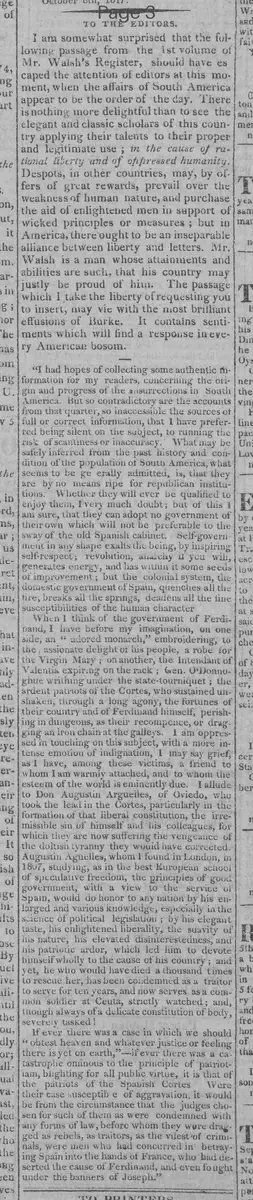
I am somewhat surprised that the following passage from the 1st volume of Mr. Walsh's Register, should have escaped the attention of editors at this moment, when the affairs of South America appear to be the order of the day. There is nothing more delightful than to see the elegant and classic scholars of this country applying their talents to their proper and legitimate use; in the cause of rational liberty and of oppressed humanity. Despots, in other countries, may, by offers of great rewards, prevail over the weakness of human nature, and purchase the aid of enlightened men in support of wicked principles or measures; but in America, there ought to be an inseparable alliance between liberty and letters. Mr. Walsh is a man whose attainments and abilities are such, that his country may justly be proud of him. The passage which I take the liberty of requesting you to insert, may vie with the most brilliant effusions of Burke. It contains sentiments which will find a response in every American bosom.
"I had hopes of collecting some authentic information for my readers, concerning the origin and progress of the insurrections in South America. But so contradictory are the accounts from that quarter, so inaccessible the sources of full or correct information, that I have preferred being silent on the subject, to running the risk of scantiness or inaccuracy. What may be safely inferred from the past history and condition of the population of South America, what seems to be generally admitted, is, that they are by no means ripe for republican institutions. Whether they will ever be qualified to enjoy them, I very much doubt; but of this I am sure, that they can adopt no government of their own which will not be preferable to the sway of the old Spanish cabinet. Self-government in any shape exalts the being, by inspiring self-respect; revolution, anarchy if you will, generates energy, and has within it some seeds of improvement; but the colonial system, the domestic government of Spain, quenches all the fire, breaks all the springs, deadens all the fine susceptibilities of the human character. When I think of the government of Ferdinand, I have before my imagination, on one side, an "adored monarch," embroidering, to the passionate delight of his people, a robe for the Virgin Mary; on another, the Intendant of Valentia expiring on the rack; Gen. O'Donoghue writhing under the state-tourniquet; the ardent patriots of the Cortes, who sustained unshaken, through a long agony, the fortunes of their country and of Ferdinand himself, perishing in dungeons, as their recompence, or dragging an iron chain at the galleys. I am oppressed in touching on this subject, with a more intense emotion of indignation, I may say grief, as I have, among these victims, a friend to whom I am warmly attached, and to whom the esteem of the world is eminently due. I allude to Don Augustin Argüelles, of Oviedo, who took the lead in the Cortes, particularly in the formation of that liberal constitution, the irrémissible sin of himself and his colleagues, for which they are now suffering the vengeance of the dolusn tyranny they would have corrected. Augustin Argüelles, whom I found in London, in 1807, studying, as in the best European school of speculative freedom, the principles of good government, with a view to the service of Spain, would do honor to any nation by his enlarged and various knowledge, especially in the science of political legislation; by his elegant taste, his enlightened liberality, the suavity of his nature, his elevated disinterestedness, and his patriotic ardor, which led him to devote himself wholly to the cause of his country; and yet, he who would have died a thousand times to rescue her, has been condemned as a traitor to serve for ten years, and now serves as a common soldier at Ceuta, strictly watched; and, though always of a delicate constitution of body, severely tasked! If ever there was a case in which we should "obtest heaven and whatever justice or feeling there is yet on earth,"—if ever there was a catastrophe ominous to the principle of patriotism, blighting for all public virtue, it is that of the patriots of the Spanish Cortes. Were their case susceptible of aggravation, it would be from the circumstance that the judges chosen for such of them as were condemned with any forms of law, before whom they were dragged as rebels, as traitors, as the vilest of criminals, were men who had concurred in betraying Spain into the hands of France, who had deserted the cause of Ferdinand, and even fought under the banners of Joseph."
What sub-type of article is it?
What themes does it cover?
What keywords are associated?
What entities or persons were involved?
Letter to Editor Details
Recipient
The Editors
Main Argument
the writer requests insertion of a passage from mr. walsh's register, praising its eloquent support for liberty and critique of spanish tyranny in south america, arguing that self-government, even anarchic, is preferable to colonial rule and highlighting the unjust persecution of patriots like don augustin argüelles.
Notable Details