Thank you for visiting SNEWPapers!
Sign up free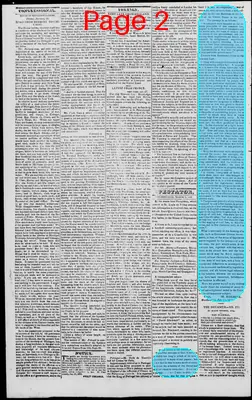
Letter to Editor
March 1, 1825
Edwardsville Spectator
Edwardsville, Madison County, Illinois
What is this article about?
Letter urges attention to Gov. Clinton's call for a codified legal system to replace uncertain common law, commenting with Bentham's 1817 extracts viewing common law as a historical blessing now a curse without codification. Signed M. Birkbeck, Wanborough, Feb. 15, 1825.
Clipping
OCR Quality
98%
Excellent
Full Text
TO THE EDITOR OF THE SPECTATOR.
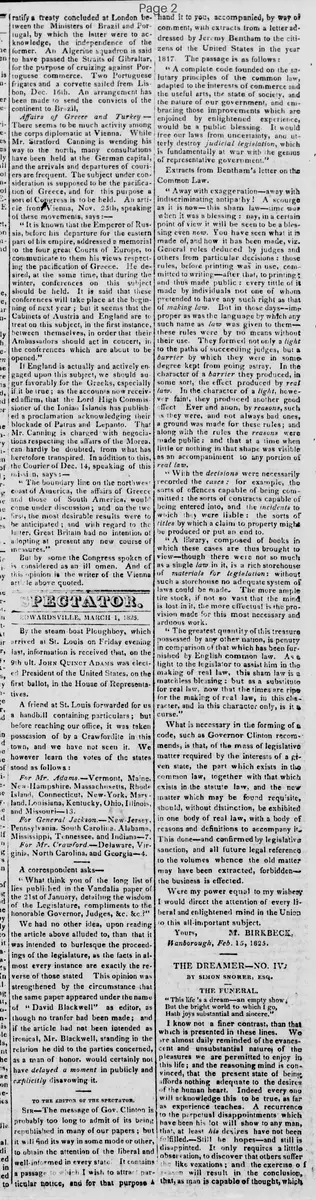
Sir—The message of Gov. Clinton is probably too long to admit of its being republished in many of our papers; but it will find its way in some mode or other, to obtain the attention of the liberal and well-informed in every state: It contains a passage to which I wish to attract particular notice, and for that purpose I hand it to you, accompanied, by way of comment, with extracts from a letter addressed by Jeremy Bentham to the citizens of the United States in the year 1817. The passage is as follows:
"A complete code founded on the salutary principles of the common law, adapted to the interests of commerce and the useful arts, the state of society, and the nature of our government, and embracing those improvements which are enjoined by enlightened experience, would be a public blessing. It would free our laws from uncertainty, and utterly destroy judicial legislation, which is fundamentally at war with the genius of representative government."
Extracts from Bentham's letter on the Common Law,
" Away with exaggeration—away with indiscriminating antipathy! A scourge as it is now—this sham law—time was when it was a blessing: nay, in a certain point of view it will be seen to be a blessing even now. You have seen what it is made of, and how it has been made, viz. General rules deduced by judges and others from particular decisions: those rules, before printing was in use, committed to writing—after that, to printing— and thus made public: every tittle of it made by individuals not one of whom pretended to have any such right as that of making law. But in those days—time proper as was the language by which any such name as law was given to them— these rules were by no means without their use. They formed not only a light to the paths of succeeding judges, but a barrier by which they were in some degree kept from going astray. In the character of a barrier they produced, in some sort, the effect produced by real law, In the character of a light, however faint, they produced another good effect Ever and anon, by reasons, such as they were, and not always bad ones, a ground was made for these rules; and along with the rules the reasons were made public: and that at a time when little or nothing in that shape was visible as an accompaniment to any portion of real law.
" With the decisions were necessarily recorded the cases: for example, the sorts of offences capable of being committed : the sorts of contracts capable of being entered into, and the incidents to which they were liable: the sorts of titles by which a claim to property might be produced or put an end to.
"A library, composed of books in which these cases are thus brought to view—though there were not so much as a single law in it, is a rich storehouse of materials for legislation: without such a storehouse no adequate system of laws could be made— The more ample the stock, if not so vast that the mind is lost in it, the more effectual is the provision made for this most necessary and arduous work.
" The greatest quantity of this treasure possessed by any other nation, is penury in comparison of that which has been furnished by English common law. As a light to the legislator to assist him in the making of real law, this sham law is a matchless blessing: but as a substitute for real law, now that the times are ripe for the making of real law, in this character, and in this character only, is it a curse."
What is necessary in the forming of a code, such as Governor Clinton recommends, is that, of the mass of legislative matter required by the interests of a given state, the part which exists in the common law, together with that which exists in the statute law, and the new matter which may be found requisite, should, without distinction, be exhibited in one body of real law, with a body of reasons and definitions to accompany it. This done—and confirmed by legislative sanction, and all future legal reference to the volumes whence the old matter may have been extracted, forbidden— the business is effected.
Were my power equal to my wishes, I would direct the attention of every liberal and enlightened mind in the Union to this all-important subject.
Yours,
M. BIRKBECK,
Wanborough, Feb. 15, 1825.
Sir—The message of Gov. Clinton is probably too long to admit of its being republished in many of our papers; but it will find its way in some mode or other, to obtain the attention of the liberal and well-informed in every state: It contains a passage to which I wish to attract particular notice, and for that purpose I hand it to you, accompanied, by way of comment, with extracts from a letter addressed by Jeremy Bentham to the citizens of the United States in the year 1817. The passage is as follows:
"A complete code founded on the salutary principles of the common law, adapted to the interests of commerce and the useful arts, the state of society, and the nature of our government, and embracing those improvements which are enjoined by enlightened experience, would be a public blessing. It would free our laws from uncertainty, and utterly destroy judicial legislation, which is fundamentally at war with the genius of representative government."
Extracts from Bentham's letter on the Common Law,
" Away with exaggeration—away with indiscriminating antipathy! A scourge as it is now—this sham law—time was when it was a blessing: nay, in a certain point of view it will be seen to be a blessing even now. You have seen what it is made of, and how it has been made, viz. General rules deduced by judges and others from particular decisions: those rules, before printing was in use, committed to writing—after that, to printing— and thus made public: every tittle of it made by individuals not one of whom pretended to have any such right as that of making law. But in those days—time proper as was the language by which any such name as law was given to them— these rules were by no means without their use. They formed not only a light to the paths of succeeding judges, but a barrier by which they were in some degree kept from going astray. In the character of a barrier they produced, in some sort, the effect produced by real law, In the character of a light, however faint, they produced another good effect Ever and anon, by reasons, such as they were, and not always bad ones, a ground was made for these rules; and along with the rules the reasons were made public: and that at a time when little or nothing in that shape was visible as an accompaniment to any portion of real law.
" With the decisions were necessarily recorded the cases: for example, the sorts of offences capable of being committed : the sorts of contracts capable of being entered into, and the incidents to which they were liable: the sorts of titles by which a claim to property might be produced or put an end to.
"A library, composed of books in which these cases are thus brought to view—though there were not so much as a single law in it, is a rich storehouse of materials for legislation: without such a storehouse no adequate system of laws could be made— The more ample the stock, if not so vast that the mind is lost in it, the more effectual is the provision made for this most necessary and arduous work.
" The greatest quantity of this treasure possessed by any other nation, is penury in comparison of that which has been furnished by English common law. As a light to the legislator to assist him in the making of real law, this sham law is a matchless blessing: but as a substitute for real law, now that the times are ripe for the making of real law, in this character, and in this character only, is it a curse."
What is necessary in the forming of a code, such as Governor Clinton recommends, is that, of the mass of legislative matter required by the interests of a given state, the part which exists in the common law, together with that which exists in the statute law, and the new matter which may be found requisite, should, without distinction, be exhibited in one body of real law, with a body of reasons and definitions to accompany it. This done—and confirmed by legislative sanction, and all future legal reference to the volumes whence the old matter may have been extracted, forbidden— the business is effected.
Were my power equal to my wishes, I would direct the attention of every liberal and enlightened mind in the Union to this all-important subject.
Yours,
M. BIRKBECK,
Wanborough, Feb. 15, 1825.
What sub-type of article is it?
Persuasive
Informative
Philosophical
What themes does it cover?
Constitutional Rights
Politics
What keywords are associated?
Legal Code
Common Law
Jeremy Bentham
Governor Clinton
Judicial Legislation
Representative Government
Codification
Legal Reform
What entities or persons were involved?
M. Birkbeck
The Editor Of The Spectator
Letter to Editor Details
Author
M. Birkbeck
Recipient
The Editor Of The Spectator
Main Argument
advocates for creating a complete legal code based on common law principles, adapted to commerce, society, and government, to eliminate uncertainty and judicial legislation, drawing on jeremy bentham's views that common law is a valuable resource but now a curse as a substitute for real law.
Notable Details
Quotes Passage From Gov. Clinton's Message On Need For A Legal Code
Extracts From Jeremy Bentham's 1817 Letter Praising Common Law As A Storehouse For Legislation But Criticizing It As A Substitute For Codified Law
Emphasizes Combining Common Law, Statute Law, And New Matter Into One Body Of Real Law With Reasons And Definitions