Thank you for visiting SNEWPapers!
Sign up free
Norfolk Gazette And Publick Ledger
Norfolk, Virginia
What is this article about?
A rhetorical essay praises Louis XVIII, the exiled French king in Britain, for his virtues, learning, and suffering, contrasting him with Napoleon the usurper, and hopes for Bourbon restoration to end French anarchy and bring peace to Europe.
Merged-components note: Continuation of the article 'Character of Lewis XVIII' from the Anti-Jacobin Review, focused on international affairs involving the French monarchy; relabeled to foreign_news.
Clipping
OCR Quality
Full Text
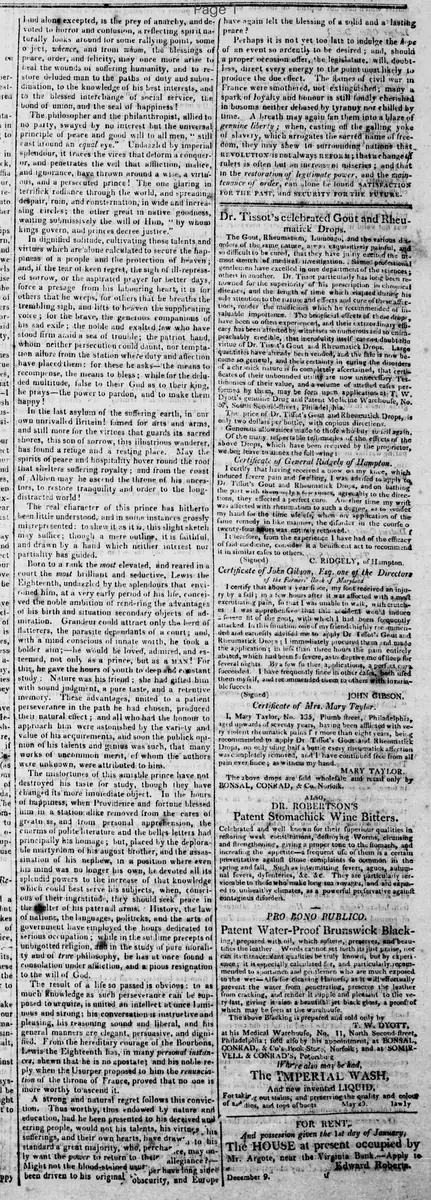
The philosopher and the philanthropist, allied to no party, swayed by no interest but the universal principle of peace and good will to all men, still cast around an equal eye. Undazzled by imperial splendour, it traces the vices that deform a conqueror, and penetrates the veil that affliction, malice, and ignorance, have thrown around a wise, a virtuous, and a persecuted prince! The one glaring in terrifick radiance through the world, and spreading despair, ruin, and consternation, in wide and increasing circles; the other great in native goodness, waiting submissively the will of Him, "by whom kings govern, and princes decree justice."
In dignified solitude, cultivating those talents and virtues which are alone calculated to secure the happiness of a people and the protection of heaven; and, if the tear of keen regret, the sigh of ill-repressed sorrow, or the aspirated prayer for better days, force a presage from his labouring heart, it is for others that he weeps, for others that he breathes the trembling sigh, and lifts to heaven the supplicating voice; for the brave, the generous companions of his sad exile; the noble and exalted few who have stood firm amidst a sea of trouble; the patriot band, whom neither persecution could daunt, nor temptation allure from the station where duty and affection have placed them: for these he asks— the means to recompense, the means to bless; while for the deluded multitude, false to their God as to their king, he prays— the power to pardon, and to make them happy!
In the last asylum of the suffering earth, in our own unrivalled Britain! famed for arts and arms, and still more for the virtues that guard its sacred shores, this son of sorrow, this illustrious wanderer, has found a refuge and a resting place. May the spirits of peace and hospitality hover round the roof that shelters suffering royalty: and from the coast of Albion may he ascend the throne of his ancestors, to restore tranquility and order to the long-distracted world!
The real character of this prince has hitherto been little understood, and in some instances grossly misrepresented: to shew it as it is, this slight sketch may suffice; though a mere outline, it is faithful. and drawn by a hand which neither interest nor partiality has guided.
Born to a rank the most elevated, and reared in a court the most brilliant and seductive, Lewis the Eighteenth, undazzled by the splendours that environed him, at a very early period of his life, conceived the noble ambition of rendering the advantages of his birth and situation secondary objects of admiration. Grandeur could attract only the herd of flatterers, the parasite dependants of a court; and, with a mind conscious of innate worth, he took a bolder aim;—he would be loved, admired, and esteemed, not only as a prince, but as a Man! For this, he gave the hours of youth to deep and constant study: Nature was his friend: she had gifted him with sound judgment, a pure taste, and a retentive memory. These advantages, united to a patient perseverance in the path he had chosen, produced their natural effect; and all who had the honour to approach him were astonished by the variety and value of his acquirements, and soon the publick opinion of his talents and genius was such, that many works of uncommon merit, of whom the authors were unknown, were attributed to him.
The misfortunes of this amiable prince have not destroyed his taste for study, though they have changed its more immediate object. In the hours of happiness, when Providence and fortune blessed him in a station alike removed from the cares of greatness, and from personal apprehension, the charms of polite literature and the belles-lettres had principally his homage; but, placed by the deplorable martyrdom of his august brother, and the assassination of his nephew, in a position where even his mind was no longer his own, he devoted all its splendid powers to the increase of that knowledge which could best serve his subjects, when, conscious of their ingratitude, they should seek peace in the shelter of his paternal arms. History, the law of nations, the languages; politics, and the arts of government have employed the hours dedicated to serious occupation; while in the sublime precepts of unbigotted religion, and in the study of pure morality and of true philosophy, he has at once found a consolation under affliction, and a pious resignation to the will of God.
The result of a life so passed is obvious: to as much knowledge as such perseverance can be supposed to acquire, is united an intellect at once luminous and strong; his conversation is instructive and pleasing, his reasoning sound and liberal, and his general manners are elegant, persuasive, and dignified. From the hereditary courage of the Bourbons, Lewis the Eighteenth has, in many personal instances, shewn that he is no apostate and his noble reply when the Usurper proposed to him the renunciation of the throne of France, proved that no one is more worthy to ascend it.
A strong and natural regret follows this conviction. Thus worthy, thus endowed by nature and education, had he been presented to his deceived and erring people, would not his talents, his virtues, his sufferings, and their own hearts, have drawn them to his standard? a great majority, who, perhaps want the power to return to these, may on-allegiance?
Might not the blood-stained usurper have long since been driven to his original obscurity, and Europe have again felt the blessing of a solid and a lasting peace?
Perhaps it is not yet too late to indulge the hope of an event so ardently to be desired; and, should a proper occasion offer, she legislature, will, doubtless, direct every energy to the point most likely to produce the due effect. The flames of civil war in France were smothered, not extinguished; many a spark of loyalty and honour is still fondly cherished in bosoms neither debased by tyranny nor chilled by time. A breath may again fan them into a blaze of genuine liberty; when, casting off the galling yoke of slavery, which arrogates the sacred name of freedom, they may shew the surrounding nations that REVOLUTION is not always reform; that a changed rulers is often but an increase of miseries; and that in the restoration of legitimate power, and the maintenance of order, can alone be found SATISFACTION FOR THE PAST, AND SECURITY FOR THE FUTURE.
What sub-type of article is it?
What keywords are associated?
What entities or persons were involved?
Where did it happen?
Foreign News Details
Primary Location
France
Key Persons
Outcome
hopes for restoration of louis xviii to end anarchy and bring peace to europe
Event Details
The text lauds Louis XVIII's character, education, and virtues while in exile in Britain, contrasts him with the conquering usurper spreading ruin, describes his studies in history, politics, and religion, and expresses regret over the French Revolution's chaos, hoping for his return to the throne to restore order and legitimate power.