Thank you for visiting SNEWPapers!
Sign up free
Alexandria Daily Advertiser
Alexandria, Virginia
What is this article about?
Corrector responds to Aristides' critique in the Alexandria Daily Advertiser, defending a bill and memorial for town governance reforms. He refutes misquotations, satirizes logical flaws in Aristides' arguments on electoral districts, and supports expansions in corporation powers for nuisances, jurisdiction, and tax recovery, while open to compromise.
Clipping
OCR Quality
Full Text
-3-.
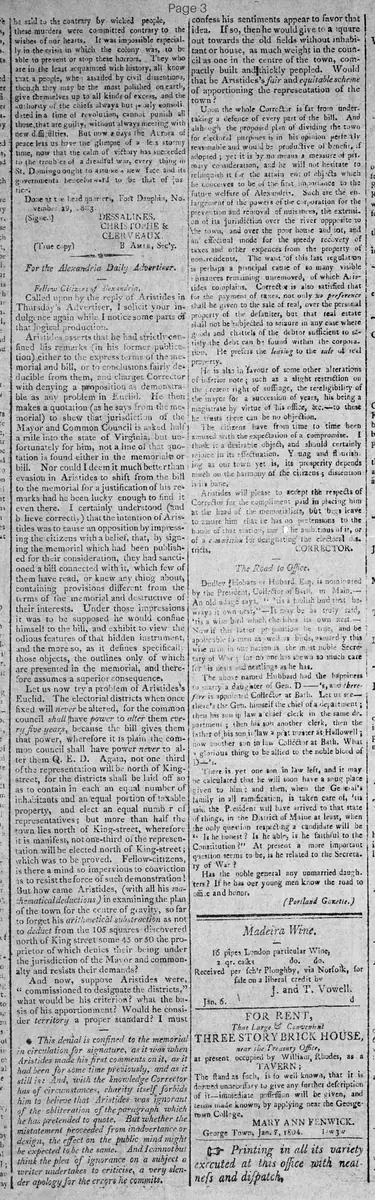
Fellow Citizens of Alexandria,
Called upon by the reply of Aristides in Thursday's Advertiser, I solicit your indulgence again while I notice some parts of that logical production.
Aristides asserts that he had strictly confined his remarks (in his former publication) either to the express terms of the memorial and bill, or to conclusions fairly deducible from them, and charges Corrector with denying a proposition as demonstrable as any problem in Euclid. He then makes a quotation (as he says from the memorial) to shew that jurisdiction of the Mayor and Common Council is asked half a mile into the state of Virginia, but unfortunately for him, not a line of that quotation is found either in the memorial or bill. Nor could I deem it much better than evasion in Aristides to shift from the bill to the memorial for a justification of his remarks had he been lucky enough to find it even there. I certainly understood (and believe correctly) that the intention of Aristides was to cause an opposition by impressing the citizens with a belief, that, by signing the memorial which had been published for their consideration, they had sanctioned a bill connected with it, which few of them have read, or knew any thing about, containing provisions different from the terms of the memorial and destructive of their interests. Under those impressions it was to be supposed he would confine himself to the bill, and exhibit to view the odious features of that hidden instrument, and the more so, as it defines specifically those objects, the outlines only of which are presented in the memorial, and therefore assumes a superior consequence.
Let us now try a problem of Aristides's Euclid. The electoral districts when once fixed will never be altered, for the common council shall have power to alter them every five years, because the bill gives them that power, wherefore it is plain the common council shall have power never to alter them Q. E. D. Again, not one third of the representation will be north of King-street, for the districts shall be laid off so as to contain in each an equal number of inhabitants and an equal portion of taxable property, and elect an equal number of representatives; but more than half the town lies north of King-street, wherefore it is manifest, not one-third of the representation will be elected north of King-street; which was to be proved. Fellow-citizens, is there a mind so impervious to conviction as to resist the force of such demonstration!
But how came Aristides, (with all his mathematical deductions) in examining the plan of the town for the centre of gravity, so far to forget his arithmetical subtraction as not to deduct from the 105 squares discovered north of King street some 45 or 50 the proprietor of which denies their being under the jurisdiction of the Mayor and commonalty and resists their demands?
And now, suppose Aristides were, "commissioned to designate the districts." what would be his criterion? what the basis of his apportionment? Would he consider territory a proper standard? I must confess his sentiments appear to favor that idea. If so, then he would give to a square out towards the old fields without inhabitant or house, as much weight in the council as one in the centre of the town, compactly built and thickly peopled. Would that be Aristides's fair and equitable scheme of apportioning the representation of the town?
Upon the whole Corrector is far from undertaking a defence of every part of the bill. And although the proposed plan of dividing the town for electoral purposes is in his opinion perfectly reasonable and would be productive of benefit, if adopted; yet it is by no means a measure of primary consideration, and he will not hesitate to relinquish it for the attainment of objects which he conceives to be of the first importance to the future welfare of Alexandria. Such are the enlargement of the powers of the corporation for the prevention and removal of nuisances, the extension of its jurisdiction over the river opposite to the town, and over the poor house and lot, and an effectual mode for the speedy recovery of taxes and other expences from the property of non-residents. The want of this last regulation is perhaps a principal cause of so many visible nuisances remaining unremoved, of which Aristides complains. Corrector is also satisfied that for the payment of taxes, not only preference shall be given to the sale of real, over the personal property of the defaulter, but that real estate shall not be subjected to seizure in any case where goods and chattels of the debtor sufficient to satisfy the debt can be found within the corporation. He prefers the leasing to the sale of real property.
He is also in favour of some other alterations of inferior note: such as a slight restriction on the present right of suffrage, the re-eligibility of the mayor for a succession of years, his being a magistrate by virtue of his office, &c.--to these he trusts there can be no objection.
The citizens have from time to time been amused with the expectation of a compromise. I think it a desirable object, and should certainly rejoice in its effectuation. Young and flourishing as our town yet is, its prosperity depends much on the harmony of the citizens; dissention is its bane.
Aristides will please to accept the respects of Corrector for the compliment paid in placing him at the head of the memorialists, but begs leave to assure him that he has no pretensions to the honor of that station, nor is ambitious of it, or of a commission for designating the electoral districts.
CORRECTOR.
What sub-type of article is it?
What themes does it cover?
What keywords are associated?
What entities or persons were involved?
Letter to Editor Details
Author
Corrector
Recipient
Fellow Citizens Of Alexandria
Main Argument
corrector defends the bill and memorial against aristides' misrepresentations, emphasizing its benefits for corporation powers, nuisance removal, jurisdiction extension, and tax recovery, while critiquing electoral district arguments and expressing willingness to compromise on divisions for greater town welfare.
Notable Details