Thank you for visiting SNEWPapers!
Sign up free
Gazette Of The United States, & Philadelphia Daily Advertiser
Philadelphia, Philadelphia County, Pennsylvania
What is this article about?
On June 7 in The Hague, Utrecht province representatives enacted reforms equalizing ecclesiastical privileges, ending public-funded church salaries after four months, claiming benefices and public church properties as provincial assets while allowing reformed congregations continued access to churches.
Clipping
OCR Quality
Full Text
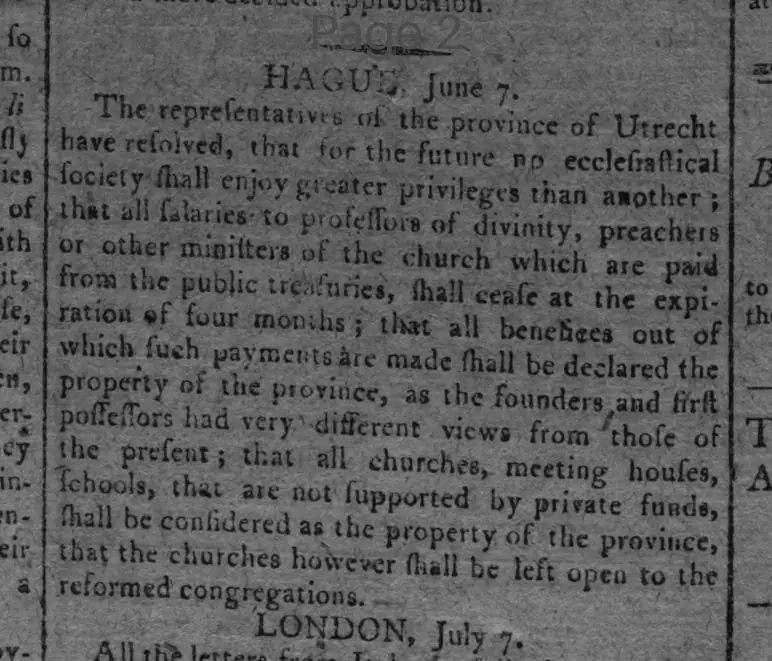
The representatives of the province of Utrecht have resolved, that for the future no ecclesiastical society shall enjoy greater privileges than another; that all salaries to professors of divinity, preachers or other ministers of the church which are paid from the public treasuries, shall cease at the expiration of four months; that all benefices out of which such payments are made shall be declared the property of the province, as the founders and first possessors had very different views from those of the present; that all churches, meeting houses, schools, that are not supported by private funds, shall be considered as the property of the province, that the churches however shall be left open to the reformed congregations.
What sub-type of article is it?
What keywords are associated?
Where did it happen?
Foreign News Details
Primary Location
Utrecht
Event Date
June 7
Outcome
salaries to church ministers from public funds to cease after four months; benefices and public-supported churches, meeting houses, and schools declared provincial property, with churches remaining open to reformed congregations.
Event Details
Representatives of Utrecht province resolved that no ecclesiastical society shall have greater privileges than another; all salaries to professors of divinity, preachers, or other church ministers paid from public treasuries shall cease after four months; benefices funding such payments declared provincial property due to differing views of founders; all non-privately funded churches, meeting houses, and schools considered provincial property, though churches left open to reformed congregations.