Thank you for visiting SNEWPapers!
Sign up free
Pinedale Roundup
Pinedale, Sublette County, Fremont County, Wyoming
What is this article about?
Deputy Assistant DA James J. Wilson testifies before a legislative committee in New York about swindles targeting immigrants, including underwater lots, fake Brooklyn Bridge concessions, bogus railroad shares, and money transmission delays, costing millions annually. Other witnesses detail bond frauds, peonage in labor camps, and historical express company failures.
Clipping
OCR Quality
Full Text
Lots Under Water and Railroads Among Things "Sold" to Immigrants.
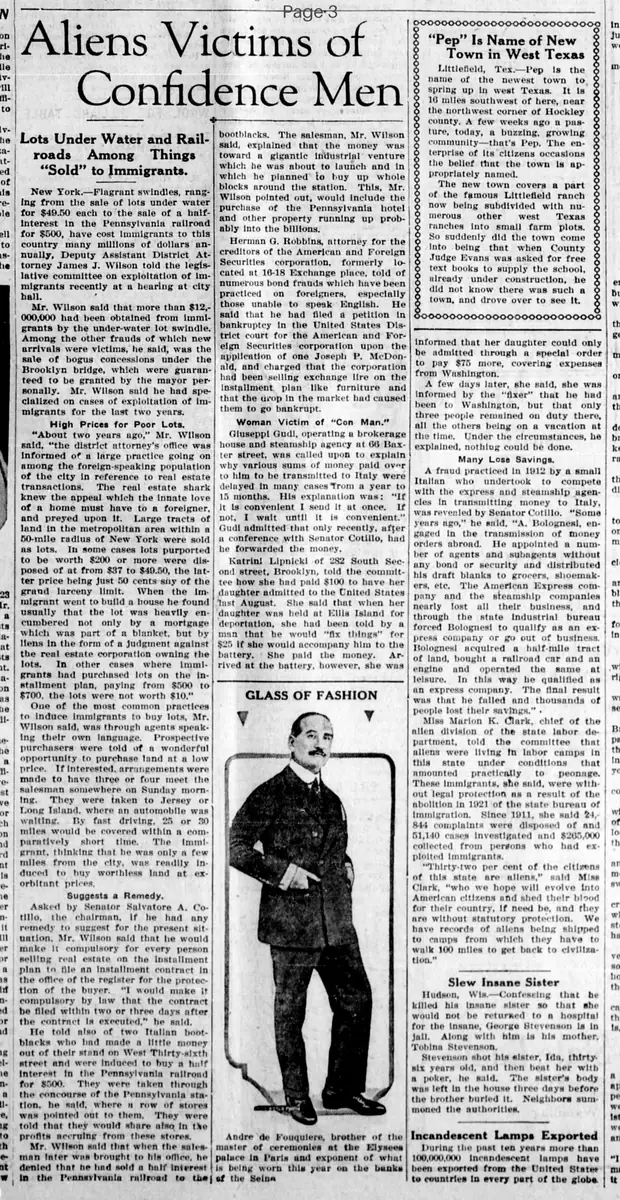
New York.—Flagrant swindles, ranging from the sale of lots under water for $49.50 each to the sale of a half-interest in the Pennsylvania railroad for $500, have cost immigrants to this country many millions of dollars annually, Deputy Assistant District Attorney James J. Wilson told the legislative committee on exploitation of immigrants recently at a hearing at city hall.
Mr. Wilson said that more than $12,000,000 had been obtained from immigrants by the under-water lot swindle.
Among the other frauds of which new arrivals were victims, he said, was the sale of bogus concessions under the Brooklyn bridge, which were guaranteed to be granted by the mayor personally. Mr. Wilson said he had specialized on cases of exploitation of immigrants for the last two years.
High Prices for Poor Lots.
"About two years ago," Mr. Wilson said, "the district attorney's office was informed of a large practice going on among the foreign-speaking population of the city in reference to real estate transactions. The real estate shark knew the appeal which the innate love of a home must have to a foreigner, and preyed upon it. Large tracts of land in the metropolitan area within a 50-mile radius of New York were sold as lots. In some cases lots purported to be worth $200 or more were disposed of at from $37 to $49.50, the latter price being just 50 cents shy of the grand larceny limit. When the immigrant went to build a house he found usually that the lot was heavily encumbered not only by a mortgage which was part of a blanket, but by liens in the form of a judgment against the real estate corporation owning the lots. In other cases where immigrants had purchased lots on the installment plan, paying from $500 to $700, the lots were not worth $10."
One of the most common practices to induce immigrants to buy lots, Mr. Wilson said, was through agents speaking their own language. Prospective purchasers were told of a wonderful opportunity to purchase land at a low price. If interested, arrangements were made to have three or four meet the salesman somewhere on Sunday morning.
They were taken to Jersey or Long Island, where an automobile was waiting.
By fast driving, 25 or 30 miles would be covered within a comparatively short time. The immigrant, thinking that he was only a few miles from the city, was readily induced to buy worthless land at exorbitant prices.
Suggests a Remedy.
Asked by Senator Salvatore A. Cotillo, the chairman, if he had any remedy to suggest for the present situation, Mr. Wilson said that he would make it compulsory for every person selling real estate on the installment plan to file an installment contract in the office of the register for the protection of the buyer. "I would make it compulsory by law that the contract be filed within two or three days after the contract is executed," he said.
He told also of two Italian bootblacks who had made a little money out of their stand on West Thirty-sixth street and were induced to buy a half interest in the Pennsylvania railroad for $500. They were taken through the concourse of the Pennsylvania station, he said, where a row of stores was pointed out to them. They were told that they would share also in the profits accruing from these stores.
Mr. Wilson said that when the salesman later was brought to his office, he denied that he had sold a half interest in the Pennsylvania railroad to the bootblacks. The salesman, Mr. Wilson said, explained that the money was toward a gigantic industrial venture which he was about to launch and in which he planned to buy up whole blocks around the station. This, Mr. Wilson pointed out, would include the purchase of the Pennsylvania hotel and other property running up probably into the billions.
Herman G. Robbins, attorney for the creditors of the American and Foreign Securities corporation, formerly located at 16-18 Exchange place, told of numerous bond frauds which have been practiced on foreigners, especially those unable to speak English. He said that he had filed a petition in bankruptcy in the United States District court for the American and Foreign Securities corporation upon the application of one Joseph P. McDonald, and charged that the corporation had been selling exchange lire on the installment plan like furniture and that the drop in the market had caused them to go bankrupt.
Woman Victim of "Con Man."
Giuseppi Gudi, operating a brokerage house and steamship agency at 66 Baxter street, was called upon to explain why various sums of money paid over to him to be transmitted to Italy were delayed in many cases from a year to 15 months. His explanation was:
"If it is convenient I send it at once. If not, I wait until it is convenient."
Gudi admitted that only recently, after a conference with Senator Cotillo, had he forwarded the money.
Katrin Lipnicki of 282 South Second street, Brooklyn, told the committee how she had paid $100 to have her daughter admitted to the United States last August. She said that when her daughter was held at Ellis Island for deportation, she had been told by a man that he would "fix things" for $25 if she would accompany him to the battery. She paid the money.
Arrived at the battery, however, she was informed that her daughter could only be admitted through a special order to pay $75 more, covering expenses from Washington.
A few days later, she said, she was informed by the "fixer" that he had been to Washington, but that only three people remained on duty there, all the others being on a vacation at the time. Under the circumstances, he explained, nothing could be done.
Many Lose Savings.
A fraud practiced in 1912 by a small Italian who undertook to compete with the express and steamship agencies in transmitting money to Italy, was revealed by Senator Cotillo. "Some years ago," he said, "A. Bolognesi, engaged in the transmission of money orders abroad. He appointed a number of agents and subagents without any bond or security and distributed his draft blanks to grocers, shoemakers, etc. The American Express company and the steamship companies nearly lost all their business, and through the state industrial bureau forced Bolognesi to qualify as an express company or go out of business.
Bolognesi acquired a half-mile tract of land, bought a railroad car and an engine and operated the same at leisure. In this way he qualified as an express company. The final result was that he failed and thousands of people lost their savings.
Miss Marion K. Clark, chief of the alien division of the state labor department, told the committee that aliens were living in labor camps in this state under conditions that amounted practically to peonage.
These immigrants, she said, were without legal protection as a result of the abolition in 1921 of the state bureau of immigration. Since 1911, she said 24,844 complaints were disposed of and 51,140 cases investigated and $265,000 collected from persons who had exploited immigrants.
"Thirty-two per cent of the citizens of this state are aliens," said Miss Clark, "who we hope will evolve into American citizens and shed their blood for their country, if need be, and they are without statutory protection. We have records of aliens being shipped to camps from which they have to walk 10 miles to get back to civilization."
What sub-type of article is it?
What themes does it cover?
What keywords are associated?
What entities or persons were involved?
Where did it happen?
Story Details
Key Persons
Location
New York
Story Details
Testimonies at a legislative hearing reveal widespread swindles on immigrants, including sales of underwater lots, fake railroad interests, delayed money transmissions, immigration fixes, bond frauds, and peonage in labor camps, costing millions and prompting calls for legal protections.