Thank you for visiting SNEWPapers!
Sign up free
The Elk County Advocate
Ridgway, Elk County, Pennsylvania
What is this article about?
Mr. A. B. Allen of New York reports successful cultivation of rhubarb, currants, and gooseberries in sandy and gravelly soils at Tom's River, N.J., using stable manure and mulching, refuting claims that such fruits cannot grow in poor sandyland.
Clipping
OCR Quality
Full Text
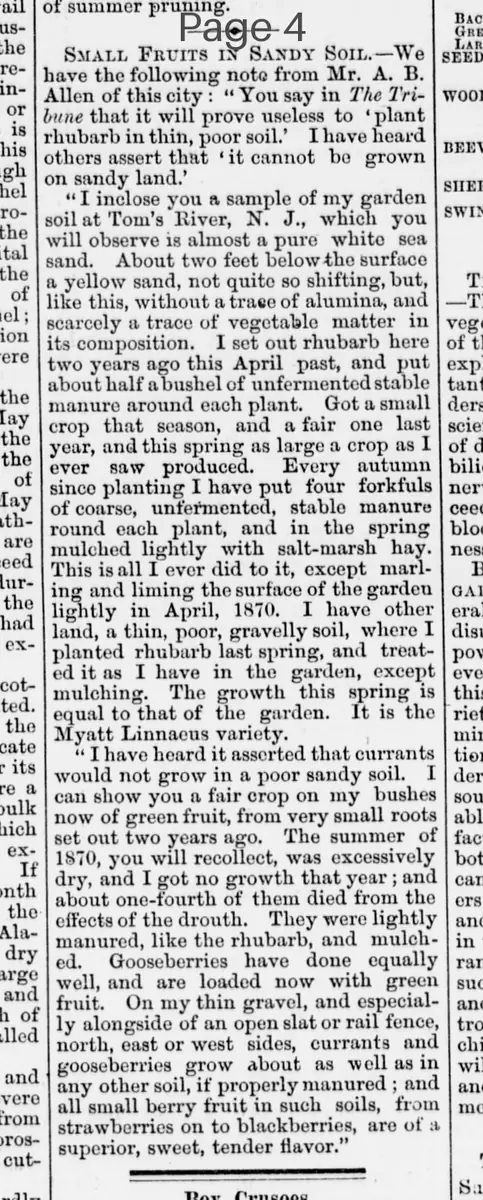
"I inclose you a sample of my garden soil at Tom's River, N. J., which you will observe is almost a pure white sea sand. About two feet below the surface a yellow sand, not quite so shifting, but, like this, without a trace of alumina, and scarcely a trace of vegetable matter in its composition. I set out rhubarb here two years ago this April past, and put about half a bushel of unfermented stable manure around each plant. Got a small crop that season, and a fair one last year, and this spring as large a crop as I ever saw produced. Every autumn since planting I have put four forkfuls of coarse, unfermented, stable manure round each plant, and in the spring mulched lightly with salt-marsh hay. This is all I ever did to it, except marling and liming the surface of the garden lightly in April, 1870. I have other land, a thin, poor, gravelly soil, where I planted rhubarb last spring, and treated it as I have in the garden, except mulching. The growth this spring is equal to that of the garden. It is the Myatt Linnaeus variety.
I have heard it asserted that currants would not grow in a poor sandy soil. I can show you a fair crop on my bushes now of green fruit, from very small roots set out two years ago. The summer of 1870, you will recollect, was excessively dry, and I got no growth that year; and about one-fourth of them died from the effects of the drouth. They were lightly manured, like the rhubarb, and mulched. Gooseberries have done equally well, and are loaded now with green fruit. On my thin gravel, and especially alongside of an open slat or rail fence, north, east or west sides, currants and gooseberries grow about as well as in any other soil, if properly manured; and all small berry fruit in such soils, from strawberries on to blackberries, are of a superior, sweet, tender flavor.'
What sub-type of article is it?
What themes does it cover?
What keywords are associated?
What entities or persons were involved?
Where did it happen?
Story Details
Key Persons
Location
Tom's River, N. J.
Event Date
Two Years Ago This April Past; Summer Of 1870; April, 1870; Last Spring
Story Details
Mr. A. B. Allen demonstrates successful growth of rhubarb (Myatt Linnaeus variety), currants, and gooseberries in nearly pure white sea sand and thin gravelly soil using unfermented stable manure, mulching with salt-marsh hay, and light marling and liming, producing large crops despite dry summers and common assertions to the contrary; small fruits in such soils yield superior flavor.