Thank you for visiting SNEWPapers!
Sign up free
Constitutional Whig
Richmond, Virginia
What is this article about?
A subscriber to the Compiler newspaper shares an extract from L.H. Girardin's 'Continuation of Burk's History of Virginia' detailing the 1781 Siege of Yorktown, the advance against York, key battles, and Cornwallis's surrender to Washington and French allies. The letter praises Girardin's eloquence and laments Richmond's loss of him as an educator.
Merged-components note: Continuation of the historical letter on the Siege of Yorktown.
Clipping
OCR Quality
Full Text
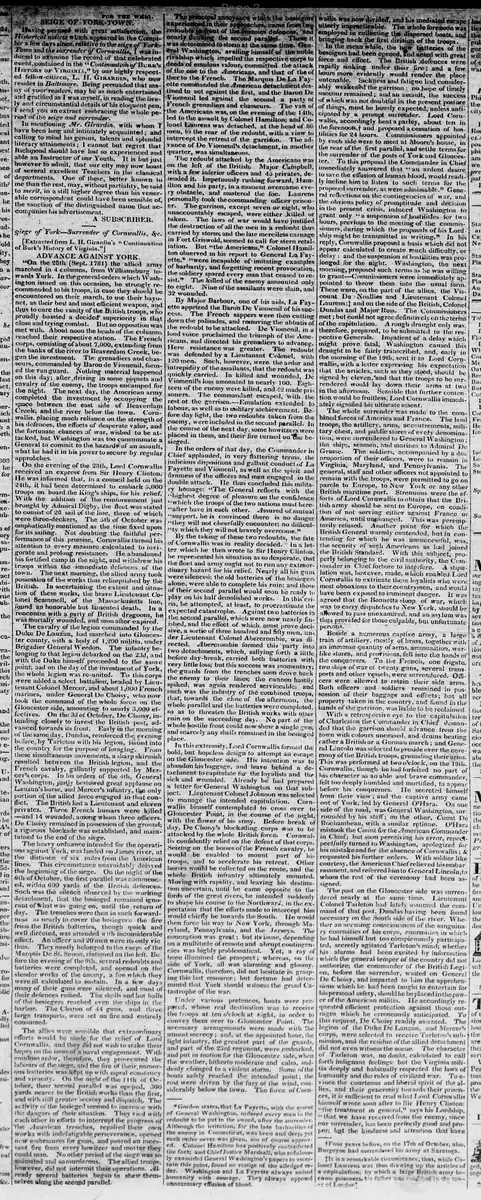
Having perused with great satisfaction, the Historical notices which appeared in the Compiler a few days since, relative to the siege of York-Town and the surrender of Cornwallis, I was induced to examine the record of that celebrated event, contained in the "Continuation of Burk's History of Virginia," by our highly respected fellow-citizen, L. H. Girardin, who now resides in Baltimore. Being persuaded that many of your readers, may be as much entertained and gratified as I was myself, in reading the lively and circumstantial details of his eloquent pen, I send you an extract embracing the whole period of the siege and surrender.
In mentioning Mr. Girardin, with whom I have been long and intimately acquainted; and calling to mind his genius, talents and splendid literary attainments; I cannot but regret that Richmond should have lost so experienced and able an Instructor of our Youth. "It is but just however to admit, that our city may now boast of several excellent Teachers in the classical departments. One of these, better known to me than the rest, may, without partiality, be said to merit, in a still higher degree than his venerable correspondent could have been sensible of, the sanction of the distinguished name that accompanies his advertisement."
A SUBSCRIBER.
siege of
York—Surrender of Cornwallis, &c.
[Extracted from L. H. Girardin's "Continuation of Burk's History of Virginia."]
ADVANCE AGAINST YORK.
"On the 28th (Sept. 1781) the allied army marched in 4 columns, from Williamsburg towards York. In the general orders which Washington issued on this occasion, he strongly recommended to his troops, in case they should be encountered on their march, to use their bayonet, as their best and most efficient weapon, and thus to cure the vanity of the British troops, who proudly boasted a decided superiority in that close and trying combat. But no opposition was met with. About noon the heads of the columns reached their respective station. The French corps, consisting of about 7,000, extending from the banks of the river to Beaverdam Creek, began the investment. The grenadiers and chasseurs, commanded by Baron de Viomenil, formed the van guard. Nothing material happened on this day; after driving in some piquets and cavalry of the enemy, the troops encamped for the night. The next day, the American army completed the investment by occupying the space between the east side of Beaverdam Creek, and the river below the town. Cornwallis, placing much reliance on the strength of his defences, the effects of desperate valor, and the fortunate chances of war, wished to be attacked, but Washington was too consummate a General to commit to the hazards of an assault, what he had it in his power to secure by regular approaches.
On the evening of the 28th, Lord Cornwallis received an express from Sir Henry Clinton. He was informed that, in a council held on the 24th, it had been determined to embark 5,000 troops on board the King's ships, for his relief. With the addition of the reinforcement just brought by Admiral Digby, the fleet was stated to consist of 26 sail of the line, three of which were three-deckers. The 5th of October was emphatically mentioned as the time fixed upon for its sailing. Not doubting the faithful performance of this promise, Cornwallis turned his attention to every measure calculated to invigorate and prolong resistance. He abandoned his fortified camp in the night, and withdrew his troops within the immediate defences of the town. The next morning, the allied army took possession of the works thus relinquished by the British. In ascertaining the extent and situation of these works, the brave Lieutenant Colonel Scammell, of the Massachusetts line, found an honorable but lamented death. In a rencontre with a party of British dragoons, he was mortally wounded, and soon after expired. The cavalry of the legion commanded by the Duke De Lauzun, had marched into Gloucester county, with a body of 1,200 militia, under Brigadier General Weedon. The infantry belonging to that legion debarked on the 23d, and with the Duke himself proceeded to the same point; and on the day of the investment of York, the whole legion was re-united. To this corps were added a select battalion, headed by Lieutenant Colonel Mercer, and about 1,000 French marines, under General De Choisy, who now took the command of the whole force on the Gloucester side, amounting to nearly 3,000 effectives. On the 3d of October, De Choisy, intending closely to invest the British post, advanced towards its front. Early in the morning of the same day, Dundas, reinforced the evening before by Tarleton with his legion, issued into the country for the purpose of foraging. From these simultaneous movements, a sharp skirmish resulted between the British legion, and the French cavalry, gallantly supported by Mercer's corps. In his orders of the 4th, General Washington, justly bestowed great applause on Lauzun's horse, and Mercer's infantry, the only portion of the allied force engaged in that conflict. The British lost a Lieutenant and eleven privates. Three French hussars were killed -and 14 wounded, among whom three officers. De Choisy remained in possession of the ground: a rigorous blockade was established, and maintained to the end of the siege.
The heavy ordnance intended for the operations against York, was landed on James river, at the distance of six miles from the American lines. This circumstance unavoidably delayed the beginning of the siege. On the night of the 6th of October, the first parallel was commenced, within 600 yards of the British defences. Such was the silence observed by the working detachment, that the besieged remained ignorant of what was going on, until the return of day. The trenches were then in such forwardness as nearly to cover the besiegers: the fire from the British batteries, though quick and well directed, was attended with inconsiderable effect. An officer and 20 men were its only victims. They mostly belonged to the corps of the Marquis De St. Simon, stationed on the left. Before the evening of the 9th, several redoubts and batteries were completed, and opened on the slender works of the enemy, a fire which they were ill calculated to sustain. In a few days many of their guns were silenced, and most of their defences ruined. The shells and hot balls of the besiegers reached even the ships in the harbor. The Charon of 44 guns, and three large transports, were set on fire and entirely consumed.
The allies were sensible that extraordinary efforts would be made for the relief of Lord Cornwallis, and they did not wish to stake their hopes on the issue of a naval engagement. With emulous ardor, therefore, they prosecuted the labours of the siege, and the fire of their numerous batteries was kept up with equal constancy and vivacity. On the night of the 11th of October, their second parallel was opened, 300 yards nearer to the British works than the first, and with still greater secrecy and dispatch. The activity of the besieged seemed to increase with the dangers of their situation. They vied with each other in efforts to interrupt the progress of The American trenches, repaired their own works with indefatigable perseverance, opened new embrasures for guns, and poured an incessant fire from every howitzer and mortar they could man. No other period of the siege was so animated and so murderous. The allied troops, however, did not intermit their operations. Already several batteries began to show themselves along the second parallel.
The principal annoyance which the besiegers experienced in their approaches, came from two redoubts in front of the enemies defences, and nearly flanking the second parallel. These it was determined to storm at the same time. General Washington, availing himself of the noble rivalry which impelled the respective corps to deeds of emulous valour, committed the attack of the one to the Americans, and that of the other to the French. The Marquis De Lafayette commanded the American detachment destined to act against the first, and the Baron De Viomenil led against the second a party of French grenadiers and chasseurs. The van of the Americans was, on the evening of the 14th, led to the assault by Colonel Hamilton; and Colonel Laurens was detached, at the head of 80 men, to the rear of the redoubt, with a view to intercept the retreat of the garrison. The advance of De Viomenil's detachment, in another quarter, was simultaneous.
The redoubt attacked by the Americans was on the left of the British. Major Campbell, with a few inferior officers and 45 privates, defended it. Impetuously rushing forward, Hamilton and his party, in a moment overcame every obstacle, and mastered the foe. Laurens personally took the commanding officer prisoner. The garrison, except seven or eight, who unaccountably escaped, were either killed or taken. The laws of war would have justified the destruction of all the men in a redoubt thus carried by storm; and the late merciless carnage in Fort Griswold, seemed to call for stern retaliation. But "the Americans," Colonel Hamilton observed in his report to General Lafayette.* "were incapable of imitating examples of barbarity, and forgetting recent provocation, the soldiery spared every man that ceased to resist." The killed of the enemy amounted only to eight. Nine of the assailants were slain, and 32 wounded.
By Major Barbour, one of his aids, Lafayette apprised the Baron De Viomenil of his success. The French sappers were then cutting down the palisades, and removing the abatis of the redoubt to be attacked. De Viomenil, in a loud voice proclaimed the triumph of the Americans, and directed his grenadiers to advance. Here resistance was greater. The redoubt was defended by a Lieutenant Colonel, with 120 men. Such, however, were the ardor and intrepidity of the assailants, that the redoubt was quickly carried. In killed and wounded, De Viomenil's loss amounted to nearly 100. Eighteen of the enemy were killed, and 42 made prisoners. The commandant escaped, with the rest of the garrison.--Emulation extended to labour, as well as to military achievement. Before day light, the two redoubts taken from the enemy, were included in the second parallel. In the course of the next day, some howitzers were placed in them, and their fire turned on the besieged.
In the orders of that day, the Commander in Chief applauded, in very flattering terms, the judicious dispositions and gallant conduct of Lafayette and Viomenil, as well as the spirit and firmness of the officers and men engaged in the double attack. He thus concluded this military homage: "The General reflects with the highest degree of pleasure on the confidence which the troops of the two nations must hereafter have in each other. Assured of mutual support, he is convinced there is no danger they will not cheerfully encounter; no difficulty which they will not bravely overcome."
By the taking of these two redoubts, the fate of Cornwallis was in reality decided. In a letter which he then wrote to Sir Henry Clinton, he represented his situation as so desperate, that the fleet and army ought not to run any extraordinary hazard for his relief. Nearly all his guns were silenced; the old batteries of the besiegers alone, were able to complete his ruin; and those of their second parallel would soon be ready to play on his half demolished works. In this crisis, he attempted, at least, to procrastinate the expected catastrophe. Against two batteries in the second parallel, which were now nearly finished, and the effect of which must prove decisive, a sortie of three hundred and fifty men, under Lieutenant Colonel Abercrombie, was directed. Abercrombie formed this party into two detachments, which, sallying forth a little before day-break, carried both batteries with very little loss; but this success was momentary; the guards from the trenches soon drove back the enemy to their lines; the cannon hastily spiked, was again rendered serviceable; and such was the industry of the combined troops, that, towards the close of the afternoon, the whole parallel and the batteries were completed, so as to threaten the British works with utter ruin on the succeeding day. No part of the whole hostile front could now show a single gun; and scarcely any shells remained in the besieged place.
In this extremity, Lord Cornwallis formed the bold, but hopeless design to attempt an escape on the Gloucester side. His intention was to abandon his baggage, and leave behind a detachment to capitulate for the loyalists and the sick and wounded. Already he had prepared a letter for General Washington on that subject. Lieutenant Colonel Johnson was selected to manage the intended capitulation. Cornwallis himself contemplated to cross over to Gloucester Point, in the course of the night, with the flower of his army. Before break of day. De Choisy's blockading corps was to be attacked by the whole British force. Cornwallis confidently relied on the defeat of that corps. Seizing on the horses of the French cavalry, he would be enabled to mount part of his troops, and to accelerate his retreat. Other horses would be collected on the route, and the whole British infantry ultimately mounted. Moving with rapidity, and leaving his destination uncertain, until he came opposite to the fords of the great rivers, he intended suddenly to shape his course to the Northward, in the expectation that the efforts made to intercept him would chiefly be towards the South. He would then force his way to New York, through Maryland, Pennsylvania, and the Jerseys. The conception was great; but its issue, depending on a multitude of remote and abrupt contingencies was highly problematical. Yet, a ray of hope illumined the prospect; whereas, on the side of York, all was alarming and gloomy. Cornwallis, therefore, did not hesitate in grasping this last resource; but fortune had determined that York should witness the grand Catastrophe of the war.
Under various pretences, boats were prepared, whose real destination was to receive the troops at ten o'clock at night, in order to convey them over to Gloucester Point. The necessary arrangements were made with the utmost secrecy ; and, at the appointed hour, the light infantry, the greatest part of the guards, and part of the 23rd regiment, were embarked. and put in motion for the Gloucester side, when the weather, hitherto moderate and calm, suddenly changed to a violent storm. Some of the boats safely reached the intended point; the rest were driven by the fury of the wind, considerably below the town. The force of Cornwallis was now divided, and his meditated escape utterly impracticable. The whole forenoon was employed in collecting the dispersed boats, and bringing back the first division of the troops. In the mean while, the new batteries of the besiegers had been opened, and acted with great force and effect. The British defences were rapidly sinking under their fire; and a few hours more evidently would render the place untenable. Sickness and fatigue had considerably weakened the garrison : no hope of timely succour remained; and an assault, the success of which was not doubtful in the present posture of things, must be hourly expected, unless anticipated by a prompt surrender. Lord Cornwallis, accordingly beat a parley, about ten in the forenoon, and proposed a cessation of hostilities for 24 hours. Commissioners appointed by each side were to meet at Moore's house, in the rear of the first parallel, and settle terms for the surrender of the posts of York and Gloucester. To this proposal the Commander in Chief immediately answered that "an ardent desire to save the effusion of human blood, would readily incline him to listen to such terms for the proposed surrender, as were admissible." General reflections on the contingencies of war, and the obvious policy of promptitude and decision in the present crisis, induced Washington to grant only "a suspension of hostilities for two hours, previous to the meeting of the commissioners, during which the proposals of his Lordship might be transmitted in writing." In his reply, Cornwallis proposed a basis which did not appear calculated to create much difficulty, or delay : and the suspension of hostilities was prolonged for the night. Washington, the next morning, proposed such terms as he was willing to grant--Commissioners were immediately appointed to throw them into the usual form. These were, on the part of the allies, the Viscount De Noailles and Lieutenant Colonel Laurens; and on the side of the British, Colonel Dundas and Major Ross. The Commissioners met ; but could not agree definitively on the terms of the capitulation. A rough draught only was, therefore, prepared, to be submitted to the respective Generals. Impatient of a delay which might prove fatal, Washington caused this draught to be fairly transcribed, and, early in the morning of the 19th, sent it to Lord Cornwallis, with a letter expressing his expectation that the articles, such as they stood, should be signed by eleven, 'and that the troops to be surrendered would lay down their arms at two in the afternoon. Sensible that further contention would be fruitless, Lord Cornwallis immediately signified his ultimate assent.
The whole surrender was made to the combined forces of America and France. The land troops, the artillery, arms, accoutrements, military chest, and public stores of every denomination, were surrendered to General Washington; the ships, seamen, and marines to Admiral De Grasse.
The soldiers, accompanied by a due proportion of their officers, were to remain in Virginia, Maryland, and Pennsylvania. The general, staff and other officers not appointed to remain with the troops, were permitted to go on parole to Europe, to New York or any other British maritime port. Strenuous were the efforts of Lord Cornwallis to obtain that the British army should be sent to Europe, on condition of not serving either against France or America, until exchanged. This was peremptorily refused. Another point on which the British General warmly contended, but in contending for which he was unsuccessful, was the security of such Americans as had joined the British Standard. With this subject, properly belonging to the civil authority, the Commander in Chief forbore to interfere. A stipulation was, however, made, which enabled Lord Cornwallis to extricate those loyalists who were most obnoxious to their countrymen, and would have been exposed to imminent danger. It was agreed that the Bonetta sloop of war, which was to carry dispatches to New York, should be allowed to pass unexamined, and an asylum was thus provided for those culpable, but unfortunate persons.
Beside a numerous captive army, a large train of artillery, mostly of brass, together with an immense quantity of arms, ammunition, warlike stores, and provisions, fell into the hands of the conquerors. To the French, one frigate, two ships of war of twenty guns, several transports and other vessels, were surrendered. Officers were allowed to retain their side arms. Both officers and soldiers remained in possession of their baggage and effects; but all property taken in the country, and found in the hands of the garrison, was liable to be reclaimed.
With a retrospective eye to the capitulation of Charleston the Commander in Chief demanded that the garrison should advance from the town with colours cased, and drums beating either a British or a German march; and General Lincoln was selected to preside over the ceremony of the British troops, grounding their arms. This was performed at two o'clock, on the 19th. Cornwallis, though he had forfeited no part of his character as an able and brave commander, felt too deeply humbled and mortified, to appear before his conquerors. He secreted himself from their view; and the captive army came out of York, led by General O'Hara. On one side of the road, was General Washington, surrounded by his staff; on the other, Count De Rochambeau, with a similar retinue. O'Hara mistook the Count for the American Commander in Chief; but soon perceiving his error, respectfully turned to Washington, apologized for his mistake and for the absence of Cornwallis; & requested his further orders. With soldier like courtesy, the American Chief relieved his embarrassment, and referred him to General Lincoln, to whom the rest of the ceremony had been assigned.
The post on the Gloucester side was surrendered nearly at the same time. Lieutenant Colonel Tarleton had lately assumed the command of that post, Dundas having been found necessary on the South side of the river. Whether an accusing consciousness of the sanguinary enormities of his corps, enormities in which he had himself but too conspicuously participated, secretly agitated Tarleton's mind; whether his alarms had been excited by information which the general temper of the country did not authorize; the commander of the British Legion, before the surrender, waited on General De Choisy, and imparted to him the apprehensions which he had been taught to entertain for his personal safety, should he be placed in the power of the American militia. He accordingly requested efficient protection against those outrages which he erroneously anticipated. To this request, De Choisy readily assented. The legion of the Duke De Lauzun, and Mercer's corps, were selected to receive Tarleton's submission, and the residue of the allied detachment did not even witness the scene. The character of Tarleton was, no doubt, calculated to call forth indignant feelings: but the Virginia militia deeply and habitually respected the laws of humanity and the rules of civilized war. To evince the courteous and liberal spirit of the allies, and their generosity towards their prisoners, it is sufficient to read what Lord Cornwallis himself wrote soon after to Sir Henry Clinton: "the treatment in general," says his Lordship, "that we have received from the enemy, since our surrender, has been perfectly good and proper; but the kindness and attention that have been shown to us by the French officers in particular, their delicate sensibility of our situation, their generous and pressing offers of money, both public and private, to any amount, has really gone beyond what I can possibly describe, and will, I hope, make an impression on the breast of every British officer, whenever the fortune of war should put any of them into our power."
Four years before, on the 17th of October, also, Burgoyne had surrendered his army at Saratoga.
It is a remarkable circumstance, that, while Colonel Laurens was thus drawing up the articles of a capitulation, by which a large British army became prisoners, his father was confined in the tower of London?
*Gordon states, that La Fayette, with the assent of General Washington, ordered every man in the redoubt to be put to the sword, after the surrender. Although the irritation, for the late barbarities of the enemy in Connecticut, was keen and deep, yet such order never was given, nor of course approved. Colonel Hamilton has positively contradicted the fact; and Chief Justice Marshall, who sedulously examined General Washington's papers to ascertain this point, found no vestige of the alleged order. Washington and La Fayette always united humanity with courage. They always opposed unnecessary effusion of blood.
What sub-type of article is it?
What themes does it cover?
What keywords are associated?
What entities or persons were involved?
Letter to Editor Details
Author
A Subscriber.
Main Argument
the letter shares a detailed historical extract from l.h. girardin's work on the siege of yorktown and cornwallis's surrender to inform and entertain readers, while praising girardin's talents and regretting his departure from richmond.
Notable Details