Thank you for visiting SNEWPapers!
Sign up free
Portland Gazette, And Maine Advertiser
Portland, Cumberland County, Maine
What is this article about?
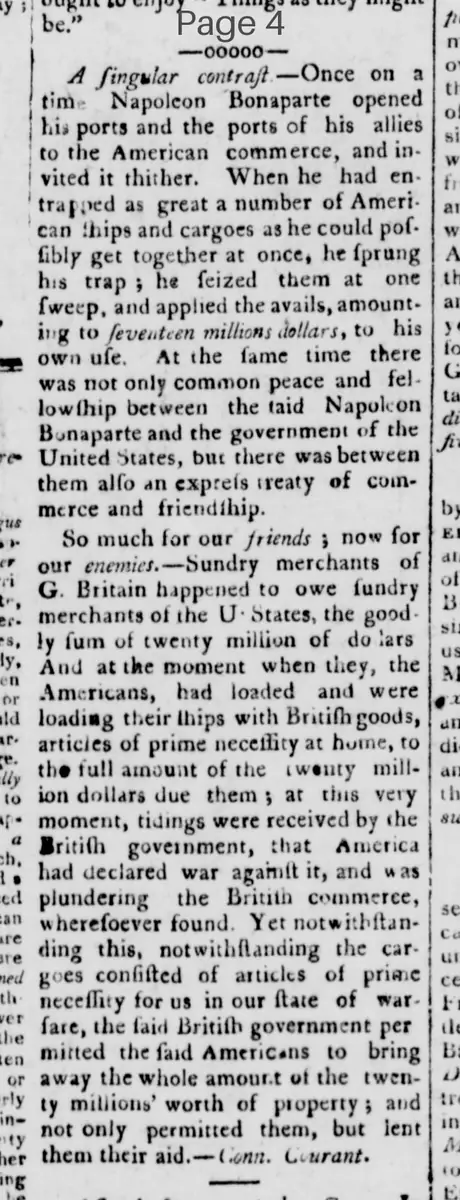
Historical commentary contrasts Napoleon's seizure of American ships and cargoes worth $17 million despite a US-France treaty of commerce and friendship, with Britain's permission for American merchants to export $20 million in essential goods after the US declaration of war.
Clipping
OCR Quality
Full Text
So much for our friends; now for our enemies.—Sundry merchants of G. Britain happened to owe sundry merchants of the U. States, the goodly sum of twenty million of dollars. And at the moment when they, the Americans, had loaded and were loading their ships with British goods, articles of prime necessity at home, to the full amount of the twenty million dollars due them; at this very moment, tidings were received by the British government, that America had declared war against it, and was plundering the British commerce, wheresoever found. Yet notwithstanding this, notwithstanding the cargoes consisted of articles of prime necessity for us in our state of warfare, the said British government permitted the said Americans to bring away the whole amount of the twenty millions' worth of property; and not only permitted them, but sent them their aid.—(Conn. Courant.)
What sub-type of article is it?
What keywords are associated?
What entities or persons were involved?
Foreign News Details
Key Persons
Outcome
napoleon seized american ships and cargoes worth seventeen million dollars; british government permitted americans to export twenty million dollars worth of goods despite war declaration.
Event Details
Napoleon Bonaparte invited American commerce to French and allied ports, then seized numerous ships and cargoes worth $17 million for his own use, despite peace and a treaty of commerce and friendship with the US. In contrast, British merchants owed US merchants $20 million; as Americans loaded ships with essential British goods to cover this debt, news arrived of US war declaration and plundering of British commerce, yet Britain allowed the full export and provided aid.