Thank you for visiting SNEWPapers!
Sign up free
Story
September 4, 1820
Alexandria Gazette & Daily Advertiser
Alexandria, Virginia
What is this article about?
A notice from the National Intelligencer describes figured stones, or Lusus Naturae, resembling trees, plants, animals, or houses, including one owned by Mr. Stoughton, Spanish Consul in Boston. These natural formations demonstrate nature's inscrutable power in fossils.
Clipping
OCR Quality
98%
Excellent
Full Text
From the National Intelligencer.
In the National intelligencer of August 25, is a notice of a singular Lusus Naturae in possession of Mr. Stoughton, the Consul of Spain at Boston.
Perhaps the following may be acceptable to your philosophic readers.
OF FIGURED STONES.
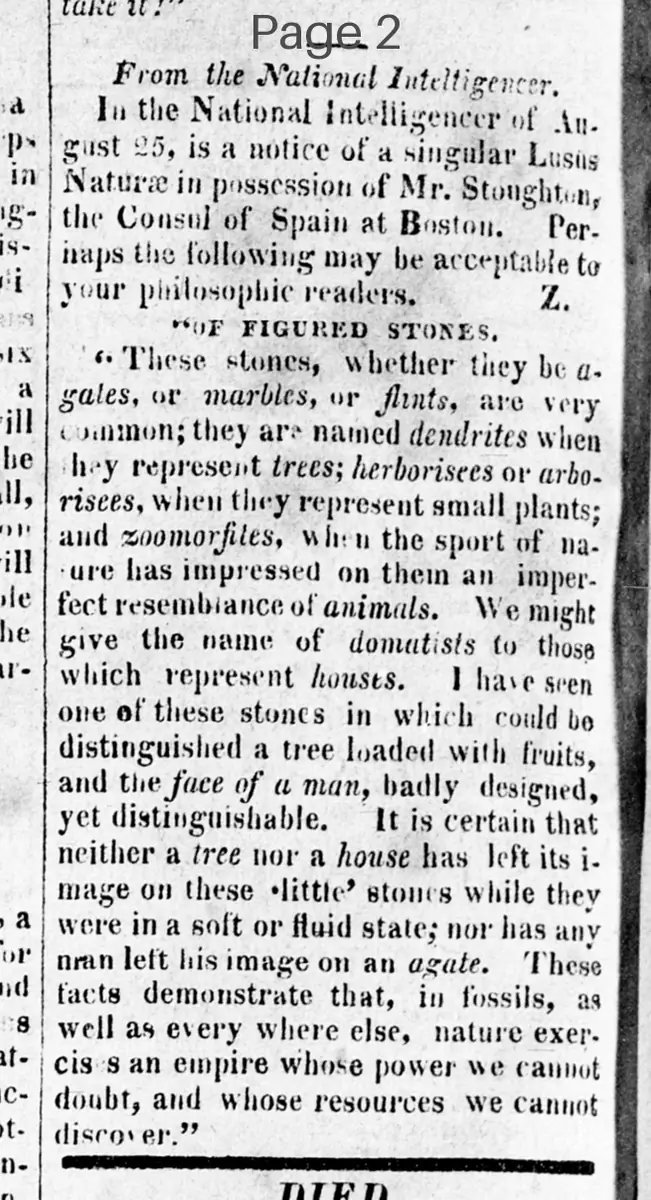
These stones, whether they be agates, or marbles, or flints, are very common; they are named dendrites when they represent trees; herborisees or arborisees, when they represent small plants: and zoomorphites, when the sport of nature has impressed on them an imperfect resemblance of animals. We might give the name of domists to those which represent houses. I have seen one of these stones in which could be distinguished a tree loaded with fruits, and the face of a man, badly designed, yet distinguishable. It is certain that neither a tree nor a house has left its image on these little stones while they were in a soft or fluid state; nor has any man left his image on an agate. These facts demonstrate that, in fossils, as well as every where else, nature exercises an empire whose power we cannot doubt, and whose resources we cannot discover.
In the National intelligencer of August 25, is a notice of a singular Lusus Naturae in possession of Mr. Stoughton, the Consul of Spain at Boston.
Perhaps the following may be acceptable to your philosophic readers.
OF FIGURED STONES.
These stones, whether they be agates, or marbles, or flints, are very common; they are named dendrites when they represent trees; herborisees or arborisees, when they represent small plants: and zoomorphites, when the sport of nature has impressed on them an imperfect resemblance of animals. We might give the name of domists to those which represent houses. I have seen one of these stones in which could be distinguished a tree loaded with fruits, and the face of a man, badly designed, yet distinguishable. It is certain that neither a tree nor a house has left its image on these little stones while they were in a soft or fluid state; nor has any man left his image on an agate. These facts demonstrate that, in fossils, as well as every where else, nature exercises an empire whose power we cannot doubt, and whose resources we cannot discover.
What sub-type of article is it?
Curiosity
Extraordinary Event
What themes does it cover?
Nature
What keywords are associated?
Figured Stones
Lusus Naturae
Dendrites
Zoomorphites
Natural Phenomena
Fossils
What entities or persons were involved?
Mr. Stoughton
Where did it happen?
Boston
Story Details
Key Persons
Mr. Stoughton
Location
Boston
Event Date
August 25
Story Details
Notice of singular figured stones resembling natural objects and figures, owned by Mr. Stoughton; explanation of types like dendrites and zoomorphites; observation of a stone with tree and man's face; conclusion on nature's power in forming such fossils without direct imprints.