Thank you for visiting SNEWPapers!
Sign up free
News Observer Chronicle
Raleigh, Wake County, North Carolina
What is this article about?
An interview with a friend of Col. Breckinridge details his defense strategy in the breach of promise trial brought by Miss Pollard, including impeaching her chastity, denying marriage promises, and affirming his political re-election prospects in Kentucky.
Clipping
OCR Quality
Full Text
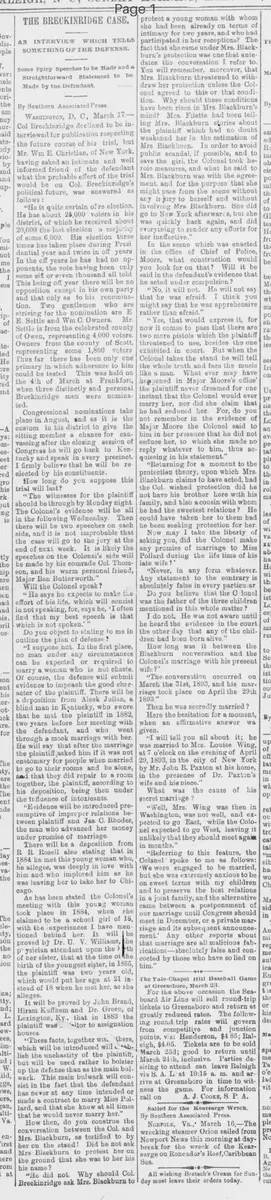
AN INTERVIEW WHICH TELLS SOMETHING OF THE DEFENSE.
Some Spicy Speeches to be Made and a Straightforward Statement to be Made by the Defendant
By Southern Associated Press
WASHINGTON, D. C., March 17—Col. Breckinridge declined to be interviewed for publication respecting the future course of his trial, but Mr. Wm. E. Christian, of New York, having asked an intimate and well informed friend of the defendant what the probable effect of the trial would be on Col. Breckinridge's political future, was answered as follows:
"He is quite certain of re-election. He has about 25,000 voters in his district, of which he received about 20,000 the last election—a majority of some 6,000. His election three times has taken place during Presidential year and twice in off years. In the off years he has had no opponents, the vote having been only some six or seven thousand all told. This being off year there will be no opposition except in his own party and that only as to his renomination. Two gentlemen who are striving for the nomination are E. E. Settle and Wm. C. Owens. Mr. Settle is from the celebrated county of Owen, representing 4,000 voters. Owens from the county of Scott, representing some 1,800 voters. Thus far there has been only one primary in which adherence to him could be tested. This was held on the 4th of March at Frankfort, when three distinctly and personal Breckinridge men were nominated. Congressional nominations take place in August, and as it is the custom in his district to give the sitting member a chance for canvassing after the closing session of Congress he will go back to Kentucky and speak in every precinct. I firmly believe that he will be re-elected by his constituents."
How long do you suppose this trial will last?
"The witnesses for the plaintiff should be through by Monday night. The Colonel's evidence will be all in the following Wednesday. Then there will be two speeches on each side, and it is not improbable that the case will go to the jury at the end of next week. It is likely the speeches on the Colonel's side will be made by his comrade Col. Thompson, and his warm personal friend, Major Ben Butterworth."
Will the Colonel speak?
"He says he expects to make the effort of his life, which will consist in not speaking, for, says he, 'I often find that my best speech is that which is not spoken.'"
Do you object to stating to me in outline the plan of defense?
"I suppose not. In the first place, no man under any circumstances can be expected or required to marry a woman who is not chaste. Of course, the defense will submit evidence to impeach the good character of the plaintiff. There will be a deposition from Aleck Julian, a blind man in Kentucky, who swore that he met the plaintiff in 1882, two years before her meeting with the defendant, and who went through a mock marriage with her. He will say that after the marriage the plaintiff asked him if it was not customary for people when married to go to their rooms and be alone, and that they did repair to a room together, the plaintiff, according to his deposition, being then under the influence of intoxicants.
"Evidence will be introduced presumptive of improper relations between plaintiff and Jas. C. Rhodes, the man who advanced her money under promise of marriage. There will be a deposition from R. R. Rosell also stating that in 1884 he met this young woman who, he alleges, was deeply in love with him and who implored him as he was leaving her to take her to Chicago.
As has been stated the Colonel's meeting with this young woman took place in 1884, when she claimed to be a school girl of 18, with the experiences I have mentioned behind her. It will be proved by Dr. U. V. Williams, the physician attendant upon the birth of her sister, that at the time of the birth of the youngest sister, in 1865, the plaintiff was two years old, which would put her age at 21 instead of 18 when he met her, as she alleges.
It will be proved by John Brand, Hiram Kuffham and Dr. Green, of Lexington, Ky., that in 1883 the plaintiff was a visitor to assignation houses.
"These facts, together with others, which will be introduced will establish the unchastity of the plaintiff, but will be used rather to bolster up the defense than as the main bulwark. This main bulwark will consist in the fact that the defendant has never at any time intended or made a contract to marry Miss Pollard, and that she knew at all times that he would never marry her."
How then, do you construe the conversation between the Col. and Mrs. Blackburn, as testified to by her on the stand! Did he not ask Mrs. Blackburn to protect her on the ground that she was to her his name?
"He did not. Why should Col. Breckinridge ask Mrs. Blackburn to protect a young woman with whom she had been already on terms of intimacy for two years, and who had participated in her receptions? The fact that she came under Mrs. Blackburn's protection was one that antedates the conversation I refer to. You will remember, moreover, that Mrs. Blackburn threatened to withdraw her protection unless the Colonel agreed to this or that condition. Why should these conditions have arisen in Mrs. Blackburn's mind? Mrs. Filette had been telling Mrs. Blackburn stories about the plaintiff which had no doubt weakened her in the estimation of Mrs. Blackburn. In order to avoid public scandal, if possible, and to save the girl, the Colonel took heroic measures, and what he said to Mrs. Blackburn was with the agreement, and for the purpose that she might pass from the scene without any injury to herself and without involving Mrs. Blackburn. She did go to New York afterwards, but she was quickly back again, and did everything to render any efforts for her ineffective."
In the scene which was enacted in the office of Chief of Police Moore, what construction would you look for on that? Will it be said in the defendant's evidence that he acted under compulsion?
"No, it will not. He will not say that he was afraid. I think you might say that he was apprehensive rather than afraid."
"Yes, that would express it, for now it comes to pass that there are two more pistols which the plaintiff threatened to use, besides the one exhibited in court. But when the Colonel takes the stand he will tell the whole truth and face the music like a man. Whatever may have happened in Major Moore's office the plaintiff never dreamed for one instant that the Colonel would ever marry her, nor did she claim that he had seduced her. For, do you not remember in the evidence of Major Moore the Colonel said to him in her presence that he did not seduce her, to which she made no reply whatever to him, thus acquiescing in his statement."
"Returning for a moment to the protection theory, upon which Mrs. Blackburn claims to have acted, had the Col. wished protection did he not have his brother here with his family, and also a cousin with whom he had the sweetest relations? He could have taken her to them had he been seeking protection for her.
Now may I take the liberty of asking you, did the Colonel make any promise of marriage to Miss Pollard during the life time of his late wife?"
"Never, in any form whatever. Any statement to the contrary is absolutely false in every particular."
Do you believe that the Colonel was the father of the three children mentioned in this whole matter?
I do not. He was not aware until he heard the evidence in the court the other day that any of the children had been born alive."
How long was it between the Blackburn conversation and the Colonel's marriage with his present wife?
"The conversation occurred on March the 31st, 1893, and his marriage took place on April the 29th 1893."
Then he was secretly married?
Here the hesitation for a moment when an affirmative answer was given.
"I will tell you all about it; he was married to Mrs. Louise Wing at 7 o'clock on the evening of April 29, 1893, in the city of New York by Mr. John R. Paxton at his home, in the presence of Dr. Paxton's wife and his niece."
What was the cause of his secret marriage?
"Well, Mrs. Wing was then in Washington, was not well, and expected to go East, while the Colonel expected to go West, leaving it unlikely that they should meet again in months."
"Referring to this feature, the Colonel spoke to me as follows:
'We were engaged to be married but she was extremely anxious to be on sweet terms with my children and to preserve the best relations in a joint family, and the alternative came between a postponement of our marriage until Congress should meet in December, or a private marriage and its subsequent announcement.' Any other reports about that marriage are all malicious fabrications—absolutely false and concocted by those who have so lied on him."
What sub-type of article is it?
What themes does it cover?
What keywords are associated?
What entities or persons were involved?
Where did it happen?
Story Details
Key Persons
Location
Washington, D. C.
Event Date
March 17
Story Details
An interview outlines Col. Breckinridge's defense in Miss Pollard's breach of promise suit, impeaching her chastity via depositions of prior relationships and mock marriage, denying any marriage contract, explaining conversations with Mrs. Blackburn as efforts to avoid scandal, and detailing his secret marriage to Mrs. Wing shortly after.