Thank you for visiting SNEWPapers!
Sign up free
The New York Journal, And Daily Patriotic Register
New York, New York County, New York
What is this article about?
In April 1788, the Parliament of Paris presented a remonstrance to King Louis XVI protesting his unconstitutional imposition of a tax law on November 19, 1787, despite parliamentary opposition. The 24-page document defended constitutional principles and public liberties. The King responded on April 17, rejecting their claims and asserting his absolute authority.
Merged-components note: These two components are a direct continuation: the remonstrance of the French Parliament followed immediately by the King's answer, forming a single coherent article on the topic.
Clipping
OCR Quality
Full Text
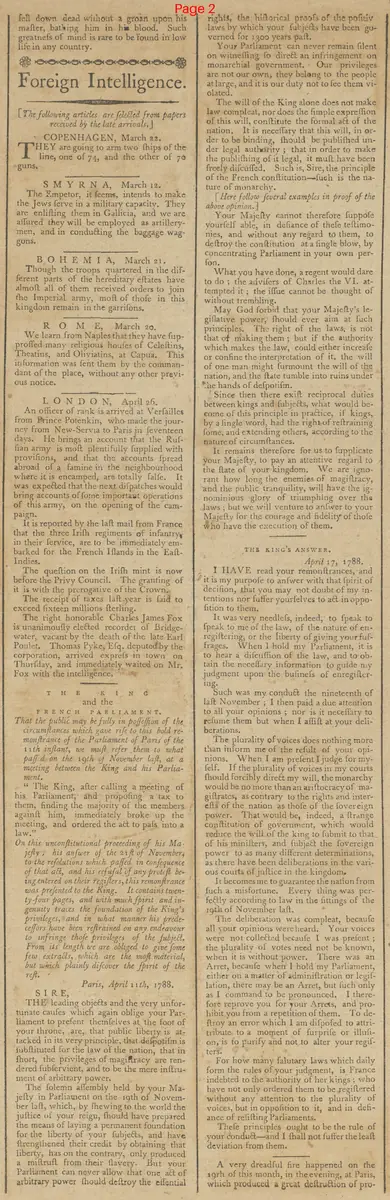
That the public may be fully in possession of the circumstances which gave rise to this bold remonstrance of the Parliament of Paris of the 11th instant, we must refer them to what passed on the 19th of November last, at a meeting between the King and his Parliament.
"The King, after calling a meeting of his Parliament, and proposing a tax to them, finding the majority of the members against him, immediately broke up the meeting, and ordered the act to pass into a law."
On this unconstitutional proceeding of his Majesty; his answer of the 21st of November to the resolutions which passed in consequence of that act, and his refusal of any protest being entered on their registers, this remonstrance was presented to the King. It contains twenty-four pages, and with much spirit and ingenuity traces the foundation of the King's privileges, and in what manner his predecessors have been restrained on any endeavour to infringe those privileges of the subject. From its length we are obliged to give some few extracts, which are the most material, but which plainly discover the spirit of the rest.
Paris, April 11th, 1788.
SIRE,
THE leading objects and the very unfortunate causes which again oblige your Parliament to present themselves at the foot of your throne, are, that public liberty is attacked in its very principle, that despotism is substituted for the law of the nation, that in short, the privileges of magistracy are rendered subservient, and to be the mere instrument of arbitrary power.
The solemn assembly held by your Majesty in Parliament on the 19th of November last, which, by shewing to the world the justice of your reign, should have prepared the means of laying a permanent foundation for the liberty of your subjects, and have strengthened their credit by obtaining that liberty, has on the contrary, only produced a mistrust from their slavery. But your Parliament can never allow that one act of arbitrary power should destroy the essential rights, the historical proofs of the positive laws by which your subjects have been governed for 1300 years past.
Your Parliament can never remain silent on witnessing so direct an infringement on monarchical government. Our privileges are not our own, they belong to the people at large, and it is our duty not to see them violated.
The will of the King alone does not make law complete, nor does the simple expression of this will, constitute the formal act of the nation. It is necessary that this will, in order to be binding, should be published under legal authority; that in order to make the publishing of it legal, it must have been freely discussed. Such is, Sire, the principle of the French constitution—such is the nature of monarchy.
Here follow several examples in proof of the above opinion.
Your Majesty cannot therefore suppose yourself able, in defiance of these testimonies, and without any regard to them, to destroy the constitution at a single blow, by concentrating Parliament in your own person.
What you have done, a regent would dare to do; the advisers of Charles the VI. attempted it; the issue cannot be thought of without trembling.
May God forbid that your Majesty's legislative power, should ever aim at such principles. The right of the laws, is not that of making them; but if the authority which makes the law, could either increase or confine the interpretation of it, the will of one man might surmount the will of the nation, and the state tumble into ruins under the hands of despotism.
Since then there exist reciprocal duties between kings and subjects, what would become of this principle in practice, if kings, by a single word, had the right of restraining some, and extending others, according to the nature of circumstances.
It remains therefore for us to supplicate your Majesty, to pay an attentive regard to the state of your kingdom. We are ignorant how long the enemies of magistracy, and the public tranquility, will have the ignominious glory of triumphing over the laws; but we will venture to answer to your Majesty for the courage and fidelity of those who have the execution of them.
THE KING'S ANSWER.
April 17, 1788.
I HAVE read your remonstrances, and it is my purpose to answer with that spirit of decision, that you may not doubt of my intentions nor suffer yourselves to act in opposition to them.
It was very needless, indeed, to speak to me of the law, of the nature of registering, or the liberty of giving your suffrages. When I hold my Parliament, it is to hear a discussion of the law, and to obtain the necessary information to guide my judgment upon the business of registering.
Such was my conduct the nineteenth of last November: I then paid a due attention to all your opinions; nor is it necessary to resume them but when I assist at your deliberations.
The plurality of voices does nothing more than inform me of the result of your opinions. When I am present I judge for myself. If the plurality of voices in my courts should forcibly direct my will, the monarchy would be no more than an aristocracy of magistrates, as contrary to the rights and interests of the nation as those of the sovereign power. That would be, indeed, a strange constitution of government, which would reduce the will of the king to submit to that of his ministers, and subject the sovereign power to as many different determinations, as there have been deliberations in the various courts of justice in the kingdom.
It becomes me to guarantee the nation from such a misfortune. Every thing was perfectly according to law in the sittings of the 19th of November last.
The deliberation was complete, because all your opinions were heard. Your voices were not collected because I was present; the plurality of votes need not be known, when it is without power. There was an Arret, because when I hold my Parliament, either on a matter of administration or legislation, there may be an Arret, but such only as I command to be pronounced. I therefore reprove you for your Arrets, and prohibit you from a repetition of them. To destroy an error which I am disposed to attribute to a moment of surprise or illusion, is to purify and not to alter your registers.
For how many salutary laws which daily form the rules of your judgment, is France indebted to the authority of her kings; who have not only ordered them to be registered without any attention to the plurality of voices, but in opposition to it, and in defiance of resisting Parliaments.
These principles ought to be the rule of your conduct—and I shall not suffer the least deviation from them.
What sub-type of article is it?
What keywords are associated?
What entities or persons were involved?
Where did it happen?
Foreign News Details
Primary Location
Paris
Event Date
April 11, 1788
Key Persons
Outcome
the king rejected the remonstrance on april 17, 1788, asserting his absolute authority and prohibiting further protests.
Event Details
The Parliament of Paris presented a 24-page remonstrance to the King on April 11, 1788, protesting his unconstitutional imposition of a tax law on November 19, 1787, despite majority opposition. The document argued against despotism, defended constitutional principles requiring free discussion and legal publication of laws, and cited historical precedents. The King responded by defending his actions as lawful and upholding monarchical power over parliamentary votes.