Thank you for visiting SNEWPapers!
Sign up free
The Butler County Press
Hamilton, Butler County, Ohio
What is this article about?
In Sweden, the Swedish Employers' Association and Swedish Federation of Labor signed a new agreement for automatic wage adjustments based on cost of living changes, similar to the U.S. 'Little Steel Formula.' Wages currently cover half the wartime rise from 169 to 240 index.
Clipping
OCR Quality
Full Text
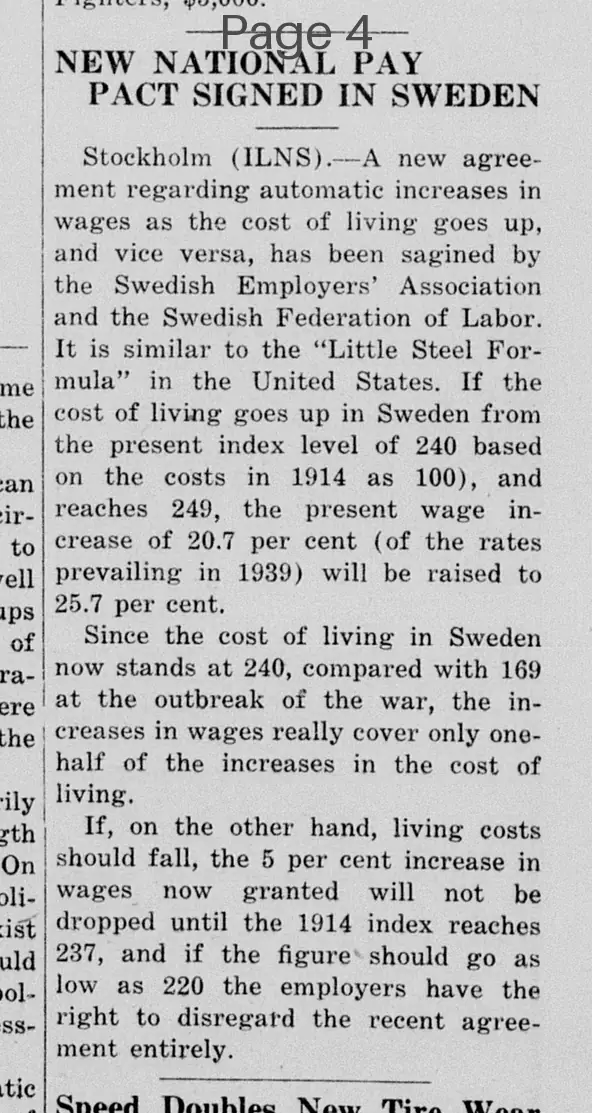
PACT SIGNED IN SWEDEN
Stockholm (ILNS).--A new agreement regarding automatic increases in wages as the cost of living goes up, and vice versa, has been signed by the Swedish Employers' Association and the Swedish Federation of Labor.
It is similar to the "Little Steel Formula" in the United States. If the cost of living goes up in Sweden from the present index level of 240 based on the costs in 1914 as 100), and reaches 249, the present wage increase of 20.7 per cent (of the rates prevailing in 1939) will be raised to 25.7 per cent.
Since the cost of living in Sweden now stands at 240, compared with 169 at the outbreak of the war, the increases in wages really cover only one-half of the increases in the cost of living.
If, on the other hand, living costs should fall, the 5 per cent increase in wages now granted will not be dropped until the 1914 index reaches 237, and if the figure should go as low as 220 the employers have the right to disregard the recent agreement entirely.
What sub-type of article is it?
What keywords are associated?
Where did it happen?
Foreign News Details
Primary Location
Sweden
Event Details
A new agreement for automatic wage increases tied to cost of living changes was signed by the Swedish Employers' Association and the Swedish Federation of Labor. It mirrors the U.S. 'Little Steel Formula.' Current cost of living index is 240 (1914=100), up from 169 at war's outbreak; wages increased 20.7% from 1939 levels, covering half the rise. If index hits 249, wage increase rises to 25.7%; if falls to 237, 5% wage boost holds; below 220, agreement can be disregarded.