Thank you for visiting SNEWPapers!
Sign up free
Norfolk Gazette And Publick Ledger
Norfolk, Virginia
What is this article about?
French colonial authorities in Guadaloupe issue a decree on March 21, 1808, opening all ports to French, allied, and neutral vessels carrying provisions, exempting them from duties to counter the US embargo's impact on supplies amid British blockade.
Clipping
OCR Quality
Full Text
The view taken of the dispositions of the embargo is somewhat laughable.
Balt. Amer.
In the name of the Emperor of the French.
LIBERTY of The Seas.
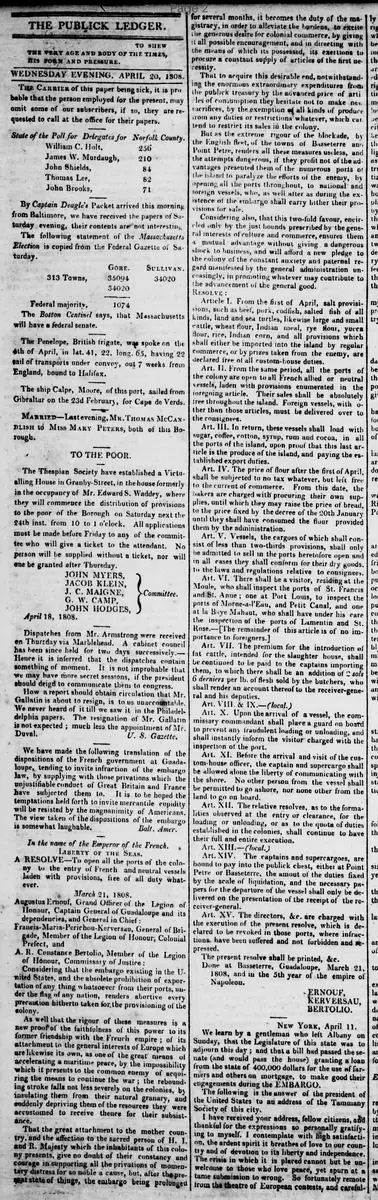
A RESOLVE—To open all the ports of the colony to the entry of French and neutral vessels laden with provisions, free of all duty whatever.
March 21, 1808.
Augustus Ernouf, Grand Officer of the Legion of Honour, Captain General of Guadaloupe and its dependencies, and General in Chief :
Francis-Maria-Perichou-Kerversau, General of Brigade, Member of the Legion of Honour, Colonial Prefect, and
A. R. Constance Bertolio, Member of the Legion of Honour, Commissary of Justice :
Considering that the embargo existing in the United States, and the absolute prohibition of exportation of any thing whatsoever from their ports, under the flag of any nation, renders abortive every precaution hitherto taken for the provisioning of the colony.
As well that the rigour of these measures is a new proof of the faithfulness of this power to its former friendship with the French empire ; of its attachment to the general interests of Europe which are likewise its own, as one of the great means of accelerating a maritime peace, by the impossibility which it presents to the common enemy of acquiring the means to continue the war; the rebounding stroke falls not less severely on the colonies, by insulating them from their natural granary, and suddenly depriving them of the resources they were accustomed to receive thence for their subsistence.
That the great attachment to the mother country, and the affection to the sacred person of H. I. and R. Majesty which the inhabitants of this colony present, give no doubt of their constancy and courage in supporting all the privations of momentary distress for so noble a cause, but, after the present state of things, the embargo being prolonged for several months. it becomes the duty of the magistracy, in order to alleviate the burdens, to excite the generous desire for colonial commerce, by giving it all possible encouragement, and in directing with the means of which its possessed, its exertions to procure a constant supply of articles of the first necessity.
That to acquire this desirable end, notwithstanding the enormous extraordinary expenditures from the publick treasury by the advanced price of articles of consumption they hesitate not to make new sacrifices, by the exemption of all kinds of produce from any duties or restrictions whatever, which can tend to restrict its sales in the colony.
But as the extreme rigour of the blockade, by the English fleet, of the towns of Basseterre and Point Petre, renders all these measures useless, and the attempts dangerous, if they profit not of the advantages presented them of the numerous ports of the island to paralyze the efforts of the enemy, by opening all the ports throughout, to national and foreign vessels, who, as well after as during the existence of the embargo shall carry hither their provisions for sale.
Considering also, that this two-fold favour, encircled only by the just bounds prescribed by the general interests of culture and commerce, ensures them a mutual advantage without giving a dangerous shock to business, and will afford a new pledge to the colony of the constant anxiety and paternal regard manifested by the general administration unceasingly, in promoting whatever may contribute to the advancement of the general good.
Resolve :
Article I. From the first of April, salt provisions, such as beef, pork, codfish, salted fish of all kinds, land and sea turtles, likewise large and small cattle, wheat flour, Indian meal, rye flour, yucca flour, rice, Indian corn, and all provisions which shall either be imported into the island by regular commerce, or by prizes taken from the enemy, are declared free of all custom-house duties.
Art. II. From the same period, all the ports of the colony are open to all French allied or neutral vessels, laden with provisions enumerated in the foregoing article. Their sales shall be absolutely free throughout the island. Foreign vessels, with other than those articles, must be delivered over to the consignees.
Art. III. In return, these vessels shall load with sugar, coffee, cotton, syrup, rum and cocoa, in all the ports of the island, upon proof that this last article is the produce of the island, and paying the established export duties.
Art. IV. The price of flour after the first of April, shall be subjected to no tax whatever, but left free to the current of commerce. From this date, the bakers are charged with procuring their own supplies, until which they may raise the price of bread, to the price fixed by the decree of the 20th January until they shall have consumed the flour provided them by the administration.
Art. V. Vessels, the cargoes of which shall consist of less than two-thirds provisions, shall only be admitted to sell in the ports heretofore open and in all cases they shall conform for their dry goods, to the laws and regulations relative to consignees.
Art. VI. There shall be a visitor, residing at the Moule, who shall inspect the ports of St. Francis and St. Anne; one at Port Louis, to inspect the ports of Morne-a-l'Eau, and Petit Canal, and one at la Baye Mahaut, who shall have under his care the inspection of the ports of Lamentin and St. Rose.—The remainder of this article is of no importance to foreigners.
Art. VII. The premium for the introduction of fat cattle, intended for the slaughter house, shall be continued to be paid to the captains importing them, to which there shall be an addition of 6 sols 6 derniers per lb. of flesh sold by the butchers, who shall render an account thereof to the receiver-general and his deputies.
Art. VIII. & IX.—(local.)
Art. X. Upon the arrival of a vessel, the commissary commandant shall place a guard on board to prevent any fraudulent loading or unloading, and shall instantly inform the visitor charged with the inspection of the port.
Art. XI. Before the arrival and visit of the custom-house officer, the captain and supercargo shall be allowed alone the liberty of communicating with the shore. No other person from the vessel shall be permitted to go ashore, nor none other from the land to go on board.
Art. XII. The relative resolves, as to the formalities observed at the entry or clearance, for the loading or unloading, or as to the quota of duties established in the colonies, shall continue to have their full and entire execution.
Art. XIII.—(local.)
Art. XIV. The captains and supercargoes, are bound to pay into the publick chest, either at Point Petre or Basseterre, the amount of the duties fixed by the scale of liquidation, and the necessary papers for the departure of the vessel shall only be delivered on the presentation of the receipt of the receiver-general.
Art. XV. The directors, &c. are charged with the execution of the present resolve, which is declared to be revoked in those ports, where infractions have been suffered and not forbidden and repressed.
The present resolve shall be printed, &c.
Done at Basseterre, Guadaloupe, March 21, 1808, and in the 5th year of the empire of Napoleon.
ERNOUF,
KERVERSAU,
BERTOLIO.
What sub-type of article is it?
What keywords are associated?
What entities or persons were involved?
Where did it happen?
Foreign News Details
Primary Location
Guadaloupe
Event Date
March 21, 1808
Key Persons
Outcome
all ports opened to french, allied, and neutral vessels laden with provisions, free of custom-house duties; sales free throughout the island; vessels to load colonial produce in return, paying export duties; flour prices freed from tax.
Event Details
French colonial officials in Guadaloupe issue a resolve to counter the US embargo and British blockade by opening all ports to import provisions duty-free, encouraging trade with neutral vessels to ensure subsistence supplies for the colony.