Thank you for visiting SNEWPapers!
Sign up free
Story
September 9, 1861
Cincinnati Daily Press
Cincinnati, Hamilton County, Ohio
What is this article about?
Article discusses Erythroxylon Coca plant from Bolivia and Peru, its narcotic invigorating properties allowing extreme endurance without food or sleep, historical uses by Peruvians and Spaniards, and Dr. Maisch's recommendation for army and navy surgeons to test it for preserving life and enhancing vigor in troops.
Clipping
OCR Quality
95%
Excellent
Full Text
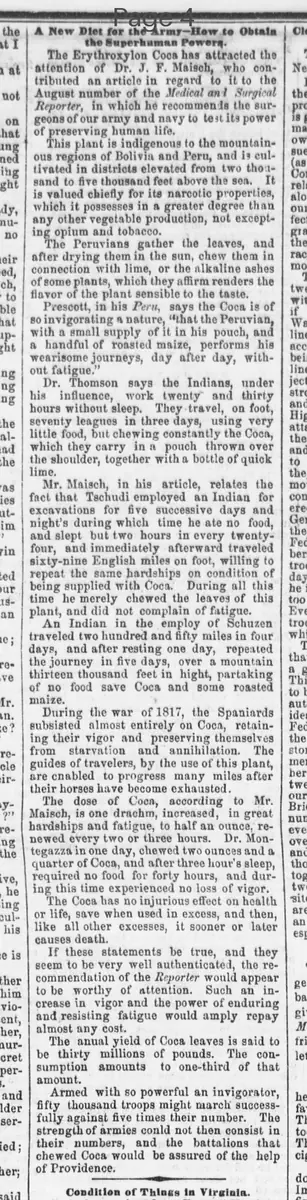
A New Diet for the Army—How to Obtain the Superhuman Powers,
The Erythroxylon Coca has attracted the attention of Dr. J. F. Maisch, who contributed an article in regard to it to the August number of the Medical and Surgical Reporter, in which he recommends the surgeons of our army and navy to test its power of preserving human life.
This plant is indigenous to the mountainous regions of Bolivia and Peru, and is cultivated in districts elevated from two thousand to five thousand feet above the sea. It is valued chiefly for its narcotic properties, which it possesses in a greater degree than any other vegetable production, not excepting opium and tobacco.
The Peruvians gather the leaves, and after drying them in the sun, chew them in connection with lime, or the alkaline ashes of some plants, which they affirm renders the flavor of the plant sensible to the taste.
Prescott, in his Peru, says the Coca is of so invigorating a nature, "that the Peruvian with a small supply of it in his pouch, and a handful of roasted maize, performs his wearisome journeys, day after day, without fatigue."
Dr. Thomson says the Indians, under his influence, work twenty and thirty hours without sleep. They travel, on foot, seventy leagues in three days, using very little food, but chewing constantly the Coca, which they carry in a pouch thrown over the shoulder, together with a bottle of quick lime.
Mr. Maisch, in his article, relates the fact that Tschudi employed an Indian for excavations for five successive days and nights, during which time he ate no food, and slept but two hours in every twenty-four, and immediately afterward traveled sixty-nine English miles on foot, willing to repeat the same hardships on condition of being supplied with Coca. During all this time he merely chewed the leaves of this plant, and did not complain of fatigue.
An Indian in the employ of Schuzen traveled two hundred and fifty miles in four days, and after resting one day, repeated the journey in five days, over a mountain thirteen thousand feet in height, partaking of no food save Coca and some roasted maize.
During the war of 1817, the Spaniards subsisted almost entirely on Coca, retaining their vigor and preserving themselves from starvation and annihilation. The guides of travelers, by the use of this plant, are enabled to progress many miles after their horses have become exhausted.
The dose of Coca, according to Mr. Maisch, is one drachm, increased, in great hardships and fatigue, to half an ounce, renewed every two or three hours. Dr. Montegazza in one day, chewed two ounces and a quarter of Coca, and after three hours' sleep, required no food for forty hours, and during this time experienced no loss of vigor.
The Coca has no injurious effect on health or life, save when used in excess, and then, like all other excesses, it sooner or later causes death.
If these statements be true, and they seem to be very well authenticated, the recommendation of the Reporter would appear to be worthy of attention. Such an increase in vigor and the power of enduring and resisting fatigue would amply repay almost any cost.
The annual yield of Coca leaves is said to be thirty millions of pounds. The consumption amounts to one-third of that amount.
Armed with so powerful an invigorant, fifty thousand troops might march successfully against five times their number. The strength of armies could not then consist in their numbers, and the battalions that chewed Coca would be assured of the help of Providence.
The Erythroxylon Coca has attracted the attention of Dr. J. F. Maisch, who contributed an article in regard to it to the August number of the Medical and Surgical Reporter, in which he recommends the surgeons of our army and navy to test its power of preserving human life.
This plant is indigenous to the mountainous regions of Bolivia and Peru, and is cultivated in districts elevated from two thousand to five thousand feet above the sea. It is valued chiefly for its narcotic properties, which it possesses in a greater degree than any other vegetable production, not excepting opium and tobacco.
The Peruvians gather the leaves, and after drying them in the sun, chew them in connection with lime, or the alkaline ashes of some plants, which they affirm renders the flavor of the plant sensible to the taste.
Prescott, in his Peru, says the Coca is of so invigorating a nature, "that the Peruvian with a small supply of it in his pouch, and a handful of roasted maize, performs his wearisome journeys, day after day, without fatigue."
Dr. Thomson says the Indians, under his influence, work twenty and thirty hours without sleep. They travel, on foot, seventy leagues in three days, using very little food, but chewing constantly the Coca, which they carry in a pouch thrown over the shoulder, together with a bottle of quick lime.
Mr. Maisch, in his article, relates the fact that Tschudi employed an Indian for excavations for five successive days and nights, during which time he ate no food, and slept but two hours in every twenty-four, and immediately afterward traveled sixty-nine English miles on foot, willing to repeat the same hardships on condition of being supplied with Coca. During all this time he merely chewed the leaves of this plant, and did not complain of fatigue.
An Indian in the employ of Schuzen traveled two hundred and fifty miles in four days, and after resting one day, repeated the journey in five days, over a mountain thirteen thousand feet in height, partaking of no food save Coca and some roasted maize.
During the war of 1817, the Spaniards subsisted almost entirely on Coca, retaining their vigor and preserving themselves from starvation and annihilation. The guides of travelers, by the use of this plant, are enabled to progress many miles after their horses have become exhausted.
The dose of Coca, according to Mr. Maisch, is one drachm, increased, in great hardships and fatigue, to half an ounce, renewed every two or three hours. Dr. Montegazza in one day, chewed two ounces and a quarter of Coca, and after three hours' sleep, required no food for forty hours, and during this time experienced no loss of vigor.
The Coca has no injurious effect on health or life, save when used in excess, and then, like all other excesses, it sooner or later causes death.
If these statements be true, and they seem to be very well authenticated, the recommendation of the Reporter would appear to be worthy of attention. Such an increase in vigor and the power of enduring and resisting fatigue would amply repay almost any cost.
The annual yield of Coca leaves is said to be thirty millions of pounds. The consumption amounts to one-third of that amount.
Armed with so powerful an invigorant, fifty thousand troops might march successfully against five times their number. The strength of armies could not then consist in their numbers, and the battalions that chewed Coca would be assured of the help of Providence.
What sub-type of article is it?
Medical Curiosity
Curiosity
Extraordinary Event
What themes does it cover?
Survival
Triumph
Exploration
What keywords are associated?
Coca Plant
Endurance
Army Diet
Peruvian Indians
Fatigue Resistance
Narcotic Properties
Historical Accounts
What entities or persons were involved?
Dr. J. F. Maisch
Prescott
Dr. Thomson
Tschudi
Schuzen
Dr. Montegazza
Where did it happen?
Mountainous Regions Of Bolivia And Peru
Story Details
Key Persons
Dr. J. F. Maisch
Prescott
Dr. Thomson
Tschudi
Schuzen
Dr. Montegazza
Location
Mountainous Regions Of Bolivia And Peru
Event Date
War Of 1817
Story Details
Dr. Maisch recommends Erythroxylon Coca for army use due to its ability to sustain humans through extreme fatigue and starvation, as demonstrated by Peruvian Indians and historical accounts of endurance feats without food or much sleep.