Thank you for visiting SNEWPapers!
Sign up free
Story
June 6, 1835
South Branch Intelligencer
Romney, Hampshire County, West Virginia
What is this article about?
Advice from 'Old Dutchess' on curing butter without water: work buttermilk out with salt in a wooden bowl, store overnight, repeat, then pack in jars with brine for long-term preservation up to a year, maintaining flavor.
Clipping
OCR Quality
98%
Excellent
Full Text
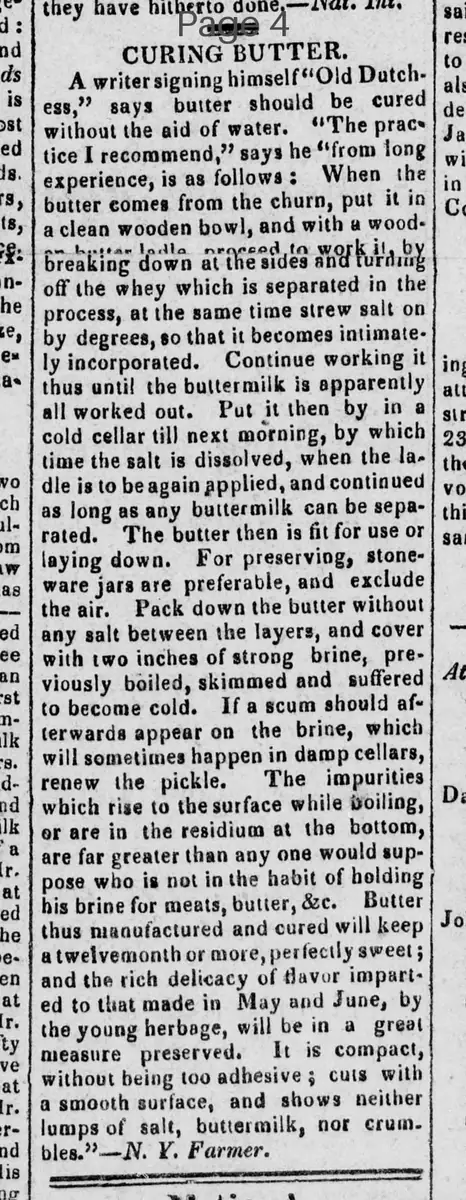
CURING BUTTER.
A writer signing himself "Old Dutchess," says butter should be cured without the aid of water. "The practice I recommend," says he "from long experience, is as follows: When the butter comes from the churn, put it in a clean wooden bowl, and with a wooden ladle proceed, to work it, by breaking down at the sides and turning off the whey which is separated in the process, at the same time strew salt on by degrees, so that it becomes intimately incorporated. Continue working it thus until the buttermilk is apparently all worked out. Put it then by in a cold cellar till next morning, by which time the salt is dissolved, when the ladle is to be again applied, and continued as long as any buttermilk can be separated. The butter then is fit for use or laying down. For preserving, stone-ware jars are preferable, and exclude the air. Pack down the butter without any salt between the layers, and cover with two inches of strong brine, previously boiled, skimmed and suffered to become cold. If a scum should afterwards appear on the brine, which will sometimes happen in damp cellars, renew the pickle. The impurities which rise to the surface while boiling, or are in the residium at the bottom, are far greater than any one would suppose who is not in the habit of holding his brine for meats, butter, &c. Butter thus manufactured and cured will keep a twelvemonth or more, perfectly sweet; and the rich delicacy of flavor imparted to that made in May and June, by the young herbage, will be in a great measure preserved. It is compact, without being too adhesive; cuts with a smooth surface, and shows neither lumps of salt, buttermilk, nor crumbles."--N. Y. Farmer.
A writer signing himself "Old Dutchess," says butter should be cured without the aid of water. "The practice I recommend," says he "from long experience, is as follows: When the butter comes from the churn, put it in a clean wooden bowl, and with a wooden ladle proceed, to work it, by breaking down at the sides and turning off the whey which is separated in the process, at the same time strew salt on by degrees, so that it becomes intimately incorporated. Continue working it thus until the buttermilk is apparently all worked out. Put it then by in a cold cellar till next morning, by which time the salt is dissolved, when the ladle is to be again applied, and continued as long as any buttermilk can be separated. The butter then is fit for use or laying down. For preserving, stone-ware jars are preferable, and exclude the air. Pack down the butter without any salt between the layers, and cover with two inches of strong brine, previously boiled, skimmed and suffered to become cold. If a scum should afterwards appear on the brine, which will sometimes happen in damp cellars, renew the pickle. The impurities which rise to the surface while boiling, or are in the residium at the bottom, are far greater than any one would suppose who is not in the habit of holding his brine for meats, butter, &c. Butter thus manufactured and cured will keep a twelvemonth or more, perfectly sweet; and the rich delicacy of flavor imparted to that made in May and June, by the young herbage, will be in a great measure preserved. It is compact, without being too adhesive; cuts with a smooth surface, and shows neither lumps of salt, buttermilk, nor crumbles."--N. Y. Farmer.
What sub-type of article is it?
Instructional Guide
Domestic Advice
What keywords are associated?
Butter Curing
Salt Incorporation
Brine Preservation
Wooden Bowl Method
Long Term Storage
What entities or persons were involved?
Old Dutchess
Story Details
Key Persons
Old Dutchess
Story Details
Method for curing butter: work out buttermilk with salt in wooden bowl, store overnight in cold cellar, repeat process, pack in stone-ware jars covered with boiled brine for preservation up to a year, maintaining flavor from May-June herbage.