Thank you for visiting SNEWPapers!
Sign up free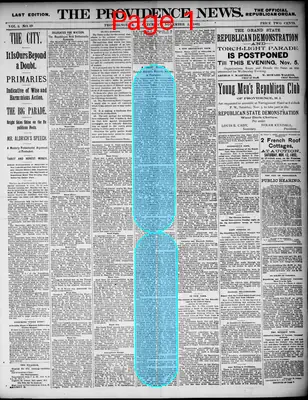
Story
November 5, 1892
The Providence News
Providence, Providence County, Rhode Island
What is this article about?
Report of a Republican rally in Pawtucket, RI, featuring Senator Nelson W. Aldrich's speech defending Republican economic policies, national banking, and protective tariffs, highlighting prosperity gains and critiquing Democrats. Other speakers praise protectionism. (218 characters)
Clipping

OCR Quality
98%
Excellent
Full Text
A GREAT SPEECH.
Senator Aldrich's Masterly Address at Pawtucket.
The Republicans of Pawtucket held a rally in Music hall last evening which was well attended. Among those present were President Tiepke of the State Republican League, Senator Fred W. Easton, Hezekiah Conant, Franklin P. Watson, Proctor C. Lull and Abraham Riley.
President Tiepke presided and presented the Hon. Nelson W. Aldrich, who spoke in substance as follows:
"Fellow Citizens:
The unparalleled advance in national prosperity and the improvement in the condition of the people of the United States constitute by far the most important benefits to humanity of the four centuries which have just closed. If the home life in Spain at the time Columbus set out on his voyage of discovery could be reproduced, we could show how great this advancement has been. There is not a home of a working man in Pawtucket but has more of the luxuries and comforts of life than the homes of the wealthiest of that time. But the most marvelous thing about this is the fact that the greatest advance has been made within the past generation. It is a generation of sound currency, of protective policy, of Republican rule, which has produced such important results.
"The advancement in national wealth during the last generation has been three times as great as in the generation preceding.
The increase of the average earnings of the workingman during the last generation has been greater than the amount received by them in the generation previous. It may seem that there is an apathy in the conduct of the present campaign, but I believe that there is a vein of deep thought running through it. The great prosperity of the country cannot fail to have its effect upon the mind. We are called upon as a people to decide whether we shall completely reverse the administration of our affairs or not.
"Let us see what is the nature of the changes which the Democrats propose to make.
The Democratic platform declares against the national banking system and advocates the return to the state banking system. We have now a system of banking unequaled by any system in the world. We have a national currency which is exchangeable all over the world. No nation has ever had a system which was equal to ours. The Democratic platform proposes to repeal the 10 per cent tax on state banks. Remove the tax and in forty-four States of the union we shall have forty-four different systems of banking and forty-four different kinds of banknotes.
The young men of the country have no conception of the condition of the country prior to 1860." The speaker then gave several instances of the trouble and inconvenience experienced under the old system. People could not pass the notes of the banks of one state in another state. One quarter of all the bank notes in circulation were counterfeits, and the loss was always sustained by the workingmen who were not acquainted with money.
Senator Aldrich then referred to the tariff question, and said: "No other community in the United States has so much at stake in this matter as the State of Rhode Island. No other people in the United States have received so many benefits from the tariff in proportion to their number.
"You remember the unbridled statements of the Democrats in 1890 in regard to the new tariff bill. They succeeded in so working upon the minds of the people of the country that they secured a majority in the House of Representatives. To-day, however, we know that our prosperity has been increased, and no other party would have the assurance to ask for support after having had their predictions proven so false.
"It has been said by our Democratic friends that notwithstanding the benefits of the protective tariff to the country the benefit was all received by the manufacturers, while the cost of living to the working men was greater. This is as far from being true as possible. Fortunately we know more to-day about this than we ever did before. It is proven conclusively that one hour of labor will buy more and go farther than in the period of 1860, the brightest period of the tariff reformer.
The wages to-day are twice as high as in any other country in the world. No man can dispute this and tell the truth. I don't suppose any man would say that any workingman in the United States was not better off than in any other country in the world. They say, it may be that wages are higher, but prices are higher. It is true that prices have been going down in the United States since 1861. Prices have not declined to the foreign level and they can do so in only one way, and we do not propose to have that.
"It is said that clothing is dearer here than in England. It costs the American manufacturer 25 cents a pound to clean wool, while it costs the Bradford manufacturers 10 cents. It costs him 50 cents a pound to make it into cloth, while it costs the English manufacturers 25 cents. Both use the same machinery. What are the elements of difference? The difference is the difference in the wages of the men in the two countries. We can reduce the cost of making the goods to the English level by reducing the wages to the same level, and that is the only way.
"What will be the effect upon the people of the United States if we reduce the cost of articles to the foreign level? It means a loss of more than $300,000,000 every year. It means a loss of prosperity. Wipe out of existence all the protected industries of Pawtucket, and what is your property worth here? What does it mean to you to have your earnings reduced to that standard of wages existing abroad. Are you willing to take away from your children the advantages which they now have and put them to work? The man who would incite the working men of this country to put the torch to the edifice of their prosperity is a man who commits a crime for which no punishment is too severe."
Mr. Aldrich's speech was a connected and forcible argument, and he was loudly applauded.
The Hon. Adin B. Capron was then introduced and spoke at length upon the application of the protective policy in this State.
President Tiepke then introduced ex-Gov. R. G. Richards of Ohio, who referred to Rhode Island and its industries as an example of the saying that "good things are done up in small packages."
He said the cause of protection was the cause of the country, and that country was always the most prosperous when the workingmen were the best paid. He said the only ones who were actually asking for free trade were the people south of the Mason and Dixon's line, with a few exceptions. That is the portion of the country that demands it. The entire wealth of the South does not aggregate more than $60,000,000 in money, and the workingmen of Rhode Island can give their clutch for that. [Applause.]
Senator Aldrich's Masterly Address at Pawtucket.
The Republicans of Pawtucket held a rally in Music hall last evening which was well attended. Among those present were President Tiepke of the State Republican League, Senator Fred W. Easton, Hezekiah Conant, Franklin P. Watson, Proctor C. Lull and Abraham Riley.
President Tiepke presided and presented the Hon. Nelson W. Aldrich, who spoke in substance as follows:
"Fellow Citizens:
The unparalleled advance in national prosperity and the improvement in the condition of the people of the United States constitute by far the most important benefits to humanity of the four centuries which have just closed. If the home life in Spain at the time Columbus set out on his voyage of discovery could be reproduced, we could show how great this advancement has been. There is not a home of a working man in Pawtucket but has more of the luxuries and comforts of life than the homes of the wealthiest of that time. But the most marvelous thing about this is the fact that the greatest advance has been made within the past generation. It is a generation of sound currency, of protective policy, of Republican rule, which has produced such important results.
"The advancement in national wealth during the last generation has been three times as great as in the generation preceding.
The increase of the average earnings of the workingman during the last generation has been greater than the amount received by them in the generation previous. It may seem that there is an apathy in the conduct of the present campaign, but I believe that there is a vein of deep thought running through it. The great prosperity of the country cannot fail to have its effect upon the mind. We are called upon as a people to decide whether we shall completely reverse the administration of our affairs or not.
"Let us see what is the nature of the changes which the Democrats propose to make.
The Democratic platform declares against the national banking system and advocates the return to the state banking system. We have now a system of banking unequaled by any system in the world. We have a national currency which is exchangeable all over the world. No nation has ever had a system which was equal to ours. The Democratic platform proposes to repeal the 10 per cent tax on state banks. Remove the tax and in forty-four States of the union we shall have forty-four different systems of banking and forty-four different kinds of banknotes.
The young men of the country have no conception of the condition of the country prior to 1860." The speaker then gave several instances of the trouble and inconvenience experienced under the old system. People could not pass the notes of the banks of one state in another state. One quarter of all the bank notes in circulation were counterfeits, and the loss was always sustained by the workingmen who were not acquainted with money.
Senator Aldrich then referred to the tariff question, and said: "No other community in the United States has so much at stake in this matter as the State of Rhode Island. No other people in the United States have received so many benefits from the tariff in proportion to their number.
"You remember the unbridled statements of the Democrats in 1890 in regard to the new tariff bill. They succeeded in so working upon the minds of the people of the country that they secured a majority in the House of Representatives. To-day, however, we know that our prosperity has been increased, and no other party would have the assurance to ask for support after having had their predictions proven so false.
"It has been said by our Democratic friends that notwithstanding the benefits of the protective tariff to the country the benefit was all received by the manufacturers, while the cost of living to the working men was greater. This is as far from being true as possible. Fortunately we know more to-day about this than we ever did before. It is proven conclusively that one hour of labor will buy more and go farther than in the period of 1860, the brightest period of the tariff reformer.
The wages to-day are twice as high as in any other country in the world. No man can dispute this and tell the truth. I don't suppose any man would say that any workingman in the United States was not better off than in any other country in the world. They say, it may be that wages are higher, but prices are higher. It is true that prices have been going down in the United States since 1861. Prices have not declined to the foreign level and they can do so in only one way, and we do not propose to have that.
"It is said that clothing is dearer here than in England. It costs the American manufacturer 25 cents a pound to clean wool, while it costs the Bradford manufacturers 10 cents. It costs him 50 cents a pound to make it into cloth, while it costs the English manufacturers 25 cents. Both use the same machinery. What are the elements of difference? The difference is the difference in the wages of the men in the two countries. We can reduce the cost of making the goods to the English level by reducing the wages to the same level, and that is the only way.
"What will be the effect upon the people of the United States if we reduce the cost of articles to the foreign level? It means a loss of more than $300,000,000 every year. It means a loss of prosperity. Wipe out of existence all the protected industries of Pawtucket, and what is your property worth here? What does it mean to you to have your earnings reduced to that standard of wages existing abroad. Are you willing to take away from your children the advantages which they now have and put them to work? The man who would incite the working men of this country to put the torch to the edifice of their prosperity is a man who commits a crime for which no punishment is too severe."
Mr. Aldrich's speech was a connected and forcible argument, and he was loudly applauded.
The Hon. Adin B. Capron was then introduced and spoke at length upon the application of the protective policy in this State.
President Tiepke then introduced ex-Gov. R. G. Richards of Ohio, who referred to Rhode Island and its industries as an example of the saying that "good things are done up in small packages."
He said the cause of protection was the cause of the country, and that country was always the most prosperous when the workingmen were the best paid. He said the only ones who were actually asking for free trade were the people south of the Mason and Dixon's line, with a few exceptions. That is the portion of the country that demands it. The entire wealth of the South does not aggregate more than $60,000,000 in money, and the workingmen of Rhode Island can give their clutch for that. [Applause.]
What sub-type of article is it?
Historical Event
What themes does it cover?
Triumph
Moral Virtue
What keywords are associated?
Republican Rally
Senator Aldrich
Protective Tariff
National Banking
Economic Prosperity
Political Speech
What entities or persons were involved?
Nelson W. Aldrich
Tiepke
Fred W. Easton
Hezekiah Conant
Franklin P. Watson
Proctor C. Lull
Abraham Riley
Adin B. Capron
R. G. Richards
Where did it happen?
Pawtucket, Rhode Island
Story Details
Key Persons
Nelson W. Aldrich
Tiepke
Fred W. Easton
Hezekiah Conant
Franklin P. Watson
Proctor C. Lull
Abraham Riley
Adin B. Capron
R. G. Richards
Location
Pawtucket, Rhode Island
Story Details
Republicans hold rally in Pawtucket; Senator Aldrich delivers speech praising Republican policies for national prosperity, defending national banking system and protective tariff against Democratic proposals; other speakers follow on protectionism.