Thank you for visiting SNEWPapers!
Sign up free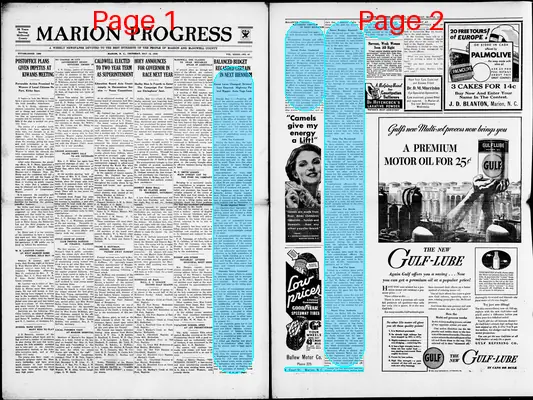
Marion Progress
Marion, Mcdowell County, North Carolina
What is this article about?
The 1935 North Carolina legislature adjourned after passing over 100 bills, including sales tax continuation without food exemptions, mandatory drivers' licenses, expanded highway patrol, reduced auto tags, uniform game laws, and constitutional amendments. Appropriations rose with salary increases; balanced budget expected.
Merged-components note: This is a continuation of the story from page 1 to page 2, as indicated by '(Continued on next page)' and '(Continued from first page)' in the text.
Clippings

1 of 2
OCR Quality
Full Text
Game Laws Changed. Drivers' Law Enacted. Highway Patrol Bigger. Auto Tags Less.
Raleigh May 11.--Presiding officers of the general assembly this afternoon were completing the signing of more than 100 bills written into law yesterday and today by the legislators before the 1935 session adjourned sine die.
Long conferences on liquor legislation in the office of Governor Ehringhaus resulted in a deadlock between wets and drys but the solons had written into law measures to call referendums in 17 counties and two townships of an 18th on the question of establishing county control liquor systems.
Sales Tax Continued
During the hectic days, the legislature voted to continue the present 3% retail sales tax for another two years and eliminated all food exemptions which are now allowed. A supplementary bill was later passed to restore the exemption to milk but every other item sold in the state will be taxed. There were few other major changes in taxes, though a brand new levy was provided for chain filling stations.
Appropriations for every state service were boosted above those of two years ago and allotments for personal service were raised enough to allow 20 per cent salary increases for 1935-36 and 25 per cent for 1936-1937 if revenues will permit.
The legislature wrote into law a statewide drivers license requirement. Drivers of all motor vehicles must be licensed and those with one year of experience may secure their cards without cost by November 1.
Double Highway Patrol
As supplementary legislation the solons doubled the size of the state highway patrol and created a division of highway safety in the state department of revenue.
The cost of automobile license tags next year will be 27 per cent below the present scale, the legislators decided, with the rate based on 40 cents per hundredweight instead of 55 cents.
A statewide schoolbook rental system was authorized by the legislators and proponents of the measure said the inauguration of the system would save hundreds of thousands of dollars yearly to school patrons
A new tubercular sanitarium was authorized to be built somewhere in western North Carolina at a cost of $250,000, for which bonds will be issued, and bonds for permanent improvements at the three insane hospitals and Caswell training school were also voted.
Absentee Voting Continued
There were many efforts to repeal the absentee ballot law or strengthen it on a statewide basis but all were rejected. Many counties got passed local laws on the voting question.
A number of constitutional amendments were approved by the solons and will be submitted to the voters in 1936. They include: A proposal to permit classification of property for taxation; a proposal to increase the membership of the Supreme Court from five to seven; a proposal to exempt homesteads up to $1,000 from taxation; a proposal to adopt a new formula for limiting state debt; and a proposal to allow taxes up to 10% on incomes instead of the present 6%.
A new statewide game law to put every county fully under the state game and inland fisheries commission in control of hunting, fishing, etc., was enacted, as were measures to aid in establishing state and national parks and the like.
A lethal gas chamber was provided to be substituted after July 1 for the electric chair in legal executions.
A number of measures sent to the state from the national government in Washington became law. They provide for full state participation in the federal public works program.
The lawmakers also wrote into law several bills aimed at clearing the way for provision of federal funds (Continued on next page)
BALANCED BUDGET
Regarded Certain
IN NEXT BIENNIUM
(Continued from first page)
for port development at Morehead City.
Occupational diseases and sufferers from them were placed under the terms and benefits of the workmen's compensation act.
Special Probes Conducted
Charges of mistreatment of prisoners in the highway penal division and of mistreatment of patients and employes of the state hospital for insane at Morganton caused special legislative investigations. Five former officials of a convict camp in Mecklenburg, are now under indictment on charges of mistreatment of two negro prisoners as the result of court, legislative and welfare investigations.
More money was appropriated to the Morganton hospital in an effort to remedy things there.
There were many bitter fights during the session, especially those between administrationists and the McDonald-Lumpkin bloc in the house over taxation matters and the senate battles between administration men and anti-sales taxers. But, as is the custom, members of both divisions got together this week to sing praises of each other and declare that legislative fights were things of the past for another two years.
Better Business Expected
For the second year the budget balance is more dependent upon business conditions, since appropriations are increased by approximately $1,750,000 but the tax levies remain at the same rate.
A. J. Maxwell, commissioner of revenue, estimates that a 6% increase in business during 1936-1937 over his estimates for 1935-1936 will provide a balanced budget for the biennium without cutting allotments to state departments and institutions.
Maxwell estimates the revenue bill will yield $31,157,000 in taxes the first year but even this estimate is dependent upon continuance of present business conditions since many of the levies are upon gross or net earnings of corporations and individuals.
Breaking down the revenue bill into sections, Maxwell estimates that inheritance taxes will yield $750,000; business license taxes "schedule B" $2,400,000; franchise taxes $7,000,000; income taxes $7,590,000; 3% sales tax with no food exemptions $9,800,000; beer taxes $400,000; non-tax revenues $1,042,000; balance in treasury July 1 $200,000; collections of delinquent 1931 ad valorem taxes $175,000; gasoline diversions $1,800,000.
There were no rate changes in the inheritance tax schedules but license taxes were revised in some instances with hotels and restaurants getting a lower base rate when the general sales tax was levied on meals.
Sales Tax Re-enacted
The sales tax, bone of contention for three sessions, was re-enacted at three per cent and the present exemption of nine basic articles of food was eliminated. Striking out of the food exemptions is estimated by Maxwell to increase the sales tax yield by $1,500,000 annually.
The estimate of beer tax yields was boosted $100,000 annually when the legal alcoholic content of the beverage was raised from 3.2 to 5%.
Income tax rates remain as at present but the exemption for charitable and other contributions was lowered from 15% to 10% of net incomes.
Constitutional officers-the secretary of state, superintendent of public instruction, state auditor and state treasurer-will in 1937 receive their first raise since 1921, the constitution providing that new salary scales may not become effective in the midst of a term. All will receive $6,000 annually instead of the present $4,500 stipend.
Governor Can Decide
A similar salary was voted to the commissioner of public utilities for each year of the 1935-37 biennium and the commissioner of paroles will be allowed a maximum of $4,500, at the discretion of the governor, instead of the present $3,000 salary.
Salaries of solicitors were jumped back to the pre-1933 level of $4,500 per annum as were those of the adjutant general and the commissioners of labor, agriculture, and insurance. During the past two years the solicitors have received $3,900 annually and the commissioners $3,825.
No increases were voted the other two constitutional officers, the governor and the attorney general, who had their pay raised to $11,100 and $7,500, respectively, by legislative act in 1929.
New Deal For Game
Setting up a uniform game policy out of a patchwork of statutes, a "new deal" for wildlife is promised.
The measure, introduced by Senator Carl W. Bailey of Washington, codified the numerous local regulations, making unnecessary many of the wildlife statutes that have been passed since the game law was first enacted in 1927.
Game wardens, under the new bill will henceforth be known as "game protectors." New appointees to these positions must have a knowledge of wildlife and of the statutes for protecting game.
Board Gives Authority
Under the Bailey bill, the board of conservation and development is given sufficiently broad authority to meet any emergency requiring a change in seasons or bag limits, either within or outside the dates and bag limits set down in the law.
Formerly, authority of the board in these matters extended only within the limits written into the law.
Another change in the game statutes eliminates the old zone system of regulating seasons over which considerable controversy has developed in the past.
Strenuous efforts to abolish the statewide absentee ballot law during the legislature just closed met with defeat on every hand but numerous counties eliminated absentee voting in the election of local officers.
Except for the provision that candidates of independent parties must secure the signature of 25 per cent instead of the present 10 per cent of the state's voters in the preceding election in order to get their names printed on the ballots, there was little change in the statewide election laws.
What sub-type of article is it?
What themes does it cover?
What keywords are associated?
What entities or persons were involved?
Where did it happen?
Story Details
Key Persons
Location
Raleigh, North Carolina
Event Date
May 11, 1935
Story Details
The 1935 North Carolina General Assembly session concluded with over 100 bills passed, including continuation of the 3% sales tax without most food exemptions, drivers' license requirements, doubled highway patrol, reduced auto tags, statewide schoolbook rental, new tubercular sanitarium, constitutional amendments for 1936 vote, uniform game law, lethal gas chamber for executions, and participation in federal programs. Liquor referendums were set in 17 counties and two townships. Appropriations increased with salary raises. Investigations addressed prisoner and patient mistreatment. A balanced budget was projected based on business growth estimates.