Thank you for visiting SNEWPapers!
Sign up free
Literary
November 29, 1822
The Virginian
Lynchburg, Virginia
What is this article about?
In 'The Miscellanist No. VIII,' Old Squire recounts to Xantippe a tragic tale of a pure-hearted maiden who dies from grief after her lover's death and her avaricious father's prohibition of their marriage. He reflects on broken hearts, shares a similar ongoing case near Lynchburg, and decries parental tyranny. Civilis appends a supportive note.
Clipping
OCR Quality
95%
Excellent
Full Text
FOR THE VIRGINIAN.
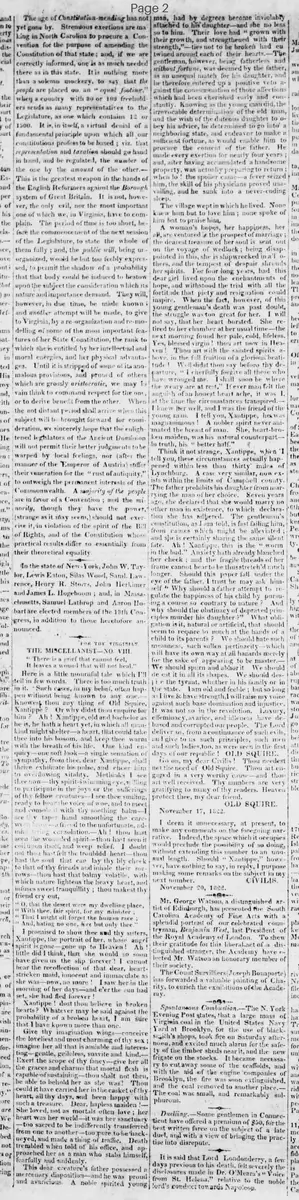
THE MISCELLANIST—NO. VIII.
'There is a grief that cannot feel,
It leaves a wound that will not heal.'
Here is a little mournful tale which I'll
tell in few words. There is too much truth
in it. Such cases, in my belief, often happen
without being known to any one.—
Knowest thou any thing of Old Squire,
Xantippe? Or why didst thou enquire for
him? 'Ah! Xantippe, old and bachelor as
he is, he hath a heart yet, in which all mankind
might shelter—a heart, that could take
thee into his bosom, and keep thee warm
with the breath of his life. One kind enquiry—one
soft look—a single sensation of
sympathy, from thee, dear Xantippe, shall
revive his pulse, and cheer him to overflowing
vitality. Methinks I see
thee now—thy spirit-swimming eye, willing
to participate in the joys or the sufferings
of thy fellow creatures—I see thee smiling,
ready to hear the voice of woe, and to meet
and console it with thy soothing balm—I
see thy taper hand smoothing the care-worn
brow—a friend to the unfortunate, administering
consolation.—Ah! thou hast
seen the wounded spirit—thou hast seen it
coil upon itself, and weep relief. I doubt
not thou hast felt the troubled heart—thou
hast the soul that can lay thy lily cheek
to that of thy friends and inhale their sorrows—thou
hast that balmy volatile, with
which nature lightens the heavy heart, and
infuses sweet tranquillity; thou makest thy
friend cry out,
'O, that the desert were my dwelling place,
With thee, fair spirit, for my minister;
That I might all forget the human race;
And, hating no one, love but only thee.'
I promised to show thee and thy sisters,
Xantippe, the portrait of her, whose angel
spirit is gone—gone up to Heaven! Ah!
little did I think, that she would so soon
have given us the slip forever! I cannot
bear the recollection of that dear, heart-stricken
maid, innocent and immaculate as
she was—now, no more! I saw her in the
morning of her days—and e'er the sun had
set, she had fled forever!
Xantippe! dost thou believe in broken
hearts? Whatever may be said against the
probability of a broken heart, I am sure
that I have known more than one.
Give thy imagination wings—conceive
the loveliest and most charming of thy sex;
imagine her all that is amiable and interesting—gentle,
guileless, suave and kind.—
Exert the scope of thy fancy—give her all
the graces and charms that mortal flesh is
capable of sustaining—thou shalt not then,
be able to behold her as she was! Thou
couldst have carried her in the casket of thy
heart, all thy days, and been happy with
such a treasure. Dear, hapless maiden!—
She loved, not as mortals often love: her
heart was her world—it was her sanctuary
—too sacred to be indifferently transferred
from one to another—too pure to be hackneyed,
and made a thing of traffic. Death
trembled when told of his office, and approached
her as a man who stabs himself,
fearfully and suddenly.
This dear creature's father possessed a
mercenary disposition—and he was proud
and avaricious. A noble spirited young
man, had by degrees become inviolably attached
to his daughter—and she no less
so to him. Their love had 'grown with
their growth, and strengthened with their
strength,'—ties not to be broken had entwined
around each of their hearts.—The
gentleman, however, being fatherless and
without fortune, was deemed by the father,
as an unequal match for his daughter, and
he therefore entered up a positive veto against
the consummation of those affections
which had been cherished early and constantly.
Knowing as the young man did, the
irrevocable determination of the old man,
and the wish of the dutiful daughter to obey
his advice, he determined to go into a neighboring
state, and endeavor to make a
sufficient fortune, as would enable him to
procure the consent of the father. He
made every exertion for nearly four years:
and, after having accumulated a handsome
property, was actually preparing to return;
when lo! the spoiler came—a fever seized
him, the skill of his physicians proved unavailing,
and he sunk into a never-ending
sleep.
The village wept in which he lived. None
knew him but to love him; none spoke of
him but to praise him.
A woman's hopes, her happiness, her
all, are ventured in the prospect of marriage;
the dearest treasure of her soul is sent out
on the voyage of wedlock; being disappointed
in this, she is shipwrecked in all others,
and the tempest of despair shrouds
her spirits. For four long years, had this
dear girl lived upon the enchantments of
hope, and withstood the trial with all the
fortitude that piety and resignation could
inspire. When the fact, however, of this
young gentleman's death was past doubt,
the struggle was too great for her. I will
not say, that her heart bursted. She retired
to her chamber at her usual time—the
next morning found her pale, cold, lifeless.
Yes, blessed virgin! thou art now in Heaven!
Thou art with the sainted spirits above,
in the full fruition of a glorious beatitude!
Well didst thou say before thy departure,
'I heartily forgive all these who
have wronged me. I shall soon be where
the weary are at rest.' If ever man felt the
anguish of an honest heartache, it was I
at the time the circumstances transpired.—
I knew her well, and I was the friend of the
young man. I tell you, Xantippe, he was
magnanimous! A nobler spirit never animated
the breast of man. She, heart-broken
maiden, was his natural counterpart—
in truth, his 'better half.'
Think it not strange, Xantippe, when I
tell you, these circumstances actually happened
within less than thirty miles of
Lynchburg. A case very similar, now exists
within the limits of Campbell county.
The father prohibits his daughter from marrying
the man of her choice. Seven years
ago, she declared that she would marry no
other man in existence, to which declaration
she has adhered. The gentleman's
constitution, as I am told, is fast failing him,
from causes which might be alleviated:
and she is certainly sharing the same silent
fate. Ah! Xantippe, this is the 'worm
in the bud.' Anxiety hath already blanched
her cheek; and the fragile threads of her
frame cannot bear to be thus stretched much
longer. Should this paper fall under the
eye of the father, I trust he may ask himself
'Why should a father attempt to regulate
the happiness of his child by pursuing
a course so contrary to nature?' And
why should the obstinacy of depraved principles
murder his daughter? 'What obligation
is it, natural or artificial, that should
seem to require so much at the hands of a
child to its parents? We should hate such
meanness, such sullen pertinacity—which
will have its own way at all hazards merely
for the sake of appearing to be master.—
We should spurn and abhor it We should
detest it in all its shapes. It should des-
tise the tyrant, whether in his family or in
the state.' I am old and feeble; but so long
as I live & have strength, I will raise my voice
against such base domination and injustice.
It was not so in the revolution. Luxury,
effeminacy, avarice, and idleness have debased
and corrupted our people. The Lord
deliver us, from a continuance of such evils,
and give to us such principles, such men
and such ladies, too, as were seen in the first
days of our republic!
OLD SQUIRE.
Go on, my dear Civilis! Thou needest
not the aid of Old Squire. Thou art engaged
in a very worthy cause—and thou
art well received. Thy numbers are very
gratifying to many of thy readers. Heaven
protect thee, my dear friend.
OLD SQUIRE.
November 17, 1822.
I deem it unnecessary, at present, to
make any comments on the foregoing narrative.
Indeed, the space which it occupies
would preclude the possibility of so doing,
without extending this number to an unusual
length. Should 'Xantippe,' however,
have nothing to say, in reply, I purpose
making some remarks on the subject in my
next number.
CIVILIS.
November 20, 1822.
THE MISCELLANIST—NO. VIII.
'There is a grief that cannot feel,
It leaves a wound that will not heal.'
Here is a little mournful tale which I'll
tell in few words. There is too much truth
in it. Such cases, in my belief, often happen
without being known to any one.—
Knowest thou any thing of Old Squire,
Xantippe? Or why didst thou enquire for
him? 'Ah! Xantippe, old and bachelor as
he is, he hath a heart yet, in which all mankind
might shelter—a heart, that could take
thee into his bosom, and keep thee warm
with the breath of his life. One kind enquiry—one
soft look—a single sensation of
sympathy, from thee, dear Xantippe, shall
revive his pulse, and cheer him to overflowing
vitality. Methinks I see
thee now—thy spirit-swimming eye, willing
to participate in the joys or the sufferings
of thy fellow creatures—I see thee smiling,
ready to hear the voice of woe, and to meet
and console it with thy soothing balm—I
see thy taper hand smoothing the care-worn
brow—a friend to the unfortunate, administering
consolation.—Ah! thou hast
seen the wounded spirit—thou hast seen it
coil upon itself, and weep relief. I doubt
not thou hast felt the troubled heart—thou
hast the soul that can lay thy lily cheek
to that of thy friends and inhale their sorrows—thou
hast that balmy volatile, with
which nature lightens the heavy heart, and
infuses sweet tranquillity; thou makest thy
friend cry out,
'O, that the desert were my dwelling place,
With thee, fair spirit, for my minister;
That I might all forget the human race;
And, hating no one, love but only thee.'
I promised to show thee and thy sisters,
Xantippe, the portrait of her, whose angel
spirit is gone—gone up to Heaven! Ah!
little did I think, that she would so soon
have given us the slip forever! I cannot
bear the recollection of that dear, heart-stricken
maid, innocent and immaculate as
she was—now, no more! I saw her in the
morning of her days—and e'er the sun had
set, she had fled forever!
Xantippe! dost thou believe in broken
hearts? Whatever may be said against the
probability of a broken heart, I am sure
that I have known more than one.
Give thy imagination wings—conceive
the loveliest and most charming of thy sex;
imagine her all that is amiable and interesting—gentle,
guileless, suave and kind.—
Exert the scope of thy fancy—give her all
the graces and charms that mortal flesh is
capable of sustaining—thou shalt not then,
be able to behold her as she was! Thou
couldst have carried her in the casket of thy
heart, all thy days, and been happy with
such a treasure. Dear, hapless maiden!—
She loved, not as mortals often love: her
heart was her world—it was her sanctuary
—too sacred to be indifferently transferred
from one to another—too pure to be hackneyed,
and made a thing of traffic. Death
trembled when told of his office, and approached
her as a man who stabs himself,
fearfully and suddenly.
This dear creature's father possessed a
mercenary disposition—and he was proud
and avaricious. A noble spirited young
man, had by degrees become inviolably attached
to his daughter—and she no less
so to him. Their love had 'grown with
their growth, and strengthened with their
strength,'—ties not to be broken had entwined
around each of their hearts.—The
gentleman, however, being fatherless and
without fortune, was deemed by the father,
as an unequal match for his daughter, and
he therefore entered up a positive veto against
the consummation of those affections
which had been cherished early and constantly.
Knowing as the young man did, the
irrevocable determination of the old man,
and the wish of the dutiful daughter to obey
his advice, he determined to go into a neighboring
state, and endeavor to make a
sufficient fortune, as would enable him to
procure the consent of the father. He
made every exertion for nearly four years:
and, after having accumulated a handsome
property, was actually preparing to return;
when lo! the spoiler came—a fever seized
him, the skill of his physicians proved unavailing,
and he sunk into a never-ending
sleep.
The village wept in which he lived. None
knew him but to love him; none spoke of
him but to praise him.
A woman's hopes, her happiness, her
all, are ventured in the prospect of marriage;
the dearest treasure of her soul is sent out
on the voyage of wedlock; being disappointed
in this, she is shipwrecked in all others,
and the tempest of despair shrouds
her spirits. For four long years, had this
dear girl lived upon the enchantments of
hope, and withstood the trial with all the
fortitude that piety and resignation could
inspire. When the fact, however, of this
young gentleman's death was past doubt,
the struggle was too great for her. I will
not say, that her heart bursted. She retired
to her chamber at her usual time—the
next morning found her pale, cold, lifeless.
Yes, blessed virgin! thou art now in Heaven!
Thou art with the sainted spirits above,
in the full fruition of a glorious beatitude!
Well didst thou say before thy departure,
'I heartily forgive all these who
have wronged me. I shall soon be where
the weary are at rest.' If ever man felt the
anguish of an honest heartache, it was I
at the time the circumstances transpired.—
I knew her well, and I was the friend of the
young man. I tell you, Xantippe, he was
magnanimous! A nobler spirit never animated
the breast of man. She, heart-broken
maiden, was his natural counterpart—
in truth, his 'better half.'
Think it not strange, Xantippe, when I
tell you, these circumstances actually happened
within less than thirty miles of
Lynchburg. A case very similar, now exists
within the limits of Campbell county.
The father prohibits his daughter from marrying
the man of her choice. Seven years
ago, she declared that she would marry no
other man in existence, to which declaration
she has adhered. The gentleman's
constitution, as I am told, is fast failing him,
from causes which might be alleviated:
and she is certainly sharing the same silent
fate. Ah! Xantippe, this is the 'worm
in the bud.' Anxiety hath already blanched
her cheek; and the fragile threads of her
frame cannot bear to be thus stretched much
longer. Should this paper fall under the
eye of the father, I trust he may ask himself
'Why should a father attempt to regulate
the happiness of his child by pursuing
a course so contrary to nature?' And
why should the obstinacy of depraved principles
murder his daughter? 'What obligation
is it, natural or artificial, that should
seem to require so much at the hands of a
child to its parents? We should hate such
meanness, such sullen pertinacity—which
will have its own way at all hazards merely
for the sake of appearing to be master.—
We should spurn and abhor it We should
detest it in all its shapes. It should des-
tise the tyrant, whether in his family or in
the state.' I am old and feeble; but so long
as I live & have strength, I will raise my voice
against such base domination and injustice.
It was not so in the revolution. Luxury,
effeminacy, avarice, and idleness have debased
and corrupted our people. The Lord
deliver us, from a continuance of such evils,
and give to us such principles, such men
and such ladies, too, as were seen in the first
days of our republic!
OLD SQUIRE.
Go on, my dear Civilis! Thou needest
not the aid of Old Squire. Thou art engaged
in a very worthy cause—and thou
art well received. Thy numbers are very
gratifying to many of thy readers. Heaven
protect thee, my dear friend.
OLD SQUIRE.
November 17, 1822.
I deem it unnecessary, at present, to
make any comments on the foregoing narrative.
Indeed, the space which it occupies
would preclude the possibility of so doing,
without extending this number to an unusual
length. Should 'Xantippe,' however,
have nothing to say, in reply, I purpose
making some remarks on the subject in my
next number.
CIVILIS.
November 20, 1822.
What sub-type of article is it?
Prose Fiction
Essay
What themes does it cover?
Love Romance
Death Mortality
Moral Virtue
What keywords are associated?
Broken Heart
Forbidden Love
Parental Tyranny
Grief And Death
Moral Reflection
What entities or persons were involved?
Old Squire
Literary Details
Title
The Miscellanist—No. Viii.
Author
Old Squire
Subject
A Mournful Tale Of Broken Hearts And Parental Opposition To Love
Key Lines
'There Is A Grief That Cannot Feel, It Leaves A Wound That Will Not Heal.'
'O, That The Desert Were My Dwelling Place, With Thee, Fair Spirit, For My Minister; That I Might All Forget The Human Race; And, Hating No One, Love But Only Thee.'
'I Heartily Forgive All These Who Have Wronged Me. I Shall Soon Be Where The Weary Are At Rest.'