Thank you for visiting SNEWPapers!
Sign up free
The Rhode Island American, And General Advertiser
Providence, Providence County, Rhode Island
What is this article about?
The 16th U.S. Congress ended its session on March 3, 1821, in Washington, with unanimous thanks to Senate President Gaillard and near-unanimous to House Speaker Taylor. Key outcomes: bankruptcy bill failed due to Missouri Question; Navy, military, Florida, and loan bills passed after debates.
Merged-components note: Sequential reports detailing the closing sessions and outcomes of the 16th Congress, adjacent in reading order.
Clipping
OCR Quality
Full Text
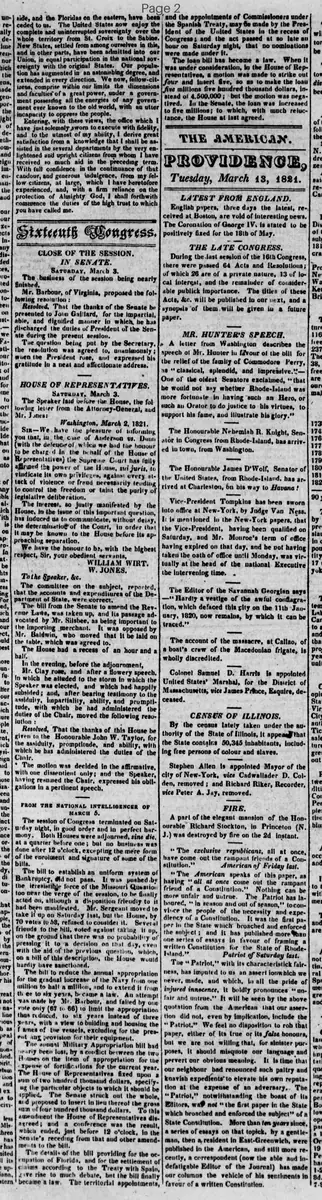
CLOSE OF THE SESSION.
IN SENATE.
Saturday, March 3.
The business of the session being nearly finished, Mr. Barbour, of Virginia, proposed the following resolution:
Resolved, That the thanks of the Senate be presented to John Gaillard, for the impartial, able, and dignified manner in which he has discharged the duties of President of the Senate during the present session.
The question being put by the Secretary, the resolution was agreed to, unanimously; when the President rose, and expressed his gratitude in a neat and affectionate address.
HOUSE OF REPRESENTATIVES.
Saturday, March 3.
The Speaker laid before the House, the following letter from the Attorney-General, and Mr. Jones:
Washington, March 2, 1821.
Sir—We have the pleasure of informing you that, in the Case of Anderson vs. Dunn (with the defence of which we had the honour to be charged in the behalf of the House of Representatives) the Supreme Court has fully affirmed the power of the House, sui juris, to vindicate its own privileges, against every attack of violence or fraud necessarily tending to control the freedom or taint the purity of legislative deliberation.
The interest, so justly manifested by the House, in the issue of this important question, has induced us to communicate, without delay, the determination of the Court, in order that it may be known to the House before its approaching separation.
We have the honour to be, with the highest respect, Sir, your obedient servants,
WILLIAM WIRT.
W. JONES.
To the Speaker, &c.
The committee on the subject, reported, that the accounts and expenditures of the Department of State, were correct.
The bill from the Senate to amend the Revenue Laws, was taken up, and its passage advocated by Mr. Silsbee, as being important to the importing merchant. It was opposed by Mr. Baldwin, who moved that it be laid on the table, which was agreed to.
The House had a recess of an hour and a half.
In the evening, before the adjournment, Mr. Clay rose, and after a flowery speech, in which he alluded to the storm in which the Speaker was elected, and which had—happily subsided; and, after bearing testimony to the assiduity, impartiality, ability, and promptitude, with which he had administered the duties of the Chair, moved the following resolution:
Resolved, That the thanks of this House be given to the Honourable John W. Taylor, for the assiduity, promptitude, and ability, with which he has administered the duties of the Chair.
The motion was decided in the affirmative, with one dissentient only; and the Speaker, having resumed the Chair, expressed his obligations in a pertinent speech.
FROM THE NATIONAL INTELLIGENCER OF MARCH 5.
The session of Congress terminated on Saturday night, in good order and in perfect harmony. Both Houses were adjourned, sine die, at a quarter before one; but no business was done after 12 o'clock, excepting the mere form of the enrolment and signature of some of the bills.
The bill to establish an uniform system of Bankruptcy, did not pass. It was pushed by the irresistible force of the Missouri Question too near the verge of the session, to be finally acted on, although a disposition friendly to it had been manifested. Mr. Sergeant moved to take it up on Saturday last, but the House, by 70 votes to 38, refused to consider it. Several friends to the bill, voted against taking it up, on the ground that there was no probability of pressing it to a decision on that day, even with the aid of the previous question, which, on a bill of this description, the House would hardly have sanctioned.
The bill to reduce the annual appropriation for the gradual increase of the Navy from one million to half a million, and to extend it from three to six years, became a law. An attempt was made by Mr. Barbour, and failed by one vote only (67 to 66) to limit the appropriation thus reduced, to six years instead of three years, with a view to building and housing the frames of the vessels, excluding for the present any provision for their equipment.
The annual Military Appropriation bill had nearly been lost, by a conflict between the two Houses on the item of appropriation for the expense of fortifications for the current year. The House of Representatives fixed upon a sum of two hundred thousand dollars, specifying the particular objects to which it should be applied. The Senate struck out the whole, and proposed to insert in lieu thereof the gross sum of four hundred thousand dollars. To this amendment the House of Representatives disagreed; and a conference was the result, which ended, just before 12 o'clock, in the Senate's receding from that and other amendments to the bill.
The details of the bill providing for the occupation of Florida, and for the settlement of claims according to the Treaty with Spain, give rise to much debate, but the bill finally became a law. The territorial appointments, and the appointments of Commissioners under the Spanish Treaty, may be made by the President of the United States in the recess of Congress; and the act passed at so late an hour on Saturday night, that no nominations were made under it.
The loan bill has become a law. When it was under consideration, in the House of Representatives, a motion was made to strike out four and insert five, so as to make the loan five millions five hundred thousand dollars, instead of 4,500,000; but the motion was negatived. In the Senate, the loan was increased to five millions; to which, with much reluctance, the House at last agreed.
What sub-type of article is it?
What keywords are associated?
What entities or persons were involved?
Where did it happen?
Domestic News Details
Primary Location
Washington
Event Date
March 3, 1821
Key Persons
Outcome
session adjourned sine die at quarter before one on march 3; bankruptcy bill failed; navy appropriation reduced to half million extended to six years became law; military appropriation bill passed after conference; florida occupation and spanish treaty claims bill became law; loan bill for five million became law.
Event Details
The 16th Congress closed its session on March 3, 1821. In the Senate, a resolution thanking President John Gaillard for his service was passed unanimously. In the House, a letter from Attorney-General William Wirt and W. Jones reported the Supreme Court's affirmation of House powers in Anderson vs. Dunn. The committee confirmed State Department accounts correct. The Senate bill to amend Revenue Laws was laid on the table. A resolution thanking Speaker John W. Taylor was passed with one dissent. The session ended in harmony; several bills passed or failed as detailed in the National Intelligencer of March 5.