Thank you for visiting SNEWPapers!
Sign up free
The Highland Weekly News
Hillsborough, Hillsboro, Highland County, Ohio
What is this article about?
Biographical account of Abraham Lincoln's life from birth in Kentucky in 1809, through poverty and self-education in Indiana and Illinois, to his political career as a Whig and Republican, including congressional service and 1858 Senate campaign against Douglas.
Merged-components note: Direct continuation of the biographical article on Abraham Lincoln across pages, with sequential reading orders.
Clippings
1 of 2
OCR Quality
Full Text
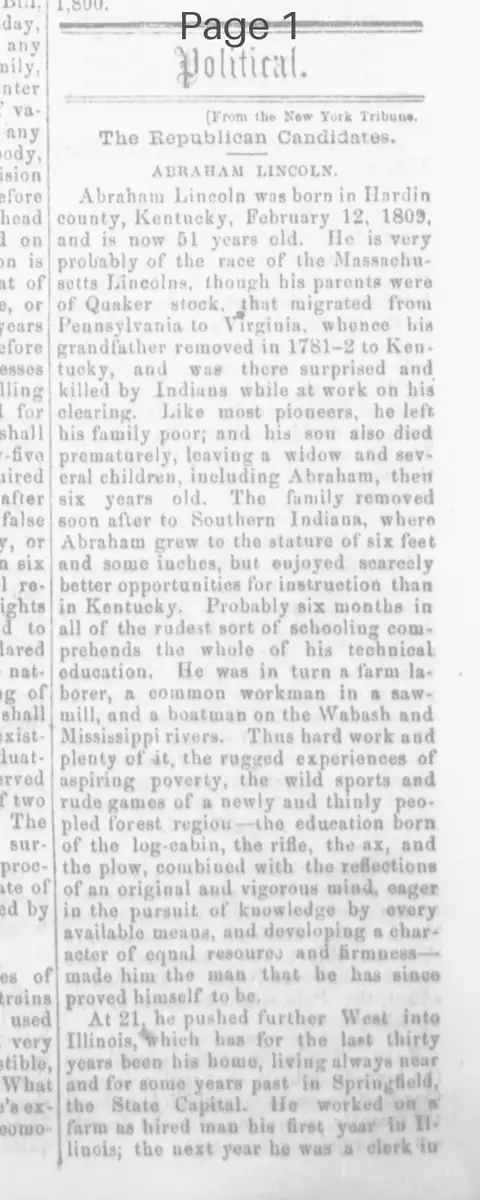
(From the New York Tribune.)
The Republican Candidates.
ABRAHAM LINCOLN
Abraham Lincoln was born in Hardin county, Kentucky, February 12, 1809, and is now 51 years old. He is very probably of the race of the Massachusetts Lincolns, though his parents were of Quaker stock, that migrated from Pennsylvania to Virginia, whence his grandfather removed in 1781-2 to Kentucky, and was there surprised and killed by Indians while at work on his clearing. Like most pioneers, he left his family poor, and his son also died prematurely, leaving a widow and several children, including Abraham, then six years old. The family removed soon after to Southern Indiana, where Abraham grew to the stature of six feet and some inches, but enjoyed scarcely better opportunities for instruction than in Kentucky. Probably six months in all of the rudest sort of schooling comprehends the whole of his technical education. He was in turn a farm laborer, a common workman in a saw-mill, and a boatman on the Wabash and Mississippi rivers. Thus hard work and plenty of it, the rugged experiences of aspiring poverty, the wild sports and rude games of a newly and thinly peopled forest region-the education born of the log-cabin, the rifle, the ax, and the plow, combined with the reflections of an original and vigorous mind, eager in the pursuit of knowledge by every available means, and developing a character of equal resource and firmness- made him the man that he has since proved himself to be
At 21, he pushed further West into Illinois, which has for the last thirty years been his home, living always near and for some years past in Springfield, the State Capital. He worked on farm as hired man his first year in Illinois, the next year he was a clerk in store then volunteered for the Black Hawk war, and was chosen a captain by his company, the next year he was an unsuccessful candidate for the Legislature; he was chosen the next, and served four sessions with eminent usefulness and steadily increasing reputation: studied law, meantime, and took his place at the bar; was early recognized as a most effective and convincing advocate before the people of Whig principles and the Protective policy, and of their Illustrious embodiment, Henry Clay; was a Whig candidate for Elector in nearly or quite every Presidential contest, from 1830 to 1852 inclusive; was chosen to the XXXth Congress from the Central District of Illinois in 1846, and served to its close, but was not a candidate for re-election; and in 1849 measurably withdrew from politics and devoted himself to the practice of his profession until the Nebraska iniquity of 1854 called him again into the political arena. He was the candidate of the Whigs for U. S. Senator before the Legislature chosen that year, but they were not a majority of the body, so he declined and urged his friends to support Judge Trumbull, the candidate of the anti-Nebraska Democrats, who was thus elected.
In the gallant and memorable Presidential contest of 1856, Mr. Lincoln's name headed the Fremont Electoral Ticket of Illinois. In 1858, he was unanimously designated by the Republican State Convention to succeed Mr. Douglas in the Senate, and thereupon canvassed the State against Mr. Douglas with an ability in which logic, art, eloquence, and thorough good nature were alike conspicuous, and which gave him a national reputation. Mr. Douglas secured a predominance in the Legislature and was elected, though Mr. Lincoln had the larger popular vote, so that if the question had been decided by the majority of the people, the champion of Squatter Sovereignty and of indifference as regards slavery extension would not now be a Senator from Illinois.
What sub-type of article is it?
What themes does it cover?
What keywords are associated?
What entities or persons were involved?
Where did it happen?
Story Details
Key Persons
Location
Kentucky, Indiana, Illinois, Springfield
Event Date
February 12, 1809
Story Details
Abraham Lincoln, born in poverty in Kentucky, self-educated through hard labor in Indiana and Illinois, rose to prominence as a lawyer and politician, serving in the Illinois legislature, U.S. Congress, and campaigning for Senate against Douglas in 1858, gaining national reputation despite electoral loss.