Thank you for visiting SNEWPapers!
Sign up free
Literary
March 5, 1817
Daily National Intelligencer
Washington, District Of Columbia
What is this article about?
An officer's letter describes his arduous ascent of Mount Vesuvius, witnessing its eruptions; explores the ruins of Pompeii with vivid frescoes and artifacts; and visits the Grotto del Cane, where a dog is nearly suffocated by carbonic gas, near Naples in 1810s.
Clipping
OCR Quality
98%
Excellent
Full Text
THE SHORES OF ITALY.
Extract of a letter from an officer of our Mediterranean squadron, to his friend in this town, received per brig Chauncey.
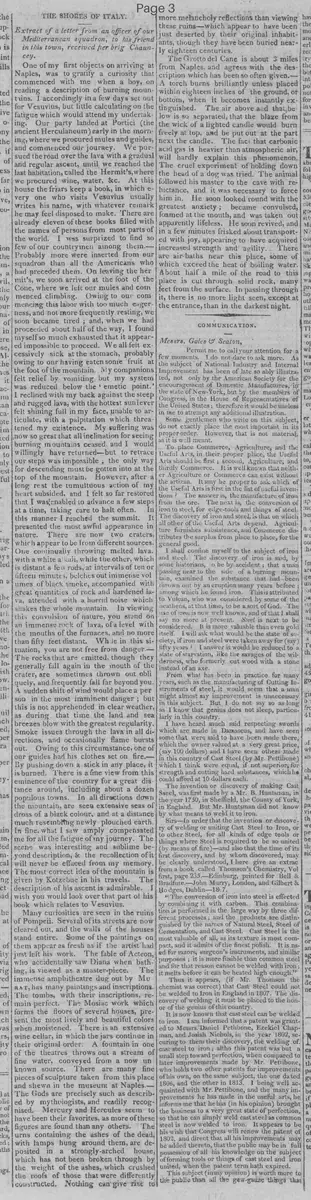
One of my first objects on arriving at Naples, was to gratify a curiosity that commenced with me when a boy, on reading a description of burning mountains. I accordingly in a few days set out for Vesuvius, but little calculating on the fatigue which would attend my undertaking. Our party landed at Portici (the ancient Herculaneum) early in the morning, where we procured mules and guides, and commenced our journey. We pursued the road over the lava with a gradual and regular ascent, until we reached the last habitation, called the Hermit's, where we procured wine, water, &c. At this house the friars keep a book, in which every one who visits Vesuvius usually writes his name, with whatever remark he may feel disposed to make. There are already eleven of these books filled with the names of persons from most parts of the world. I was surprised to find so few of our countrymen among them.—Probably more were inserted from our squadron than all the Americans who had preceded them. On leaving the hermit's, we soon arrived at the foot of the Cone, where we left our mules and commenced climbing. Owing to our commencing this labor with too much eagerness, and not more frequently resting, we soon became tired; and, when we had proceeded about half of the way, I found myself so much exhausted that it appeared impossible to proceed. We all felt excessively sick at the stomach, probably owing to our having eaten some fruit at the foot of the mountain. My companions felt relief by vomiting but my system was reduced below the 'emetic point.' I reclined with my back against the steep and rugged lava, with the hottest sun I ever felt shining full in my face, unable to articulate, with a palpitation which threatened my existence. My suffering was now so great that all inclination for seeing burning mountains ceased, and I would willingly have returned—but to retrace our steps was impossible; the only way for descending must be gotten into at the top of the mountain. However, after a long rest the tumultuous action of my heart subsided, and I felt so far restored that I was enabled to advance a few steps at a time, taking care to halt often. In this manner I reached the summit. It presented the most awful appearance in nature. There are now two craters which appear to be from different sources. One continually throwing melted lava, with a white alkali, while the other, which is distant a few rods, at intervals of ten or fifteen minutes, belches out immense volumes of black smoke, accompanied with great quantities of rock and hardened lava, attended with a horrid noise which shakes the whole mountain. In viewing this convulsion of nature, you stand on an immense rock of lava, of a level with the mouths of the furnaces, and no more than fifty feet distant. While in this situation, you are not free from danger.—The rocks that are emitted, though they generally fall again in the mouth of the crater, are sometimes thrown out obliquely, and frequently fall far beyond you. A sudden shift of wind would place a person in the most imminent danger; but this is not apprehended in clear weather, as during that time the land and sea breezes blow with the greatest regularity. Smoke issues through the lava in all directions, and occasionally flame bursts out. Owing to this circumstance, one of our guides had his clothes set on fire.—By pushing down a stick in any place, it is burned. There is a fine view from this eminence of the country for a great distance around, including about a dozen populous towns. In all directions down the mountain, are seen extensive seas of dross of a black colour, and at a distance much resembling newly ploughed earth. In fine, what I saw amply compensated me for all the fatigue of my journey. The scene was interesting and sublime beyond description, & the recollection of it will never be effaced from my memory. The most correct idea of the mountain is given by Kotzebue in his travels. The description of his ascent is admirable. I wish you would look over that part of his book which relates to Vesuvius.
Many curiosities are seen in the ruins of Pompeii. Several of its streets are now cleared out, and the walls of the houses stand entire. Some of the paintings on them appear as fresh as if the artist had just left his work. The fable of Acteon, who accidentally saw Diana when bathing, is viewed as a master-piece. The immense amphitheatre dug out by Murat, has many paintings and inscriptions. The tombs, with their inscriptions, remain perfect. The Mosaic work which forms the floors of several houses, present the most lively and beautiful colors when moistened. There is an extensive wine cellar, in which the jars continue in their original order. A fountain in one of the theatres throws out a stream of fine water, conveyed from a now unknown source. There are many fine pieces of sculpture taken from this place and shewn in the museum at Naples.—The Gods are precisely such as described by mythologists, and readily recognised. Mercury and Hercules seem to have been their favorites, as more of these figures are found than any others. The urns containing the ashes of the dead, with lamps hung around them, are deposited in a strongly-arched house, which has not been broken through by the weight of the ashes, which crushed the roofs of those that were differently constructed. Nothing can give rise to more melancholy reflections than viewing these ruins—which appear to have been just deserted by their original inhabitants, though they have been buried nearly eighteen centuries.
The Grotto del Cane is about 3 miles from Naples, and agrees with the description which has been so often given.—A torch burns brilliantly unless placed within eighteen inches of the ground, or bottom, when it becomes instantly extinguished. The air above and that below is so separated, that the blaze from the wick of a lighted candle would burn freely at top, and be put out at the part next the candle. The fact that carbonic acid gas is heavier than atmospheric air will hardly explain this phenomenon. The cruel experiment of holding down the head of a dog was tried. The animal followed his master to the cave with reluctance, and it was necessary to force him in. He soon looked round with the greatest anxiety; became convulsed, foamed at the mouth, and was taken out apparently lifeless. He soon revived, and in a few minutes frisked about transported with joy, appearing to have acquired increased strength and agility. There are air-baths near this place, some of which exceed the heat of boiling water. About half a mile of the road to this place is cut through solid rock, many feet from the surface. In passing through it, there is no more light seen, except at the entrance, than in the darkest night.
Extract of a letter from an officer of our Mediterranean squadron, to his friend in this town, received per brig Chauncey.
One of my first objects on arriving at Naples, was to gratify a curiosity that commenced with me when a boy, on reading a description of burning mountains. I accordingly in a few days set out for Vesuvius, but little calculating on the fatigue which would attend my undertaking. Our party landed at Portici (the ancient Herculaneum) early in the morning, where we procured mules and guides, and commenced our journey. We pursued the road over the lava with a gradual and regular ascent, until we reached the last habitation, called the Hermit's, where we procured wine, water, &c. At this house the friars keep a book, in which every one who visits Vesuvius usually writes his name, with whatever remark he may feel disposed to make. There are already eleven of these books filled with the names of persons from most parts of the world. I was surprised to find so few of our countrymen among them.—Probably more were inserted from our squadron than all the Americans who had preceded them. On leaving the hermit's, we soon arrived at the foot of the Cone, where we left our mules and commenced climbing. Owing to our commencing this labor with too much eagerness, and not more frequently resting, we soon became tired; and, when we had proceeded about half of the way, I found myself so much exhausted that it appeared impossible to proceed. We all felt excessively sick at the stomach, probably owing to our having eaten some fruit at the foot of the mountain. My companions felt relief by vomiting but my system was reduced below the 'emetic point.' I reclined with my back against the steep and rugged lava, with the hottest sun I ever felt shining full in my face, unable to articulate, with a palpitation which threatened my existence. My suffering was now so great that all inclination for seeing burning mountains ceased, and I would willingly have returned—but to retrace our steps was impossible; the only way for descending must be gotten into at the top of the mountain. However, after a long rest the tumultuous action of my heart subsided, and I felt so far restored that I was enabled to advance a few steps at a time, taking care to halt often. In this manner I reached the summit. It presented the most awful appearance in nature. There are now two craters which appear to be from different sources. One continually throwing melted lava, with a white alkali, while the other, which is distant a few rods, at intervals of ten or fifteen minutes, belches out immense volumes of black smoke, accompanied with great quantities of rock and hardened lava, attended with a horrid noise which shakes the whole mountain. In viewing this convulsion of nature, you stand on an immense rock of lava, of a level with the mouths of the furnaces, and no more than fifty feet distant. While in this situation, you are not free from danger.—The rocks that are emitted, though they generally fall again in the mouth of the crater, are sometimes thrown out obliquely, and frequently fall far beyond you. A sudden shift of wind would place a person in the most imminent danger; but this is not apprehended in clear weather, as during that time the land and sea breezes blow with the greatest regularity. Smoke issues through the lava in all directions, and occasionally flame bursts out. Owing to this circumstance, one of our guides had his clothes set on fire.—By pushing down a stick in any place, it is burned. There is a fine view from this eminence of the country for a great distance around, including about a dozen populous towns. In all directions down the mountain, are seen extensive seas of dross of a black colour, and at a distance much resembling newly ploughed earth. In fine, what I saw amply compensated me for all the fatigue of my journey. The scene was interesting and sublime beyond description, & the recollection of it will never be effaced from my memory. The most correct idea of the mountain is given by Kotzebue in his travels. The description of his ascent is admirable. I wish you would look over that part of his book which relates to Vesuvius.
Many curiosities are seen in the ruins of Pompeii. Several of its streets are now cleared out, and the walls of the houses stand entire. Some of the paintings on them appear as fresh as if the artist had just left his work. The fable of Acteon, who accidentally saw Diana when bathing, is viewed as a master-piece. The immense amphitheatre dug out by Murat, has many paintings and inscriptions. The tombs, with their inscriptions, remain perfect. The Mosaic work which forms the floors of several houses, present the most lively and beautiful colors when moistened. There is an extensive wine cellar, in which the jars continue in their original order. A fountain in one of the theatres throws out a stream of fine water, conveyed from a now unknown source. There are many fine pieces of sculpture taken from this place and shewn in the museum at Naples.—The Gods are precisely such as described by mythologists, and readily recognised. Mercury and Hercules seem to have been their favorites, as more of these figures are found than any others. The urns containing the ashes of the dead, with lamps hung around them, are deposited in a strongly-arched house, which has not been broken through by the weight of the ashes, which crushed the roofs of those that were differently constructed. Nothing can give rise to more melancholy reflections than viewing these ruins—which appear to have been just deserted by their original inhabitants, though they have been buried nearly eighteen centuries.
The Grotto del Cane is about 3 miles from Naples, and agrees with the description which has been so often given.—A torch burns brilliantly unless placed within eighteen inches of the ground, or bottom, when it becomes instantly extinguished. The air above and that below is so separated, that the blaze from the wick of a lighted candle would burn freely at top, and be put out at the part next the candle. The fact that carbonic acid gas is heavier than atmospheric air will hardly explain this phenomenon. The cruel experiment of holding down the head of a dog was tried. The animal followed his master to the cave with reluctance, and it was necessary to force him in. He soon looked round with the greatest anxiety; became convulsed, foamed at the mouth, and was taken out apparently lifeless. He soon revived, and in a few minutes frisked about transported with joy, appearing to have acquired increased strength and agility. There are air-baths near this place, some of which exceed the heat of boiling water. About half a mile of the road to this place is cut through solid rock, many feet from the surface. In passing through it, there is no more light seen, except at the entrance, than in the darkest night.
What sub-type of article is it?
Epistolary
Essay
Journey Narrative
What themes does it cover?
Nature
Death Mortality
What keywords are associated?
Vesuvius
Pompeii
Grotto Del Cane
Naples
Volcano Ascent
Ancient Ruins
Carbonic Gas
What entities or persons were involved?
Extract Of A Letter From An Officer Of Our Mediterranean Squadron
Literary Details
Title
The Shores Of Italy.
Author
Extract Of A Letter From An Officer Of Our Mediterranean Squadron
Subject
Travels To Vesuvius, Pompeii, And Grotto Del Cane Near Naples
Key Lines
It Presented The Most Awful Appearance In Nature.
Nothing Can Give Rise To More Melancholy Reflections Than Viewing These Ruins—Which Appear To Have Been Just Deserted By Their Original Inhabitants, Though They Have Been Buried Nearly Eighteen Centuries.
The Cruel Experiment Of Holding Down The Head Of A Dog Was Tried.