Thank you for visiting SNEWPapers!
Sign up free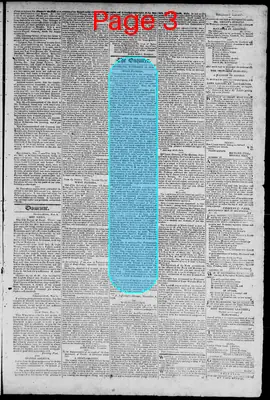
Editorial
November 13, 1810
The Enquirer
Richmond, Henrico County, Virginia
What is this article about?
Editorial from Richmond Enquirer urges President Madison to immediately take possession of West Florida, citing 1803-1804 US laws granting authority over territories ceded by France, amid subversion of Spanish control and potential foreign threats. References troop movements and Governor Claiborne's role.
Clipping
OCR Quality
95%
Excellent
Full Text
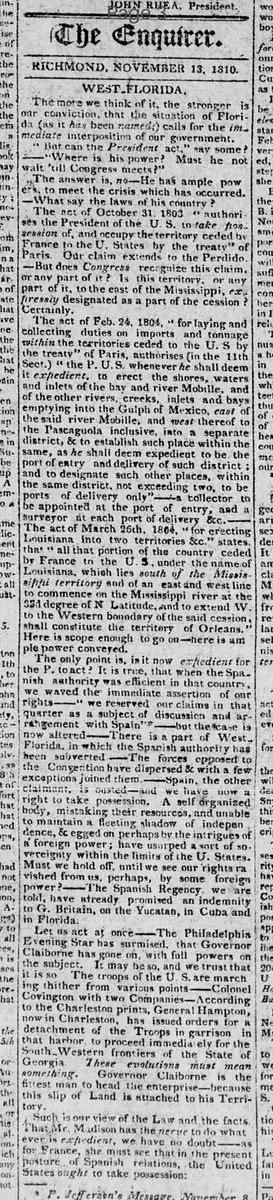
The Enquirer.
RICHMOND, NOVEMBER 13, 1810.
WEST FLORIDA.
The more we think of it, the stronger is our conviction, that the situation of Florida (as it has been named!) calls for the immediate interposition of our government.
"But can the President act," say some? "Where is his power? Must he not wait 'till Congress meets?"
The answer is, no—He has ample powers to meet the crisis which has occurred.
What say the laws of his country?
The act of October 31, 1803 "authorises the President of the U. S. to take possession of, and occupy the territory ceded by France to the U. States by the treaty of Paris." Our claim extends to the Perdido.
But does Congress recognize this claim, or any part of it? Is this territory, or any part of it, to the east of the Mississippi, expressly designated as a part of the cession? Certainly.
The act of Feb. 24, 1804, "for laying and collecting duties on imports and tonnage within the territories ceded to the U. S. by the treaty of Paris," authorises (in the 11th Sect.) "the P. U.S. whenever he shall deem it expedient, to erect the shores, waters and inlets of the bay and river Mobile, and of the other rivers, creeks, inlets and bays emptying into the Gulph of Mexico, east of the said river Mobile and west thereof to the Pascaguola inclusive, into a separate district, & to establish such place within the same, as he shall deem expedient to be the port of entry and delivery of such district; and to designate such other places, within the same district, not exceeding two, to be ports of delivery only" and a collector to be appointed at the port of entry, and a surveyor at each port of delivery &c.
The act of March 26th, 1804, "for erecting Louisiana into two territories &c." states, that "all that portion of the country ceded by France to the U.S. under the name of Louisiana, which lies south of the Mississippi territory and of an east and west line to commence on the Mississippi river at the 33d degree of N Latitude, and to extend W. to the Western boundary of the said cession, shall constitute the territory of Orleans."
Here is scope enough to go on—here is ample power conveyed.
The only point is, is it now expedient for the P. to act? It is true, that when the Spanish authority was efficient in that country, we waived the immediate assertion of our rights—and we reserved our claims in that quarter as a subject of discussion and arrangement with Spain—but the case is now altered—There is a part of West Florida, in which the Spanish authority has been subverted—a—The forces opposed to the Convention have dispersed & with a few exceptions joined them,—Spain, the other claimant, is busted—and we have now a right to take possession. A self organized body, mistaking their resources, and unable to maintain a fleeting shadow of independence, & egged on perhaps by the intrigues of a foreign power; have usurped a sort of sovereignty within the limits of the U. States. Must we hold off, until we see our rights ravished from us, perhaps, by some foreign power?—The Spanish Regency, we are told, have already promised an indemnity to G. Britain, on the Yucatan, in Cuba and in Florida.
Let us act at once—The Philadelphia Evening Star has surmised, that Governor Claiborne has gone on, with full powers on the subject. It may be so, and we trust that it is so. The troops of the U. S. are marching thither from various points—Colonel Covington with two Companies—According to the Charleston prints, General Hampton, now in Charleston, has issued orders for a detachment of the Troops in garrison in that harbor, to proceed immediately for the South Western frontiers of the State of Georgia.
These evolutions must mean something.
Governor Claiborne is the fittest man to head the enterprise—because this slip of Land is attached to his Territory.
Such is our view of the Law and the facts. That Mr. Madison has the nerve to do whatever is expedient, we have no doubt—as for France, she must see that in the present posture of Spanish relations, the United States ought to take possession:
P. Jefferson's Message, November 8, 1804.
RICHMOND, NOVEMBER 13, 1810.
WEST FLORIDA.
The more we think of it, the stronger is our conviction, that the situation of Florida (as it has been named!) calls for the immediate interposition of our government.
"But can the President act," say some? "Where is his power? Must he not wait 'till Congress meets?"
The answer is, no—He has ample powers to meet the crisis which has occurred.
What say the laws of his country?
The act of October 31, 1803 "authorises the President of the U. S. to take possession of, and occupy the territory ceded by France to the U. States by the treaty of Paris." Our claim extends to the Perdido.
But does Congress recognize this claim, or any part of it? Is this territory, or any part of it, to the east of the Mississippi, expressly designated as a part of the cession? Certainly.
The act of Feb. 24, 1804, "for laying and collecting duties on imports and tonnage within the territories ceded to the U. S. by the treaty of Paris," authorises (in the 11th Sect.) "the P. U.S. whenever he shall deem it expedient, to erect the shores, waters and inlets of the bay and river Mobile, and of the other rivers, creeks, inlets and bays emptying into the Gulph of Mexico, east of the said river Mobile and west thereof to the Pascaguola inclusive, into a separate district, & to establish such place within the same, as he shall deem expedient to be the port of entry and delivery of such district; and to designate such other places, within the same district, not exceeding two, to be ports of delivery only" and a collector to be appointed at the port of entry, and a surveyor at each port of delivery &c.
The act of March 26th, 1804, "for erecting Louisiana into two territories &c." states, that "all that portion of the country ceded by France to the U.S. under the name of Louisiana, which lies south of the Mississippi territory and of an east and west line to commence on the Mississippi river at the 33d degree of N Latitude, and to extend W. to the Western boundary of the said cession, shall constitute the territory of Orleans."
Here is scope enough to go on—here is ample power conveyed.
The only point is, is it now expedient for the P. to act? It is true, that when the Spanish authority was efficient in that country, we waived the immediate assertion of our rights—and we reserved our claims in that quarter as a subject of discussion and arrangement with Spain—but the case is now altered—There is a part of West Florida, in which the Spanish authority has been subverted—a—The forces opposed to the Convention have dispersed & with a few exceptions joined them,—Spain, the other claimant, is busted—and we have now a right to take possession. A self organized body, mistaking their resources, and unable to maintain a fleeting shadow of independence, & egged on perhaps by the intrigues of a foreign power; have usurped a sort of sovereignty within the limits of the U. States. Must we hold off, until we see our rights ravished from us, perhaps, by some foreign power?—The Spanish Regency, we are told, have already promised an indemnity to G. Britain, on the Yucatan, in Cuba and in Florida.
Let us act at once—The Philadelphia Evening Star has surmised, that Governor Claiborne has gone on, with full powers on the subject. It may be so, and we trust that it is so. The troops of the U. S. are marching thither from various points—Colonel Covington with two Companies—According to the Charleston prints, General Hampton, now in Charleston, has issued orders for a detachment of the Troops in garrison in that harbor, to proceed immediately for the South Western frontiers of the State of Georgia.
These evolutions must mean something.
Governor Claiborne is the fittest man to head the enterprise—because this slip of Land is attached to his Territory.
Such is our view of the Law and the facts. That Mr. Madison has the nerve to do whatever is expedient, we have no doubt—as for France, she must see that in the present posture of Spanish relations, the United States ought to take possession:
P. Jefferson's Message, November 8, 1804.
What sub-type of article is it?
Foreign Affairs
Constitutional
What keywords are associated?
West Florida
Us Territorial Claims
Presidential Powers
Spanish Subversion
Troop Movements
Governor Claiborne
What entities or persons were involved?
President Madison
Governor Claiborne
Colonel Covington
General Hampton
Spain
France
Great Britain
President Jefferson
Editorial Details
Primary Topic
Urging Us Possession Of West Florida
Stance / Tone
Strongly Advocating Immediate Presidential Action
Key Figures
President Madison
Governor Claiborne
Colonel Covington
General Hampton
Spain
France
Great Britain
President Jefferson
Key Arguments
President Has Ample Powers From 1803 Act To Take Possession Of Territory Ceded By France
Congress Recognizes Claim To Territory East Of Mississippi
1804 Acts Authorize Establishment Of Districts And Ports In The Region
Spanish Authority Subverted, Creating Expediency For Action
Self Organized Body Usurping Sovereignty Within Us Limits
Risk Of Foreign Powers Ravishing Us Rights
Troops Marching To The Area Indicate Preparation
Governor Claiborne Suitable To Lead Due To Territorial Attachment