Thank you for visiting SNEWPapers!
Sign up free
The New Hampshire Gazette And General Advertiser
Portsmouth, Exeter, Rockingham County, New Hampshire
What is this article about?
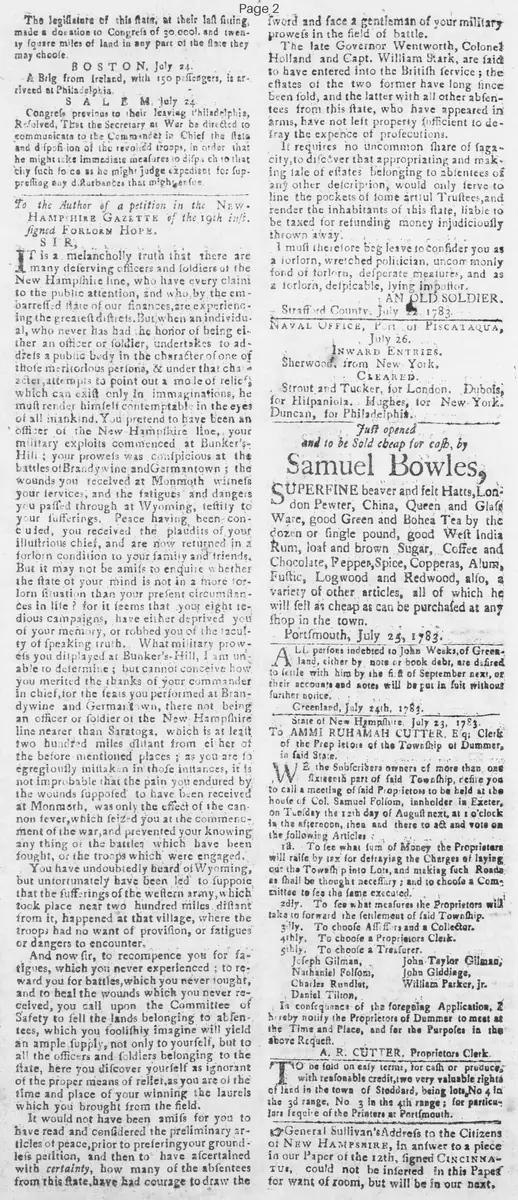
In a July 2, 1783, letter to the New-Hampshire Gazette, 'An Old Soldier' from Strafford County denounces a petition by 'Forlorn Hope' as fraudulent, accusing him of falsely claiming Revolutionary War service in battles like Bunker Hill, Brandywine, and Monmouth, and criticizing his impractical proposal to sell absentee lands for veteran relief.
Clipping
OCR Quality
Full Text
SIR,
It is a melancholy truth that there are many deserving officers and soldiers of the New Hampshire line, who have every claim to the public attention, and who, by the embarrassed state of our finances, are experiencing the greatest distress. But when an individual, who never has had the honor of being either an officer or soldier, undertakes to address a public body in the character of one of those meritorious persons, & under that character, attempts to point out a mode of relief which can exist only in imaginations, he must render himself contemptible in the eyes of all mankind. You pretend to have been an officer of the New Hampshire line.. your military exploits commenced at Bunker's Hill: your prowess was conspicuous at the battles of Brandywine and Germantown; the wounds you received at Monmouth witness your services, and the fatigues and dangers you passed through at Wyoming, testify to your sufferings. Peace having been concluded, you received the plaudits of your illustrious chief, and are now returned in a forlorn condition to your family and friends. But it may not be amiss to enquire whether the state of your mind is not in a more forlorn situation than your present circumstances in life? for it seems that your eight tedious campaigns, have either deprived you of your memory, or robbed you of the faculty of speaking truth. What military prowess you displayed at Bunker's-Hill, I am unable to determine: but cannot conceive how you merited the thanks of your commander in chief, for the feats you performed at Brandywine and Germantown, there not being an officer or soldier of the New Hampshire line nearer than Saratoga, which is at least two hundred miles distant from either of the before mentioned places: as you are so egregiously mistaken in those instances, it is not improbable that the pain you endured by the wounds supposed to have been received at Monmouth, was only the effect of the cannon fever, which seized you at the commencement of the war, and prevented your knowing any thing of the battles which have been fought, or the troops which were engaged. You have undoubtedly heard of Wyoming, but unfortunately have been led to suppose that the sufferings of the western army, which took place near two hundred miles distant from it, happened at that village, where the troops had no want of provision, or fatigues or dangers to encounter.
And now sir, to recompense you for fatigues, which you never experienced; to reward you for battles, which you never fought, and to heal the wounds which you never received, you call upon the Committee of Safety to sell the lands belonging to absentees, which you foolishly imagine will yield an ample supply, not only to yourself, but to all the officers and soldiers belonging to the state. Here you discover yourself as ignorant of the proper means of relief, as you are of the time and place of your winning the laurels which you brought from the field. It would not have been amiss for you to have read and considered the preliminary articles of peace, prior to presenting your groundless petition, and then to have ascertained with certainty, how many of the absentees from this state, have had courage to draw the sword and face a gentleman of your military prowess in the field of battle. The late Governor Wentworth, Colonel Holland and Capt. William Stark, are said to have entered into the British service; the estates of the two former have long since been sold, and the latter with all other absentees from this state, who have appeared in arms, have not left property sufficient to defray the expense of prosecutions. It requires no uncommon share of sagacity, to discover that appropriating and making sale of estates belonging to absentees of any other description, would only serve to line the pockets of some artful Trustees, and render the inhabitants of this state liable to be taxed for refunding money injudiciously thrown away. I must therefore beg leave to consider you as a forlorn, wretched politician, uncommonly fond of forlorn, desperate measures, and as a forlorn, despicable, lying impostor.
AN OLD SOLDIER.
Strafford County, July 2, 1783.
What sub-type of article is it?
What themes does it cover?
What keywords are associated?
What entities or persons were involved?
Letter to Editor Details
Author
An Old Soldier
Recipient
To The Author Of A Petition In The New Hampshire Gazette Of The 10th Inst. Signed Forlorn Hope
Main Argument
the petitioner 'forlorn hope' is accused of falsely impersonating a new hampshire veteran, with debunked claims of service in distant battles, and his proposal to sell absentee lands for relief is dismissed as ignorant and impractical, potentially leading to further taxation.
Notable Details