Thank you for visiting SNEWPapers!
Sign up free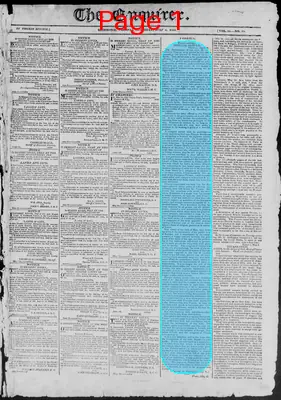
The Enquirer
Richmond, Henrico County, Virginia
What is this article about?
Official article from Vienna dated April 26 refuting French claims and reaffirming the Congress of Vienna's March 13 declaration proscribing Bonaparte, offering assistance to France if it rejects him to restore peace and honor in Europe.
Clipping

OCR Quality
Full Text
OFFICIAL ARTICLE.
Vienna, April 26.
The Declaration of the 13th March, is known in France, as is proved by the article inserted in the Journal de Paris of the 5th of April. This declaration is the unanimous expression of the wishes, and suffrages of nations. The article which pretends to refute it, presents us with the most scandalous abuse that ever has been made, of the faculty of speech, and of human reason among an enlightened people.
The development of the principles which dictate the act of the congress of the 13th of March, will demonstrate to the French nation that it never will speak the sacrilegious language which its emperor attributes to it—will separate its cause from him—preserve to the nation its real dignity—and open to it a prompt and honorable way still to rally to the rest of Europe.
The congress has not deliberated upon suppositions. It has proscribed Bonaparte. This man cannot and ought not, to find any farther asylum among civilized nations; still less can he govern them. Such is the principle of the act of proscription denounced against him. It is founded upon justice, as well as the legitimate interests of nations; it is, therefore, irrevocable.
Assistance has been offered to the French nation and to its government—it is still offered. It may nobly decline this assistance, by rejecting from its bosom the principle of the war. It cannot do without it, as long as it shall bear the yoke of a man who seeks to dishonor it, by making it guilty of a two-fold perjury.
A compact united with its sovereign—a treaty had reconciled us to Europe. Bonaparte in arrogating to himself the supreme power, has made it violate both. He re-plunges it into the horrors of civil war, anarchy and military despotism. Is it possible that he dares to promise France liberal institutions and the Empire of the laws? Is it possible that this same man can have the effrontery to promise to foreign nations, that he will respect treaties, and not interfere in their affairs? Is it he who pretends to make the independence of the French nation respected? His leaving the Island of Elba, his arrival in France, the titles with which he dares to invest himself, the authorities he has seized upon, the pretensions (prestiges) with which he surrounds it, those which he is preparing to support it -all these crimes, if legitimated by the assent of the European Powers, would threaten social order with complete destruction & nations with the yoke from which they have just been delivered.
No—no experience has been lost for Europe—after so many years of suffering and calamity, none will be lost for France. She knows the countless evils which the monstrous despotism of a single man has caused to weigh upon her, as upon the rest of the universe, while her nations feel what they owe to their dignity, as members of the European family, and to their internal prosperity as individual States. This sentiment having become common to all people and all governments, created a new moral force in political combinations, which alone made the grand alliance prosper, and enabled it even to conquer the general peace at the gates of Paris.
This force exists; it is indestructible, because it is composed of the most powerful motives (springs of action) and of the dearest sentiments—those of religion, patriotism & national honor.
The treaty of the 30th of May, laid down the basis of the restoration of the public law of Europe, and it established by its consequences, a happy concord between the progress of the spirit of the age, and the perfecting of the institutions calculated to guarantee to each people the enjoyment of its glory and its liberty. The congress of Vienna was on the eve of completing the work of the reconstruction of the political system of Europe. The same congress in the line of conduct which it has followed, proves that all interests have been maturely weighed; and its labours afford the consolatory result, which insures to nations the inalienability of their independence. It is no longer the will of the strongest which stifles the voice of truth, and crushes the most legitimate resistance—it is the right of each—it is the general interest—it is justice & political reason (raison d'etat)—no longer armies which decide.
Europe desires peace—she has doubtless need of it. But she will not think she has obtained it, till it shall be founded on the immutable principles inherent in each state, and on the common interest of all to maintain it. She is resolved not to be reduced to place it under the perpetual safeguard of armies. She cannot do this without being demoralized. But can this France represented by Addresses—this France governed by a man whom perjury and the infraction of all Treaties have conducted to the throne—can this France, as long as this man shall speak in her name, pretend to inspire that confidence, which is the first basis of political transaction?
It is with states as with individuals—their credit results only from their actions.
Europe has declared war against Bonaparte. France can and ought to prove to Europe that she sufficiently feels her own dignity, not to choose the sovereignty of this man. The French nation is powerful and free; her liberty and her greatness repose in herself, and are necessary to the balance of Europe. The peace of Paris and the congress of Vienna have proved it.
It is in this intention, and in this hope that the Declaration of the 13th March has been made. If this act is formed on a supposition, it is solely from that which is derived from the esteem which Europe has so justly given to the French nation; it has judged her; it knows that she is too enlightened, in respect to her true interests—too full of the principles of honor, to think her subjected to the will of an individual, whose power is composed of the elements which bring on the ruin of states. We repeat it, France has but to remain true to the principles on which social order is founded, in order to be at peace with Europe.
(Journal de Frankfort, May 8.)
What sub-type of article is it?
What keywords are associated?
What entities or persons were involved?
Where did it happen?
Foreign News Details
Primary Location
Vienna
Event Date
Declaration Of The 13th March, Article Dated April 26
Key Persons
Outcome
proscription of bonaparte; assistance offered to french nation if it rejects him; declaration of war against bonaparte by europe
Event Details
The Congress of Vienna's Declaration of March 13 proscribes Bonaparte following his return from Elba and seizure of power in France, violating treaties. The article refutes French justifications, emphasizes Europe's moral and political unity against him, and urges France to separate from Bonaparte to regain dignity and peace with Europe.