Thank you for visiting SNEWPapers!
Sign up free
Gazette Of The United States
New York, New York County, New York
What is this article about?
Continuation of an essay on the Roman commonwealth's constitution, detailing patrician usurpation of lands, the trial and execution of Cassius for proposing agrarian reforms, plebeian gullibility, and the biased centuriate assembly favoring the rich. Critiques aristocratic tyranny and advocates balanced government branches.
Merged-components note: The table provides numerical illustration for the essay's discussion of Roman centuries and classes, integrated spatially within the text on page 4.
Clipping
OCR Quality
Full Text
WEALTH EXAMINED.
Continued from our last.
The Romans never granted peace to their enemies until they had taken some of their territory from them. Part of such conquests were sold to defray the expense of the war: another portion was distributed among the poor plebeians. Some cantons were farmed out for the public: rapacious patricians, solely intent upon enriching themselves, took possession of some; and these lands, unjustly usurped by the rich, Cassius was for having distributed anew in favor of the plebeians.
The aristocratical pride, avarice, and ambition were all incensed, and the senators greatly alarmed. The people discovered symptoms that they begun to think themselves of the same species with their rulers: and one patrician of consular dignity dared to encourage them in such presumptuous and aspiring thoughts.
Some device or other must be invented to dupe the people, and ruin their leader: Virginia the consul soon hit upon an expedient. Rabuleius the tribune asked him in assembly, what he thought of this law? He answered, he would willingly consent that the lands should be distributed among the Roman people, provided the Latins had no share; divide et impera. This distinction without the least appearance of equity, was addressed simply to the popular hatred between the Romans and Latins, and the bait was greedily swallowed. The people were highly pleased with the consul, and began to despise Cassius, and to suspect him of ambition to be king. He continued his friendly intentions towards the people, and proposed in senate to reimburse, as it was but just, out of the public treasury, the money which the poorer citizens had paid for the corn of which Gelo, king of Syracuse, had made the commonwealth a present during the scarcity. But even this was now represented by the senate, and suspected by the people, to be only soliciting popular favor; and although the people felt every hour the necessity of a king to protect them against the tyranny of the senate, yet they had been gulled by patrician artifice into an oath against kings, and although they felt the want of such a magistrate, they had not sense enough to see it. The Agrarian law was opposed in senate by Appius and Sempronius, and evaded by the appointment of ten commissioners to survey the lands.
The next year Cassius was cited before the people, and accused by the quæstors of having taken secret measures for opening a way to the sovereignty; of having provided arms, and received money from the Latins and Hernici; and of having made a very great party among the most robust of their youth, who were continually seen in his train.
The people heard the quæstors, but gave no attention to Cassius's answer and defence. No consideration for his children, his relations, and friends, who appeared in great numbers to support him; no remembrance of his great actions, by which he had raised himself to the first dignities; nor three consulships and two triumphs, which had rendered him very illustrious, could delay his condemnation; so unpardonable a crime with the Romans was the slightest suspicion of aspiring at regal power! O ignorant, O unjust, O ungrateful, and so stupid were that very body of plebeians, who were continually suffering the cruel tyranny of patricians, and continually soliciting protectors against it! Without regarding any moderation or proportion, the blind tools of the hatred and vengeance of their enemies, they condemned Cassius to die, and the quæstors instantly carried him to the Tarpeian rock, which fronted the forum, and threw him down, in the presence of the whole people. His house was demolished, and his estate sold, to purchase a statue to Ceres; and the faction of the great grew more powerful and haughty, and rose in their contempt for the plebeians, who lost courage in proportion, and soon reproached themselves with injustice, as well as imprudence in the condemnation of the zealous defender of their interests.
They found themselves cheated in all things. The consuls neither executed the senate's decree for distributing the lands, nor were the ten commissioners elected. They complained, with great truth, that the senate did not act with sincerity; and accused the tribunes of the last year of betraying their interests. The tribunes of this year warmly demanded the execution of the decree: to elude which a new war was invented. The patricians preserved their aristocratical tyranny for many centuries, by keeping up continually some quarrel with foreigners, and by frequently creating dictators. The patricians, in the assemblies by centuries, had an immense advantage over the plebeians. The consuls were here chosen by the patricians, as Cassius and Manlius were murdered by assemblies in centuries. In 270 Cæso Fabius, one of Cassius's accusers was chosen consul, though very unpopular. In 271 the other of Cassius's accusers was chosen consul.
In these contests the steadiness of the patricians is as remarkable as the inconstancy of the plebeians; the sagacity of the former as obvious as the stupidity of the latter; and the cruelty of the former as conspicuous as the ingratitude of the latter. Prejudice, passion, and superstition, appear to have altogether governed the plebeians, without the least appearance of their being rational creatures, or moral agents; such was their total ignorance of arts and letters, all the little advantages of education which then existed being monopolized by the patricians. The aristocracy appears in precisely the same character, in all these anecdotes, as we before saw it in Venice, Poland, Bern and elsewhere. The same indispensable necessity appears in all of them, in order to preserve even the appearance of equity and liberty, to give the patricians a master in the first executive magistrate, and another master in a house of commons: I say, master; for each of the three branches must be, in its turn, both master and servant, governing and being governed by turns.
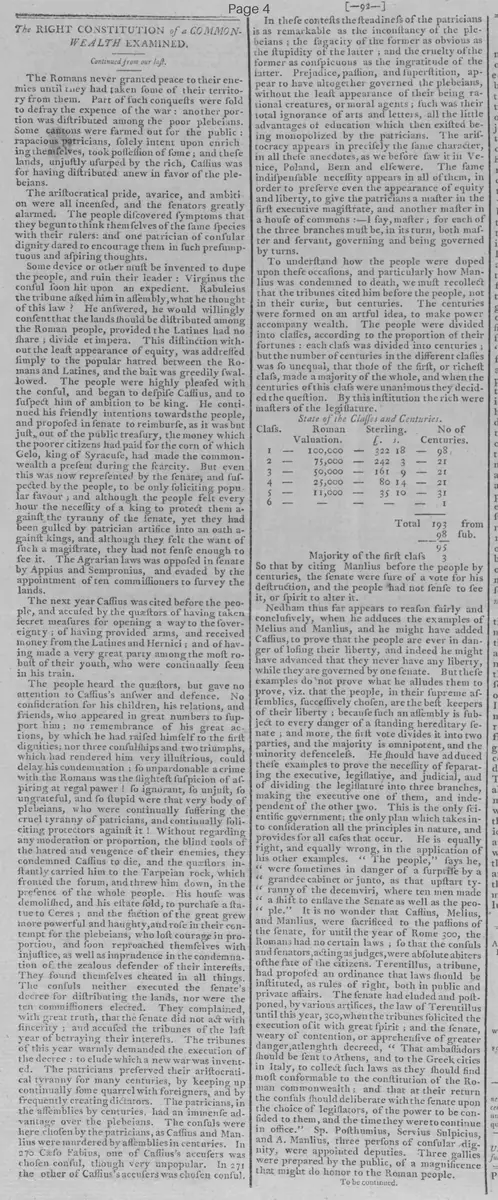
To understand how the people were duped upon these occasions, and particularly how Manlius was condemned to death, we must recollect that the tribunes cited him before the people, not in their curiæ, but centuries. The centuries were formed on an artful idea, to make power accompany wealth. The people were divided into classes, according to the proportion of their fortunes: each class was divided into centuries; but the number of centuries in the different classes was so unequal, that those of the first, or richest class, made a majority of the whole, and when the centuries of this class were unanimous they decided the question. By this institution the rich were masters of the legislature.
Total 193 from 98 sub. 95 Majority of the first class 3
So that by citing Manlius before the people by centuries, the senate were sure of a vote for his destruction, and the people had not sense to see it, or spirit to alter it.
Nedham thus far appears to reason fairly and conclusively, when he adduces the examples of Melius and Manlius, and he might have added Cassius, to prove that the people are ever in danger of losing their liberty, and indeed he might have advanced that they never have any liberty, while they are governed by one senate. But these examples do not prove what he alludes them to prove, viz. that the people, in their supreme assemblies, successively chosen, are the best keepers of their liberty; because such an assembly is subject to every danger of a standing hereditary senate; and more, the first vote divides it into two parties, and the majority is omnipotent, and the minority defenceless. He should have adduced these examples to prove the necessity of separating the executive, legislative, and judicial, and of dividing the legislature into three branches, making the executive one of them, and independent of the other two. This is the only scientific government; the only plan which takes into consideration all the principles in nature, and provides for all cases that occur. He is equally right, and equally wrong, in the application of his other examples. "The people," says he, "were sometimes in danger of a surprise by a grandee cabinet or junto, as that upstart tyranny of the decemviri, where ten men made a shift to enslave the Senate as well as the people." It is no wonder that Cassius, Melius, and Manlius, were sacrificed to the passions of the senate, for until the year of Rome 300, the Romans had no certain laws; so that the consuls and senators, acting as judges, were absolute arbiters of the fate of the citizens. Terentillus, a tribune, had proposed an ordinance that laws should be instituted, as rules of right, both in public and private affairs. The senate had eluded and postponed, by various artifices, the law of Terentillus until this year, 300, when the tribunes solicited the execution of it with great spirit; and the senate, weary of contention, or apprehensive of greater danger, at length decreed, "That ambassadors should be sent to Athens, and to the Greek cities in Italy, to collect such laws as they should find most conformable to the constitution of the Roman commonwealth; and that at their return the consuls should deliberate with the senate upon the choice of legislators, of the power to be confided to them, and the time they were to continue in office." Sp. Posthumius, Servius Sulpicius, and A. Manlius, three persons of consular dignity, were appointed deputies. Three galleys were prepared by the public, of a magnificence that might do honor to the Roman people.
To be continued.
| Claks. | Roman Valuation. | Sterling. | No of Centuries. |
| 1 | — 100,000 | — 322 18 | — 98 |
| 2 | — 75,000 | — 242 3 | — 21 |
| 3 | — 50,000 | — 161 9 | — 21 |
| 4 | — 25,000 | — 80 14 | — 21 |
| 5 | — 11,000 | — 35 10 | — 31 |
| 6 | — — | — — | — 1 |
What sub-type of article is it?
What themes does it cover?
What keywords are associated?
Literary Details
Title
The Right Constitution Of A Commonwealth. Wealth Examined.
Subject
Examination Of Roman Republican Governance And Patrician Plebeian Conflicts
Form / Style
Historical Political Essay
Key Lines