Thank you for visiting SNEWPapers!
Sign up free
Story
December 29, 1848
Anti Slavery Bugle
New Lisbon, Salem, Columbiana County, Ohio
What is this article about?
In Congress, Joshua R. Giddings presents a bill allowing male inhabitants of the District of Columbia over 21 to vote on slavery's existence via 'SLAVERY' or 'LIBERTY' tickets. Debate ensues with Mr. Tompkins questioning inclusion of negroes; Giddings affirms all males. Bill laid on table 106-79.
Clipping
OCR Quality
98%
Excellent
Full Text
Abolition in the District
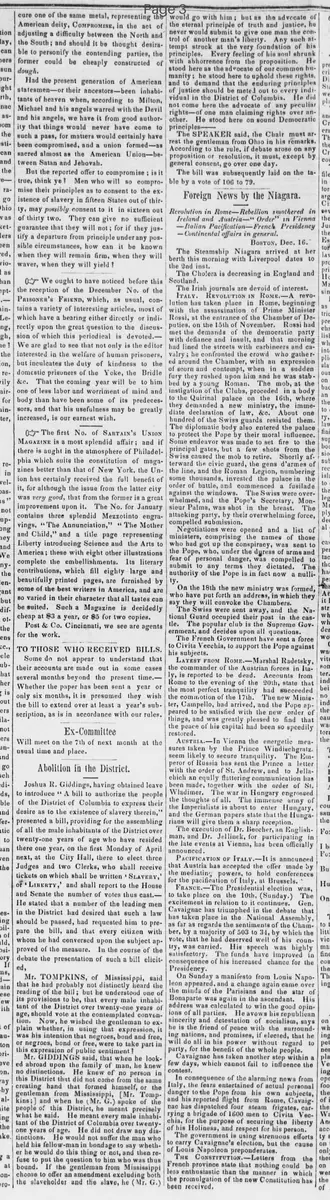
Joshua R. Giddings, having obtained leave to introduce "A bill to authorize the people of the District of Columbia to express their desire as to the existence of slavery therein," presented a bill, providing for the assembling of all the male inhabitants of the District over twenty-one years of age who have resided there one year, on the first Monday of April next, at the City Hall, there to elect three Judges and two Clerks, who shall receive tickets on which shall be written 'SLAVERY,' or 'LIBERTY,' and shall report to the House and Senate the number of votes thus cast.
He stated that a number of the leading men in the District had desired that such a law should be passed, had requested him to prepare the bill, and that every citizen with whom he had conversed upon the subject approved of the measure. In the course of the debate the presentation of such a bill elicited,
Mr. TOMPKINS, of Mississippi, said that he had probably not distinctly heard the reading of the bill; but he understood one of its provisions to be, that every male inhabitant of the District over twenty-one years of age, should vote at the contemplated convention. Now, he wished the gentleman to explain whether, in using that expression, it was his intention that negroes, bond and free, or negroes, bond or free, were to take part in this expression of public sentiment?
Mr. GIDDINGS said, that when he looked abroad upon the family of man, he knew no distinctions. He knew of no person in this District that did not come from the same creating hand that formed himself, or the gentleman from Mississippi, [Mr. Tompkins;] and when he (Mr. G.) spoke of the people of this District, he meant precisely what he said. He meant every male inhabitant of the District of Columbia over twenty-one years of age. He did not draw any distinctions. He would not suffer the man who held his fellow-man in bondage to say whether he would do this thing or not, and then refuse to put the question to him who was thus bound. If the gentleman from Mississippi choose to offer an amendment excluding both the slaveholder and the slave, he (Mr. G.) would go with him: but as the advocate of the eternal principle of truth and justice, he never would submit to give one man the control of another man's liberty. Any such attempt struck at the very foundation of his principles. Every feeling of his soul shrunk with abhorrence from the proposition. He stood here as the advocate of our common humanity; he stood here to uphold these rights, and to demand that the enduring principles of justice should be meted out to every individual in the District of Columbia. He did not come here the advocate of any peculiar rights—of one man claiming rights over another. He stood here on sound Democratic principles—
The SPEAKER said, the Chair must arrest the gentleman from Ohio in his remarks. According to the rule, if debate arose on any proposition or resolution, it must, except by general consent, go over one day.
The bill was subsequently laid on the table by a vote of 106 to 79.
Joshua R. Giddings, having obtained leave to introduce "A bill to authorize the people of the District of Columbia to express their desire as to the existence of slavery therein," presented a bill, providing for the assembling of all the male inhabitants of the District over twenty-one years of age who have resided there one year, on the first Monday of April next, at the City Hall, there to elect three Judges and two Clerks, who shall receive tickets on which shall be written 'SLAVERY,' or 'LIBERTY,' and shall report to the House and Senate the number of votes thus cast.
He stated that a number of the leading men in the District had desired that such a law should be passed, had requested him to prepare the bill, and that every citizen with whom he had conversed upon the subject approved of the measure. In the course of the debate the presentation of such a bill elicited,
Mr. TOMPKINS, of Mississippi, said that he had probably not distinctly heard the reading of the bill; but he understood one of its provisions to be, that every male inhabitant of the District over twenty-one years of age, should vote at the contemplated convention. Now, he wished the gentleman to explain whether, in using that expression, it was his intention that negroes, bond and free, or negroes, bond or free, were to take part in this expression of public sentiment?
Mr. GIDDINGS said, that when he looked abroad upon the family of man, he knew no distinctions. He knew of no person in this District that did not come from the same creating hand that formed himself, or the gentleman from Mississippi, [Mr. Tompkins;] and when he (Mr. G.) spoke of the people of this District, he meant precisely what he said. He meant every male inhabitant of the District of Columbia over twenty-one years of age. He did not draw any distinctions. He would not suffer the man who held his fellow-man in bondage to say whether he would do this thing or not, and then refuse to put the question to him who was thus bound. If the gentleman from Mississippi choose to offer an amendment excluding both the slaveholder and the slave, he (Mr. G.) would go with him: but as the advocate of the eternal principle of truth and justice, he never would submit to give one man the control of another man's liberty. Any such attempt struck at the very foundation of his principles. Every feeling of his soul shrunk with abhorrence from the proposition. He stood here as the advocate of our common humanity; he stood here to uphold these rights, and to demand that the enduring principles of justice should be meted out to every individual in the District of Columbia. He did not come here the advocate of any peculiar rights—of one man claiming rights over another. He stood here on sound Democratic principles—
The SPEAKER said, the Chair must arrest the gentleman from Ohio in his remarks. According to the rule, if debate arose on any proposition or resolution, it must, except by general consent, go over one day.
The bill was subsequently laid on the table by a vote of 106 to 79.
What sub-type of article is it?
Historical Event
What themes does it cover?
Justice
Moral Virtue
What keywords are associated?
Abolition
Slavery
District Of Columbia
Congressional Debate
Giddings
Tompkins
Voting On Liberty
What entities or persons were involved?
Joshua R. Giddings
Mr. Tompkins
The Speaker
Where did it happen?
District Of Columbia
Story Details
Key Persons
Joshua R. Giddings
Mr. Tompkins
The Speaker
Location
District Of Columbia
Event Date
First Monday Of April Next
Story Details
Joshua R. Giddings introduces a bill for District of Columbia residents to vote on slavery. Debate with Mr. Tompkins on including negroes; Giddings insists on all males. Speaker interrupts; bill tabled 106-79.