Thank you for visiting SNEWPapers!
Sign up free
Editorial
August 28, 1827
Richmond Enquirer
Richmond, Richmond County, Virginia
What is this article about?
Editorial from Norfolk Herald critiques the tariff system, quoting Daniel Webster's 1824 speech on the Tariff Bill. Webster opposes labeling protective tariffs as 'American policy' versus 'foreign policy,' arguing the bill's provisions are heterogeneous and true American policy balances agriculture, commerce, and manufactures.
Clipping
OCR Quality
95%
Excellent
Full Text
From the Norfolk Herald.
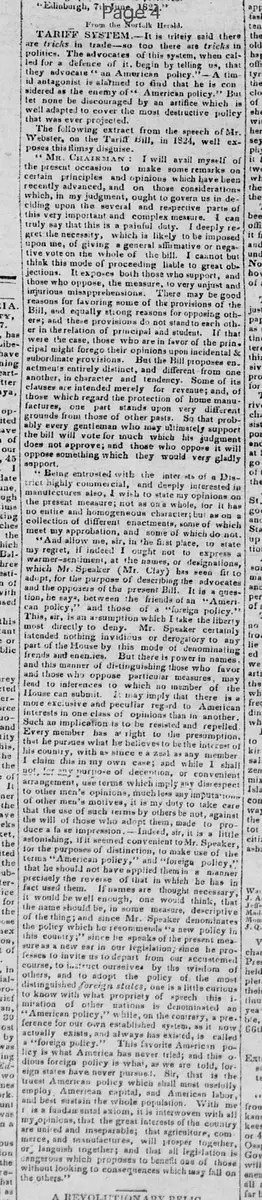
TARIFF SYSTEM.—It is truly said there are tricks in trade—so too there are tricks in politics. The advocates of this system, when called for a defence of it, begin by telling us, that they advocate "an American policy." A timid antagonist is alarmed to find that he is considered as the enemy of "American policy." But let none be discouraged by an artifice which is well adapted to cover the most destructive policy that was ever projected.
The following extract from the speech of Mr. Webster, on the Tariff Bill, in 1824, well exposes this flimsy disguise.
"MR. CHAIRMAN: I will avail myself of the present occasion to make some remarks on certain principles and opinions which have been recently advanced, and on those considerations which, in my judgment, ought to govern us in deciding upon the several and respective parts of this very important and complex measure. I can truly say that this is a painful duty. I deeply regret the necessity, which is likely to be imposed upon me, of giving a general affirmative or negative vote on the whole of the bill. I cannot but think this mode of proceeding liable to great objections. It exposes both those who support, and those who oppose, the measure, to very unjust and irritious misapprehensions. There may be good reasons for favoring some of the provisions of the Bill, and equally strong reasons for opposing others; and there provisions do not stand to each other in the relation of principal and incident. If that were the case, those who are in favor of the principal might forego their opinions upon incidental & subordinate provisions. But the Bill proposes enactments entirely distinct, and different from one another, in character and tendency. Some of its clauses are intended merely for revenue; and, of those which regard the protection of home manufactures, one part stands upon very different grounds from those of other parts. So that probably every gentleman who may ultimately support the bill will vote for much which his judgment does not approve; and those who oppose it will oppose something which they would very gladly support.
"Being entrusted with the interests of a District highly commercial, and deeply interested in manufactures also, I wish to state my opinions on the present measure; not as on a whole, for it has no entire and homogeneous character; but as on a collection of different enactments, some of which meet my approbation, and some of which do not.
"And allow me, sir, in the first place, to state my regret, if indeed I ought not to express a warmer sentiment, at the names, or designations, which Mr. Speaker (Mr. Clay) has seen fit to adopt, for the purpose of describing the advocates and the opposers of the present Bill. It is a question, he says, between the friends of an "American policy," and those of a "foreign policy." This, sir, is an assumption which I take the liberty most directly to deny. Mr. Speaker certainly intended nothing invidious or derogatory to any part of the House by this mode of denominating friends and enemies. But there is power in names. and this manner of distinguishing those who favor and those who oppose particular measures, may lead to inferences to which no member of the House can submit. It may imply that there is a more exclusive and peculiar regard to American interests in one class of opinions than in another. Such an implication is to be resisted and repelled. Every member has a right to the presumption, that he pursues what he believes to be the interest of his country, with as sincere a zeal as any member I claim this in my own case; and while I shall not, for any purpose of distinction, or convenient arrangement, use terms which imply any disrespect to other men's opinions, much less any imputations of other men's motives, it is my duty to take care that the use of such terms by others be not, against the will of those who adopt them, made to produce a false impression.—Indeed, sir, it is a little astonishing, if it seemed convenient to Mr. Speaker, for the purposes of distinction, to make use of the terms "American policy," and "foreign policy," that he should not have applied them in a manner precisely the reverse of that in which he has in fact used them. If names are thought necessary, it would be well enough, one would think, that the name should be, in some measure, descriptive of the thing; and since Mr. Speaker denominates the policy which he recommends "a new policy in this country;" since he speaks of the present measure as a new era in our legislation; since he professes to invite us to depart from our accustomed course, to instruct ourselves by the wisdom of others, and to adopt the policy of the most distinguished foreign states, one is a little curious to know with what propriety of speech this imitation of other nations is denominated an "American policy," while, on the contrary, a preference for our own established system, as it now actually exists, and always has existed, is called a "foreign policy." This favorite American policy is what America has never tried; and this odious foreign policy is what, as we are told, foreign states have never pursued. Sir, that is the truest American policy which shall most usefully employ, American capital, and American labor, and best sustain the whole population. With me it is a fundamental axiom, it is interwoven with all my opinions, that the great interests of the country are united and inseparable; that agriculture, commerce, and manufactures, will prosper together, or languish together; and that all legislation is dangerous which proposes to benefit one of those without looking to consequences which may fall on the others."
TARIFF SYSTEM.—It is truly said there are tricks in trade—so too there are tricks in politics. The advocates of this system, when called for a defence of it, begin by telling us, that they advocate "an American policy." A timid antagonist is alarmed to find that he is considered as the enemy of "American policy." But let none be discouraged by an artifice which is well adapted to cover the most destructive policy that was ever projected.
The following extract from the speech of Mr. Webster, on the Tariff Bill, in 1824, well exposes this flimsy disguise.
"MR. CHAIRMAN: I will avail myself of the present occasion to make some remarks on certain principles and opinions which have been recently advanced, and on those considerations which, in my judgment, ought to govern us in deciding upon the several and respective parts of this very important and complex measure. I can truly say that this is a painful duty. I deeply regret the necessity, which is likely to be imposed upon me, of giving a general affirmative or negative vote on the whole of the bill. I cannot but think this mode of proceeding liable to great objections. It exposes both those who support, and those who oppose, the measure, to very unjust and irritious misapprehensions. There may be good reasons for favoring some of the provisions of the Bill, and equally strong reasons for opposing others; and there provisions do not stand to each other in the relation of principal and incident. If that were the case, those who are in favor of the principal might forego their opinions upon incidental & subordinate provisions. But the Bill proposes enactments entirely distinct, and different from one another, in character and tendency. Some of its clauses are intended merely for revenue; and, of those which regard the protection of home manufactures, one part stands upon very different grounds from those of other parts. So that probably every gentleman who may ultimately support the bill will vote for much which his judgment does not approve; and those who oppose it will oppose something which they would very gladly support.
"Being entrusted with the interests of a District highly commercial, and deeply interested in manufactures also, I wish to state my opinions on the present measure; not as on a whole, for it has no entire and homogeneous character; but as on a collection of different enactments, some of which meet my approbation, and some of which do not.
"And allow me, sir, in the first place, to state my regret, if indeed I ought not to express a warmer sentiment, at the names, or designations, which Mr. Speaker (Mr. Clay) has seen fit to adopt, for the purpose of describing the advocates and the opposers of the present Bill. It is a question, he says, between the friends of an "American policy," and those of a "foreign policy." This, sir, is an assumption which I take the liberty most directly to deny. Mr. Speaker certainly intended nothing invidious or derogatory to any part of the House by this mode of denominating friends and enemies. But there is power in names. and this manner of distinguishing those who favor and those who oppose particular measures, may lead to inferences to which no member of the House can submit. It may imply that there is a more exclusive and peculiar regard to American interests in one class of opinions than in another. Such an implication is to be resisted and repelled. Every member has a right to the presumption, that he pursues what he believes to be the interest of his country, with as sincere a zeal as any member I claim this in my own case; and while I shall not, for any purpose of distinction, or convenient arrangement, use terms which imply any disrespect to other men's opinions, much less any imputations of other men's motives, it is my duty to take care that the use of such terms by others be not, against the will of those who adopt them, made to produce a false impression.—Indeed, sir, it is a little astonishing, if it seemed convenient to Mr. Speaker, for the purposes of distinction, to make use of the terms "American policy," and "foreign policy," that he should not have applied them in a manner precisely the reverse of that in which he has in fact used them. If names are thought necessary, it would be well enough, one would think, that the name should be, in some measure, descriptive of the thing; and since Mr. Speaker denominates the policy which he recommends "a new policy in this country;" since he speaks of the present measure as a new era in our legislation; since he professes to invite us to depart from our accustomed course, to instruct ourselves by the wisdom of others, and to adopt the policy of the most distinguished foreign states, one is a little curious to know with what propriety of speech this imitation of other nations is denominated an "American policy," while, on the contrary, a preference for our own established system, as it now actually exists, and always has existed, is called a "foreign policy." This favorite American policy is what America has never tried; and this odious foreign policy is what, as we are told, foreign states have never pursued. Sir, that is the truest American policy which shall most usefully employ, American capital, and American labor, and best sustain the whole population. With me it is a fundamental axiom, it is interwoven with all my opinions, that the great interests of the country are united and inseparable; that agriculture, commerce, and manufactures, will prosper together, or languish together; and that all legislation is dangerous which proposes to benefit one of those without looking to consequences which may fall on the others."
What sub-type of article is it?
Economic Policy
Trade Or Commerce
Partisan Politics
What keywords are associated?
Tariff System
American Policy
Webster Speech
Protective Tariffs
Commerce
Manufactures
Clay
1824 Tariff Bill
What entities or persons were involved?
Mr. Webster
Mr. Speaker (Mr. Clay)
Norfolk Herald
Editorial Details
Primary Topic
Critique Of Tariff System As American Policy
Stance / Tone
Opposition To Protective Tariff Labeling And Heterogeneous Bill
Key Figures
Mr. Webster
Mr. Speaker (Mr. Clay)
Norfolk Herald
Key Arguments
Tariff Advocates Use 'American Policy' As Artifice To Disguise Destructive Measures
Bill Is Not Homogeneous; Parts For Revenue Vs. Protection Differ
Regret Over Voting On Whole Bill Due To Mixed Provisions
Denial Of 'American Policy' Vs. 'Foreign Policy' Distinction As Unfair
True American Policy Employs Capital, Labor, And Balances Agriculture, Commerce, Manufactures
Protective Tariffs Imitate Foreign Policies America Has Not Tried