Thank you for visiting SNEWPapers!
Sign up free
The New Hampshire Gazette
Portsmouth, Rockingham County, New Hampshire
What is this article about?
The recent extraordinary session of the 13th Congress focused on war finance, passing laws for direct and internal taxes, a $7.5 million loan, military enhancements like sea fencibles and extended enlistments, support for privateering, prohibition of British licenses, and amendments to naturalization and session timing laws.
Clipping
OCR Quality
Full Text
The late Session of Congress.
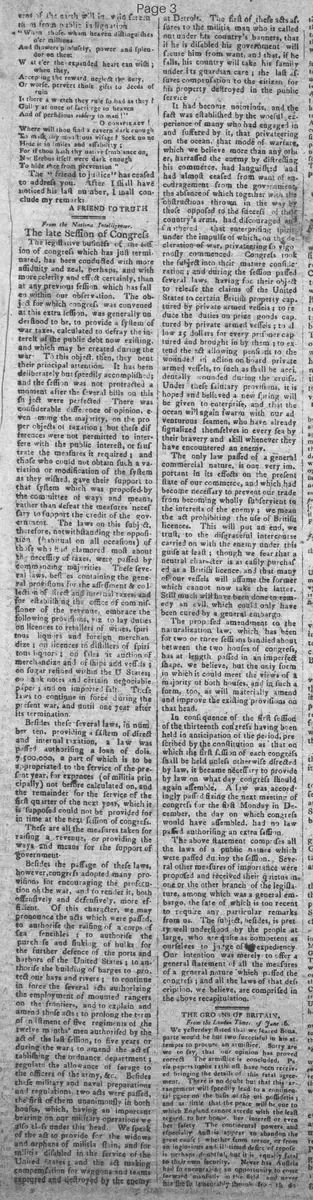
The legislative business of the last session of congress which has just terminated, has been conducted with more diligence and zeal, perhaps, and with more celerity and effect certainly, than at any previous session which has fallen within our observation. The object for which congress was convened at this extra session, was generally understood to be, to provide a system of war taxes, calculated to defray the interest of the public debt now existing, and which may be created during the war. To this object, then, they bent their principal attention. It has been deliberately but speedily accomplished; and the session was not protracted a moment after the several bills on this subject were perfected. There was considerable difference of opinion, even among the majority, on the proper objects of taxation; but these differences were not permitted to interfere with the public interest, or frustrate the measures it required: and those who could not obtain such a variation or modification of the system as they wished, gave their support to that system which was proposed by the committee of ways and means, rather than defeat the measures necessary to support the credit of the government. The laws on this subject therefore, notwithstanding the opposition (habitual on all occasions) of those who had clamored most about the necessity of taxes, were passed by commanding majorities. These several laws, besides containing the general provisions for the assessment & collection of direct and internal taxes, and for establishing the office of commissioner of the revenue, embrace the following provisions, viz to lay duties on licences to retailers of wines, spirits liquors and foreign merchandize; on licences to distillers of spirits liquors; on sales at auction of merchandize and of ships and vessels; on sugar refined within the U States; on bank notes and certain negotiable paper; and on imported salt. These laws to continue in force during the present war, and until one year after its termination.
Besides these several laws, in number ten, providing a system of direct and internal taxation, a law was passed authorizing a loan of 7 500,000, a part of which is to be appropriated to the service of the present year, for expenses (of militia principally) not before calculated on, and the remainder for the service of the first quarter of the next year, which it is supposed could not be provided for in time at the next session of congress. These are all the measures taken for raising a revenue, or providing the ways and means for the support of government.
Besides the passage of these laws, however, congress adopted many provisions for encouraging the prosecution of the war, and to render it, both offensively and defensively, more efficient. Of this character, we may pronounce the acts which were passed, to authorize the raising of a corps of sea fencibles to authorize the purchase and sinking of hulks for the further defence of the ports and harbors of the United States; to authorize the building of barges to protect our bays and rivers; to continue in force the several acts authorizing the employment of mounted rangers on the frontiers, and to explain and amend those acts: to prolong the term of enlistment of five regiments of the twelve months' men authorized by the act of the last session, to five years or during the war; to amend the act establishing the ordnance department; regulate the allowance of forage to the officers of the army, &c. Besides these military and naval preparations and regulations, two acts were passed, the first of them unanimously in both houses, which, having an important bearing on our military operations we also class under this head. We speak of the act to provide for the widows and orphans of militia slain, and for militia disabled in the service of the United States; and the act making compensation for waggons and teams seized and destroyed by the enemy at Detroit. The first of these acts afford assures to the militia man who is called out under his country's banners, that if he is disabled his government will secure him from want, and that, if he falls, his country will take his family under its guardian care; the last afford compensation to the citizen for his property destroyed in the public service.
It had become notorious, and the fact was established by the woeful experience of many who had engaged in and suffered by it, that privateering on the ocean, that mode of warfare, which we believe more than any other, harassed the enemy by distressing his commerce, had languished and had almost ceased from want of encouragement from the government, the absence of which together with the obstructions thrown in the way by those opposed to the success of the country's arms, had discouraged and rathered that enterprising spirit under the impulse of which, on the declaration of war, privateering vigorously commenced: Congress took the subject into their mature considerations; and during the session passed several laws, having for their object to release the claims of the United States to certain British property captured by private armed vessels; to reduce the duties on prize goods captured by private armed vessels; to allow 25 dollars for every prisoner captured and brought in by them; to extend the act allowing pensions to the wounded in action on board private armed vessels, to such as shall be accidentally wounded during the cruise. Under these salutary provisions, it is hoped and believed a new spring will be given to enterprise, and that the ocean will again swarm with our adventurous seamen, who have already signalized themselves in every sea by their bravery and skill whenever they have encountered an enemy.
The only law passed of a general commercial nature, is one, very important in its effects on the present state of our commerce, and which had become necessary to prevent our trade from becoming wholly subservient to the interests of the enemy; we mean the act prohibiting the use of British licences. This will put an end, we trust, to the disgraceful intercourse carried on with the enemy under this guise at least; though we fear that a neutral character is as easily purchased as a British licence, and that many of our vessels will assume the former which cannot now take the latter. Still much will have been done to remedy an evil, which could only have been cured by a general embargo.
The proposed amendment to the naturalization law, which has been for two or three sessions bandied about between the two houses of congress, has at length passed in an imperfect shape, we believe, but the only form in which it could meet the views of a majority of both houses, and in such a form, too, as will materially amend and improve the existing provisions on that head.
In consequence of the first session of the thirteenth congress having been held in anticipation of the period, prescribed by the constitution as "that on which the first session of each congress shall be held unless otherwise directed by law, it became necessary to provide by law on what day congress should again assemble. A law was accordingly passed fixing the next meeting of congress for the first Monday in December, the day on which congress would have assembled, had no law passed authorizing an extra session.
The above statement comprises all the laws of a public nature which were passed during the session. Several other measures of importance were proposed and received their quietus in one or the other branch of the legislature, among which was a general embargo, the fate of which is too recent to require any particular remarks from us. The subject, besides, is pretty well understood by the people at large, who are quite as competent as ourselves to judge of its expediency. Our intention was merely to offer a general statement of all the measures of a general nature which passed the congress; and all the laws of that description, we believe, are comprised in the above recapitulation.
What sub-type of article is it?
What keywords are associated?
Domestic News Details
Event Date
Late Extra Session Of The Thirteenth Congress
Outcome
passed ten laws on direct and internal taxes; authorized $7,500,000 loan; enacted military and naval provisions; supported privateering; prohibited british licenses; amended naturalization law; set next session for first monday in december.
Event Details
The session focused on war taxes to defray public debt interest, including duties on licenses, sales, refined sugar, bank notes, and imported salt, effective during the war and one year after. Additional measures included loan authorization, raising sea fencibles, building barges, extending enlistments, providing for militia widows/orphans and property compensation, enhancing privateering incentives, banning British licenses, and naturalization amendments.