Thank you for visiting SNEWPapers!
Sign up free
Story
June 4, 1894
The Morning News
Savannah, Chatham County, Georgia
What is this article about?
Article discusses the prevalent use of unofficial titles like 'general' and 'judge' in America despite republican ideals, contrasting with founders' debates. Focuses on John Adams' push for formal titles in 1789 Congress, ultimately rejected for simplicity.
Clipping
OCR Quality
95%
Excellent
Full Text
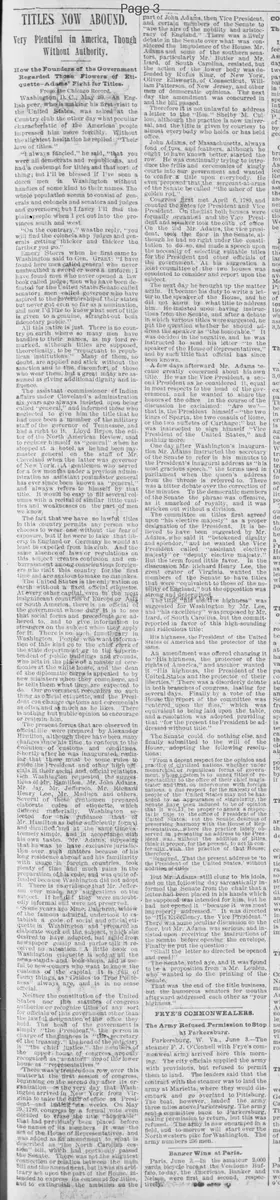
TITLES NOW ABOUND.
Very Plentiful in America, Though Without Authority.
How the Founders of the Government Regarded Those Flowers of Etiquette—Adams' Fight for Titles.
From the Chicago Record.
Washington, D. C., May 20.—An English peer, who is making his first visit to the United States, was asked at the Country club the other day what peculiar characteristic of the American people impressed him more forcibly. Without the slightest hesitation he replied: "Their love of titles."
"I always fancied," he said, "that you were all democrats and republicans, and had a contempt for titles and that sort of thing; but I'll be blessed if I've seen a dozen men in Washington without handles of some kind to their names. The whole population seems to consist of generals and colonels and senators and judges and governors; but I fancy I'll find the plain people when I get out into the provinces south and west."
"On the contrary," was the reply, "you will find the colonels and judges and generals getting thicker and thicker the farther you go."
Emery Storrs when he first came to Washington said to Gen. Grant: "I have found here men called general who never unsheathed a sword or wore a uniform; I have found men who never opened a law book called judge; men who have been defeated for the United States Senate called senator; men called governor who have aspired to the governorship of their states but never got even so far as a nomination, and now I'd like to know what sort of title is given to a genuine, straight-out bona fide notary public."
All this satire is just. There is no country on earth where so many men have handles to their names, as my lord remarked, although titles are supposed, theoretically, to be "repugnant to republican institutions." Many of them, no doubt, are applied and stick without the sanction and to the discomfort of those who wear them, but a great many are assumed as giving additional dignity and influence.
The assistant commissioner of Indian affairs under Cleveland's administration six years ago always insisted upon being called "general," and informed those who neglected to give him the title that he had once been a member of the military staff of the governor of Tennessee, and had a right to it. Lloyd Bryce, the editor of the North American Review, used to register himself as "general" when he stopped at a hotel, as he had been paymaster general on the staff of Mr. Cleveland when the latter was governor of New York. A gentleman who served for a few months under a previous administration as assistant postmaster general has ever since been known as "general," and always refers to himself by that title. It would be easy to fill several columns with a recital of similar little vanities and weaknesses on the part of men we know.
The fact that we have no lawful titles in this country permits any person who chooses to wear one without the fear of exposure, but if he were to take that liberty in England or Germany he would at least be expelled from his club. And the same absence of laws or regulations on this subject creates confusion and embarrassment among conscientious foreigners who visit this country for the first time and are anxious to make no mistakes.
The United States is the only nation on earth without a fixed official etiquette. At every other capital, even in the most insignificant countries of Europe or Asia or South America, there is an official of the government whose duty it is to see that social forms and precedents are adhered to, and to give information to strangers on the subject when they apply for it. There is no such functionary in Washington. People who want information of this kind go to the chief clerk of the state department or to the superintendent of public buildings and grounds, who acts in the place of a master of ceremonies at the white house, and the dean of the diplomatic corps is appealed to by new ministers when they come here, and he tells them what they are expected to do. Our government recognizes no such thing as official etiquette, and the President can change customs and ceremonials as often and as much as he likes. There is nothing but public opinion to encourage or restrain him.
The present forms that are observed in official life were prepared by Alexander Hamilton, although there have been many changes since his time to conform to the evolution of customs and conditions.
Shortly after he was inaugurated, realizing that there must be some rules to guide the President and other high officials in their social and official relations, Gen. Washington requested the suggestions of Mr. Hamilton, Mr. John Adams, Mr. Jay, Mr. Jefferson, Mr. Richard Henry Lee, Mr. Madison and others.
Several of these gentlemen prepared elaborate codes of etiquette, which differed materially. Washington selected for his guidance that of Mr. Hamilton as being sufficiently formal and dignified, and at the same time extremely simple, and in accordance with his own tastes. Mr. Adams, supposing that he was to have exclusive jurisdiction over such matters because of his long residence abroad and his familiarity with usage in foreign countries, took plenty of time and much pains in the preparation of his code, and was quite offended because Washington did not adopt it. There is no evidence that Mr. Jefferson ever made any suggestions on the subject. If he did they were undoubtedly informal and were not preserved.
Some years ago Mme. Dahlgren, widow of the famous admiral, undertook to establish a code of social and official etiquette in Washington and prepared an elaborate work on the subject, which she desired to have adopted, but aside from newspaper gossip and parlor talk it received no attention. A little book on Washington etiquette is sold at all the news-stands and book-shops, and is useful to new-comers who want to know the customs of the capital. It is full of funny things, as "Guides to True Politeness" always are, and is in no sense official.
Neither the constitution of the United States nor the statutes of congress authorize or recognize titles of any sort for officials of this government other than the lawful designation of the office they hold. The head of the government is simply the President, the person in charge of the finances is "the secretary of the treasury," the head of the judiciary is "the chief justice," the members of the upper house of congress are only recognized as "senators" and of the lower house as "representatives."
There was a tremendous row over this matter at the first session of congress, beginning on the second day after its organization—on the very day that Washington arrived in New York from Virginia to take the oath of office as President—and lasting six weeks. On May 29, 1789, congress by a formal vote even decided to erase the title "honorable" that had previously been placed before the names of its members. It was the act of the House of Representatives, and was added as an amendment to what is described as "the North Carolina cession" bill, which had previously passed the Senate. There was not the slightest connection or relation between the main bill and the amendment, but it was an arbitrary act upon the part of the House, intended to express its contempt for titles, and to extinguish the ambition on the part of John Adams, then Vice President, and certain members of the Senate to "ape the airs of the nobility and aristocracy of England." There was a lively debate in the Senate over what was considered the impertinence of the House. Mr. Adams and some of the southern senators, particularly Mr. Butler and Mr. Izard, of South Carolina, resisted, but the action of the lower body was defended by Rufus King, of New York. Oliver Ellsworth, of Connecticut, William Patterson, of New Jersey, and other men of democratic opinions. The next day the amendment was concurred in and the bill passed.
Therefore it is not unlawful to address a letter to the "Hon." Shelby M. Cullom, although the practice is now universal, and the title is given by courtesy to almost everybody who holds or has held office.
John Adams, of Massachusetts, always fond of fuss and feathers, although he ought to have known better, started the row. He was continually trying to introduce the frills and ceremonies of kingly courts into our government and wanted to confer a title upon everybody. He even proposed that the sergeant-at-arms of the Senate be called "the usher of the golden rod."
Congress first met April 6, 1789, and counted the votes for President and Vice President. On the 6th both houses were formally organized and the Vice President and speaker took the oath of office. On the 8th Mr. Adams, the vice president, took the floor in the Senate, although he had no right under the constitution to do so, and made a speech upon the necessity of selecting suitable titles for the President and other officials of the government. At his suggestion a joint committee of the two houses was appointed to consider and report upon the subject.
The next day he brought up the matter again. It became his duty to write a letter to the speaker of the House, and he did not know by what title to address him. He insisted upon having instructions from the Senate, and after a debate in which various titles were suggested, he put the question whether he should address the speaker as "the honorable." It was decided in the negative, and he was instructed to send his letter "to the speaker of the House of Representatives," and by such title that official has since been known.
A few days afterward Mr. Adams became greatly concerned about his own title. He was the Vice President, a second President as he considered it, equal in most respects to the head of the government, and he wanted to share the honors of the office. In the course of the discussion he exclaimed: "Are we—that is, the President himself—'the two kings of Sparta, the two consuls of Rome, or the two suffetes of Carthage;'" but he was instructed to sign himself "Vice President of the United States," and nothing more.
One day after Washington's inauguration Mr. Adams instructed the secretary of the Senate to refer in his minutes to the President's inaugural address as "his most gracious speech," the terms used in parliament when the queen's address from the throne is referred to. There was a bitter debate over the correction of the minutes. To the democratic members of the Senate the phrase was offensive, as it smacked of royalty, and it was stricken out without a division.
The committee on titles first agreed upon "his elective majesty" as a proper designation of the President. It is believed to have been suggested by Mr. Adams, who said it "betokened dignity and splendor," and he wanted the Vice President called "assistant elective majesty" or "deputy elective majesty." But the term found little favor. In the discussion Mr. Richard Henry Lee, the great orator of Virginia, wanted the members of the Senate to have titles that were "equivalent to those of the nobility of England," but the opposition was strong and determined.
The title "his elective highness" was suggested for Washington by Mr. Lee, and "his excellency" was proposed by Mr. Izard, of South Carolina, but the committee reported in favor of this high-sounding and ridiculous title:
His highness, the President of the United States of America and the protector of the same.
An amendment was offered changing it to "His highness, the protector of the rights of America," and another wanted it "His highness, the President of the United States and the protector of their liberties." There was a disorderly debate in both branches of congress, lasting for several days. Finally by a vote of the House the report of the committee was "entered upon the files," which was equivalent to being laid upon the table, and a resolution was adopted providing that "for the present the President be addressed without title."
The Senate could do nothing else, and finally submitted to the will of the House, adopting the following resolutions:
"From a decent respect for the opinion and practice of civilized nations, whether under monarchical or republican forms of government, whose custom is to annex titles of respectability to the office of their chief magistrate; and that, on intercourse with foreign nations, a due respect for the majesty of the people of the United States may not be hazarded by an appearance of singularity, the Senate have been induced to be of opinion that it would be proper to annex a respectable title to the office of President of the United States: but the Senate, desirous of preserving harmony with the House of Representatives, where the practice lately observed in presenting an address to the President was without the addition of titles, think it proper, for the present, to act in conformity with the practice of that House; therefore—
Resolved, That the present address be 'to the President of the United States,' without addition of title."
But Mr. Adams still clung to his idols, and on the following day sarcastically informed the Senate from the chair that a letter had been placed in his hands which he supposed was intended for him, but he had not opened it because it was most improperly addressed." It was directed to "His Excellency, the Vice President."
There was some jocular discussion on the floor, but Mr. Adams was serious, and insisted upon receiving the instructions of the Senate before opening the envelope. Finally he put the question:
"Shall the letter so directed be opened and read?"
The Senate voted aye, and it was found to be a proposition from a Mr. Louden, who wanted to do the printing of the Senate.
That was the end of the title business, but the humorous senators for months afterward addressed each other as "your highness."
Very Plentiful in America, Though Without Authority.
How the Founders of the Government Regarded Those Flowers of Etiquette—Adams' Fight for Titles.
From the Chicago Record.
Washington, D. C., May 20.—An English peer, who is making his first visit to the United States, was asked at the Country club the other day what peculiar characteristic of the American people impressed him more forcibly. Without the slightest hesitation he replied: "Their love of titles."
"I always fancied," he said, "that you were all democrats and republicans, and had a contempt for titles and that sort of thing; but I'll be blessed if I've seen a dozen men in Washington without handles of some kind to their names. The whole population seems to consist of generals and colonels and senators and judges and governors; but I fancy I'll find the plain people when I get out into the provinces south and west."
"On the contrary," was the reply, "you will find the colonels and judges and generals getting thicker and thicker the farther you go."
Emery Storrs when he first came to Washington said to Gen. Grant: "I have found here men called general who never unsheathed a sword or wore a uniform; I have found men who never opened a law book called judge; men who have been defeated for the United States Senate called senator; men called governor who have aspired to the governorship of their states but never got even so far as a nomination, and now I'd like to know what sort of title is given to a genuine, straight-out bona fide notary public."
All this satire is just. There is no country on earth where so many men have handles to their names, as my lord remarked, although titles are supposed, theoretically, to be "repugnant to republican institutions." Many of them, no doubt, are applied and stick without the sanction and to the discomfort of those who wear them, but a great many are assumed as giving additional dignity and influence.
The assistant commissioner of Indian affairs under Cleveland's administration six years ago always insisted upon being called "general," and informed those who neglected to give him the title that he had once been a member of the military staff of the governor of Tennessee, and had a right to it. Lloyd Bryce, the editor of the North American Review, used to register himself as "general" when he stopped at a hotel, as he had been paymaster general on the staff of Mr. Cleveland when the latter was governor of New York. A gentleman who served for a few months under a previous administration as assistant postmaster general has ever since been known as "general," and always refers to himself by that title. It would be easy to fill several columns with a recital of similar little vanities and weaknesses on the part of men we know.
The fact that we have no lawful titles in this country permits any person who chooses to wear one without the fear of exposure, but if he were to take that liberty in England or Germany he would at least be expelled from his club. And the same absence of laws or regulations on this subject creates confusion and embarrassment among conscientious foreigners who visit this country for the first time and are anxious to make no mistakes.
The United States is the only nation on earth without a fixed official etiquette. At every other capital, even in the most insignificant countries of Europe or Asia or South America, there is an official of the government whose duty it is to see that social forms and precedents are adhered to, and to give information to strangers on the subject when they apply for it. There is no such functionary in Washington. People who want information of this kind go to the chief clerk of the state department or to the superintendent of public buildings and grounds, who acts in the place of a master of ceremonies at the white house, and the dean of the diplomatic corps is appealed to by new ministers when they come here, and he tells them what they are expected to do. Our government recognizes no such thing as official etiquette, and the President can change customs and ceremonials as often and as much as he likes. There is nothing but public opinion to encourage or restrain him.
The present forms that are observed in official life were prepared by Alexander Hamilton, although there have been many changes since his time to conform to the evolution of customs and conditions.
Shortly after he was inaugurated, realizing that there must be some rules to guide the President and other high officials in their social and official relations, Gen. Washington requested the suggestions of Mr. Hamilton, Mr. John Adams, Mr. Jay, Mr. Jefferson, Mr. Richard Henry Lee, Mr. Madison and others.
Several of these gentlemen prepared elaborate codes of etiquette, which differed materially. Washington selected for his guidance that of Mr. Hamilton as being sufficiently formal and dignified, and at the same time extremely simple, and in accordance with his own tastes. Mr. Adams, supposing that he was to have exclusive jurisdiction over such matters because of his long residence abroad and his familiarity with usage in foreign countries, took plenty of time and much pains in the preparation of his code, and was quite offended because Washington did not adopt it. There is no evidence that Mr. Jefferson ever made any suggestions on the subject. If he did they were undoubtedly informal and were not preserved.
Some years ago Mme. Dahlgren, widow of the famous admiral, undertook to establish a code of social and official etiquette in Washington and prepared an elaborate work on the subject, which she desired to have adopted, but aside from newspaper gossip and parlor talk it received no attention. A little book on Washington etiquette is sold at all the news-stands and book-shops, and is useful to new-comers who want to know the customs of the capital. It is full of funny things, as "Guides to True Politeness" always are, and is in no sense official.
Neither the constitution of the United States nor the statutes of congress authorize or recognize titles of any sort for officials of this government other than the lawful designation of the office they hold. The head of the government is simply the President, the person in charge of the finances is "the secretary of the treasury," the head of the judiciary is "the chief justice," the members of the upper house of congress are only recognized as "senators" and of the lower house as "representatives."
There was a tremendous row over this matter at the first session of congress, beginning on the second day after its organization—on the very day that Washington arrived in New York from Virginia to take the oath of office as President—and lasting six weeks. On May 29, 1789, congress by a formal vote even decided to erase the title "honorable" that had previously been placed before the names of its members. It was the act of the House of Representatives, and was added as an amendment to what is described as "the North Carolina cession" bill, which had previously passed the Senate. There was not the slightest connection or relation between the main bill and the amendment, but it was an arbitrary act upon the part of the House, intended to express its contempt for titles, and to extinguish the ambition on the part of John Adams, then Vice President, and certain members of the Senate to "ape the airs of the nobility and aristocracy of England." There was a lively debate in the Senate over what was considered the impertinence of the House. Mr. Adams and some of the southern senators, particularly Mr. Butler and Mr. Izard, of South Carolina, resisted, but the action of the lower body was defended by Rufus King, of New York. Oliver Ellsworth, of Connecticut, William Patterson, of New Jersey, and other men of democratic opinions. The next day the amendment was concurred in and the bill passed.
Therefore it is not unlawful to address a letter to the "Hon." Shelby M. Cullom, although the practice is now universal, and the title is given by courtesy to almost everybody who holds or has held office.
John Adams, of Massachusetts, always fond of fuss and feathers, although he ought to have known better, started the row. He was continually trying to introduce the frills and ceremonies of kingly courts into our government and wanted to confer a title upon everybody. He even proposed that the sergeant-at-arms of the Senate be called "the usher of the golden rod."
Congress first met April 6, 1789, and counted the votes for President and Vice President. On the 6th both houses were formally organized and the Vice President and speaker took the oath of office. On the 8th Mr. Adams, the vice president, took the floor in the Senate, although he had no right under the constitution to do so, and made a speech upon the necessity of selecting suitable titles for the President and other officials of the government. At his suggestion a joint committee of the two houses was appointed to consider and report upon the subject.
The next day he brought up the matter again. It became his duty to write a letter to the speaker of the House, and he did not know by what title to address him. He insisted upon having instructions from the Senate, and after a debate in which various titles were suggested, he put the question whether he should address the speaker as "the honorable." It was decided in the negative, and he was instructed to send his letter "to the speaker of the House of Representatives," and by such title that official has since been known.
A few days afterward Mr. Adams became greatly concerned about his own title. He was the Vice President, a second President as he considered it, equal in most respects to the head of the government, and he wanted to share the honors of the office. In the course of the discussion he exclaimed: "Are we—that is, the President himself—'the two kings of Sparta, the two consuls of Rome, or the two suffetes of Carthage;'" but he was instructed to sign himself "Vice President of the United States," and nothing more.
One day after Washington's inauguration Mr. Adams instructed the secretary of the Senate to refer in his minutes to the President's inaugural address as "his most gracious speech," the terms used in parliament when the queen's address from the throne is referred to. There was a bitter debate over the correction of the minutes. To the democratic members of the Senate the phrase was offensive, as it smacked of royalty, and it was stricken out without a division.
The committee on titles first agreed upon "his elective majesty" as a proper designation of the President. It is believed to have been suggested by Mr. Adams, who said it "betokened dignity and splendor," and he wanted the Vice President called "assistant elective majesty" or "deputy elective majesty." But the term found little favor. In the discussion Mr. Richard Henry Lee, the great orator of Virginia, wanted the members of the Senate to have titles that were "equivalent to those of the nobility of England," but the opposition was strong and determined.
The title "his elective highness" was suggested for Washington by Mr. Lee, and "his excellency" was proposed by Mr. Izard, of South Carolina, but the committee reported in favor of this high-sounding and ridiculous title:
His highness, the President of the United States of America and the protector of the same.
An amendment was offered changing it to "His highness, the protector of the rights of America," and another wanted it "His highness, the President of the United States and the protector of their liberties." There was a disorderly debate in both branches of congress, lasting for several days. Finally by a vote of the House the report of the committee was "entered upon the files," which was equivalent to being laid upon the table, and a resolution was adopted providing that "for the present the President be addressed without title."
The Senate could do nothing else, and finally submitted to the will of the House, adopting the following resolutions:
"From a decent respect for the opinion and practice of civilized nations, whether under monarchical or republican forms of government, whose custom is to annex titles of respectability to the office of their chief magistrate; and that, on intercourse with foreign nations, a due respect for the majesty of the people of the United States may not be hazarded by an appearance of singularity, the Senate have been induced to be of opinion that it would be proper to annex a respectable title to the office of President of the United States: but the Senate, desirous of preserving harmony with the House of Representatives, where the practice lately observed in presenting an address to the President was without the addition of titles, think it proper, for the present, to act in conformity with the practice of that House; therefore—
Resolved, That the present address be 'to the President of the United States,' without addition of title."
But Mr. Adams still clung to his idols, and on the following day sarcastically informed the Senate from the chair that a letter had been placed in his hands which he supposed was intended for him, but he had not opened it because it was most improperly addressed." It was directed to "His Excellency, the Vice President."
There was some jocular discussion on the floor, but Mr. Adams was serious, and insisted upon receiving the instructions of the Senate before opening the envelope. Finally he put the question:
"Shall the letter so directed be opened and read?"
The Senate voted aye, and it was found to be a proposition from a Mr. Louden, who wanted to do the printing of the Senate.
That was the end of the title business, but the humorous senators for months afterward addressed each other as "your highness."
What sub-type of article is it?
Historical Event
Biography
Curiosity
What themes does it cover?
Social Manners
Moral Virtue
What keywords are associated?
Titles
Etiquette
John Adams
Founding Fathers
Republican Institutions
Congress Debate
Honorable
What entities or persons were involved?
John Adams
George Washington
Alexander Hamilton
Emery Storrs
Lloyd Bryce
Where did it happen?
Washington D.C., New York
Story Details
Key Persons
John Adams
George Washington
Alexander Hamilton
Emery Storrs
Lloyd Bryce
Location
Washington D.C., New York
Event Date
1789
Story Details
Article satirizes American fondness for unofficial titles despite republican principles; recounts 1789 congressional debates led by John Adams advocating formal titles like 'His Highness' for President, ultimately rejected in favor of plain addresses to avoid monarchical airs.