Thank you for visiting SNEWPapers!
Sign up free
Alexandria Daily Gazette, Commercial & Political
Alexandria, Virginia
What is this article about?
Court of inquiry clears Commodore John Rodgers of wrongdoing in the May 1811 naval confrontation between the US frigate President and British sloop Little Belt off the Virginia coast. The court finds the British ship fired first without provocation, resulting in minimal US casualties and the Little Belt being silenced.
Clipping
OCR Quality
Full Text
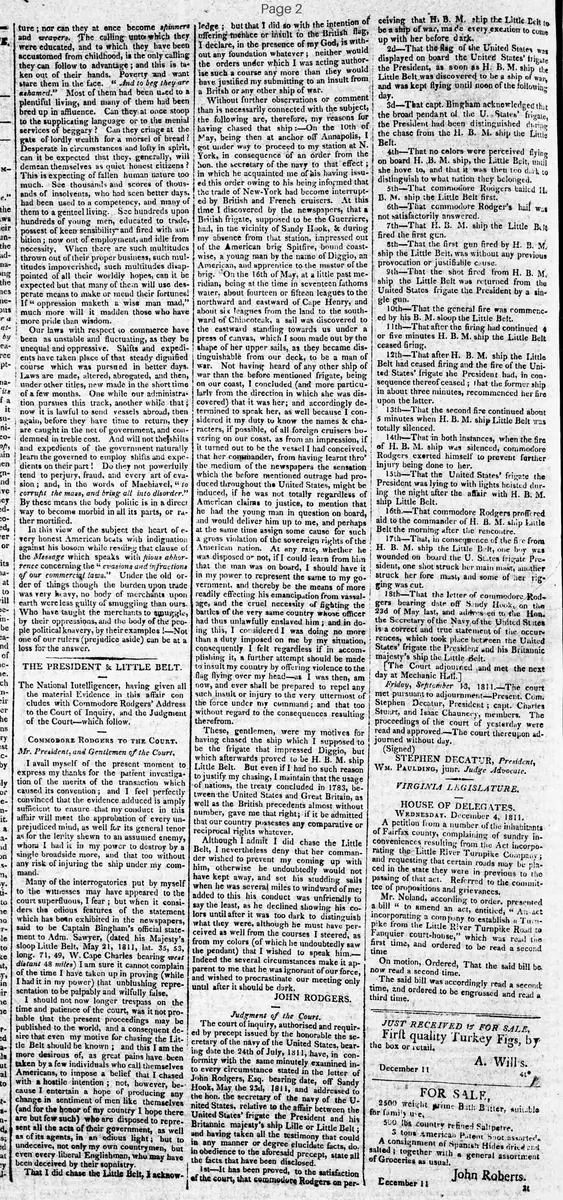
The National Intelligencer, having given all the material Evidence in this affair concludes with Commodore Rodgers' Address to the Court of Inquiry, and the Judgment of the Court--which follow.
Commodore Rodgers To The Court.
Mr. President, and Gentlemen of the Court,
I avail myself of the present moment to express my thanks for the patient investigation of the merits of the transaction which caused its convention; and I feel perfectly convinced that the evidence adduced is amply sufficient to ensure that my conduct in this affair will meet the approbation of every unprejudiced mind, as well for its general tenor as for the lenity shewn to an assumed enemy, who I had it in my power to destroy by a single broadside more, and that too without any risk of injuring the ship under my command.
Many of the interrogatories put by myself to the witnesses may have appeared to the court superfluous, I fear; but when it considers the odious features of the statement which has been exhibited in the newspapers, said to be Captain Bingham's official statement to Adm. Sawyer, (dated his Majesty's sloop Little Belt, May 21, 1811, lat. 35, 53, long. 71, 49, W. Cape Charles bearing west distant 48 miles) I am sure it cannot complain of the time I have taken up in proving (while I had it in my power) that unblushing representation to be palpably and wilfully false.
I should not now longer trespass on the time and patience of the court, was it not probable that the present proceedings may be published to the world, and a consequent desire that even my motive for chasing the Little Belt should be known; and this I am the more desirous of, as great pains have been taken by a few individuals who call themselves Americans, to impose a belief that I chased with a hostile intention; not, however, because I entertain a hope of producing any change in sentiment of men like themselves (and for the honor of my country I hope there are but few such) who are disposed to represent all the acts of their government, as well as of its agents, in an odious light; but to undeceive, not only my own countrymen, but even every liberal Englishman, who may have been deceived by their sophistry.
That I did chase the Little Belt, I acknowledge; but that I did so with the intention of offering menace or insult to the British flag, I declare, in the presence of my God, is without any foundation whatever; neither would I pursue such a course any more than the orders under which I was acting authorize or justify my submitting to an insult from a British or any other ship of war.
Without further observations or comment than is necessarily connected with the subject, the following are, therefore, my reasons for having chased that ship:--On the 10th of May, being then at anchor off Annapolis, I got under way to proceed to my station at N. York, in consequence of an order from the hon. the secretary of the navy to that effect; in which he acquainted me of his having issued this order owing to his being informed that the trade of New-York had become interrupted by British and French cruisers. At this time I discovered by the newspapers, that a British frigate, supposed to be the Guerriere had, in the vicinity of Sandy Hook, & during my absence from that station, impressed out of the American brig Spitfire, bound coastwise, a young man by the name of Diggio, an American, and apprentice to the master of the brig. On the 16th of May, at a little past meridian, being at the time in seventeen fathoms water, about fourteen or fifteen leagues to the northward and eastward of Cape Henry, and about six leagues from the land to the southward of Chincoteague, a sail was discovered to the eastward standing towards us under a press of canvas, which I soon made out by the shape of her upper sails, as they became distinguishable from our deck, to be a man of war. Not having heard of any other ship of war than the before mentioned frigate, being on our coast, I concluded (and more particularly from the direction in which she was discovered) that it was her; and accordingly determined to speak her, as well because I considered it my duty to know the names & characters, if possible, of all foreign cruisers hovering on our coast, as from an impression, if it turned out to be the vessel I had conceived, that her commander, from having learnt thro' the medium of the newspapers the sensation which the before mentioned outrage had produced throughout the United States, might be induced, if he was not totally regardless of American claims to justice, to mention that he had the young man in question on board, and would deliver him up to me, and perhaps at the same time assign some cause for such a gross violation of the sovereign rights of the American nation. At any rate, whether he was disposed or not, if I could learn from him that the man was on board, I should have it in my power to represent the same to my government, and thereby be the means of more readily effecting his emancipation from vassalage, and the cruel necessity of fighting the battles of the very same country whose officer had thus unlawfully enslaved him; and in doing this, I considered I was doing no more than a duty imposed on me by my situation, consequently I felt regardless if in accomplishing it, a further attempt should be made to insult my country by offering violence to the flag flying over my head--as I was then, am now, and ever shall be prepared to repel any such insult or injury to the very uttermost of the force under my command; and that too without regard to the consequences resulting therefrom.
These, gentlemen, were my motives for having chased the ship which I supposed to be the frigate that impressed Diggio, but which afterwards proved to be H. B. M. ship Little Belt. But even if I had no such reason to justify my chasing, I maintain that the usage of nations, the treaty concluded in 1783, between the United States and Great Britain, as well as the British precedents almost without number, gave me that right; if it be admitted that our country possesses any comparative or reciprocal rights whatever.
Although I admit I did chase the Little Belt, I nevertheless deny that her commander wished to prevent my coming up with him, otherwise he undoubtedly would not have kept away, and set his studding sails when he was several miles to windward of me; added to this his conduct was unfriendly to say the least, as he declined showing his colors until after it was too dark to distinguish what they were, although he must have perceived as well from the courses I steered, as from my colors (of which he undoubtedly saw the pendant) that I wished to speak him.-- Indeed the several circumstances make it apparent to me that he was ignorant of our force, and wished to procrastinate our meeting only until after it should be dark.
JOHN RODGERS.
Judgment of the Court.
The court of inquiry, authorised and required by precept issued by the honorable the secretary of the navy of the United States, bearing date the 24th of July, 1811, have, in conformity with the same minutely examined into every circumstance stated in the letter of John Rodgers, Esq. bearing date, off Sandy Hook, May the 23d, 1811, and addressed to the hon. the secretary of the navy of the U. nited States, relative to the affair between the United States' frigate the President and his Britannic majesty's ship Lille or Little Belt; and having taken all the testimony that could in any manner or degree elucidate facts, do, in obedience to the aforesaid precept, state all the facts that have been disclosed.
1st--It has been proved, to the satisfaction of the court, that commodore Rodgers on perceiving that H. B. M. ship the Little Belt to be a ship of war, made every exertion to come up with her before dark.
2d--That the flag of the United States was displayed on board the United States' frigate the President, as soon as H. B. M. ship the Little Belt was discovered to be a ship of war, and was kept flying until noon of the following day.
3d--That capt. Bingham acknowledged that the broad pendant of the U. States' frigate, the President had been distinguished during the chase from the H. B. M. ship the Little Belt.
4th--That no colors were perceived flying on board H. B. M. ship, the Little Belt, until she hove to, and that it was then too dark to distinguish to what nation they belonged.
5th--That commodore Rodgers hailed H. B. M. ship the Little Belt first.
6th--That commodore Rodgers' hail was not satisfactorily answered.
7th--That H. B. M. ship the Little Belt fired the first gun.
8th--That the first gun fired by H. B. M. ship the Little Belt, was without any previous provocation or justifiable cause.
9th--That the shot fired from H. B. M. ship the Little Belt was returned from the United States frigate the President by a single gun.
10th--That the general fire was commenced by his B. M. sloop the Little Belt.
11th--That after the firing had continued 4 or five minutes H. B. M. ship the Little Belt ceased firing.
12th--That after H. B. M. ship the Little Belt had ceased firing and the fire of the United States' frigate the President had, in consequence thereof ceased; that the former ship in about three minutes, recommenced her fire upon the latter.
13th--That the second fire continued about 5 minutes when H. B. M. ship Little Belt was totally silenced.
14th--That in both instances, when the fire of H. B. M. ship was silenced, commodore Rodgers exerted himself to prevent further injury being done to her.
15th--That the United States' frigate the President was lying to with lights hoisted during the night after the affair with H. B. M. ship Little Belt.
16th--That commodore Rodgers proffered aid to the commander of H. B. M. ship Little Belt the morning after the rencontre.
17th--That, in consequence of the fire from H. B. M. ship the Little Belt, one boy was wounded on board the U. States frigate President, one shot struck her main mast, another struck her fore mast, and some of her rigging was cut.
18th--That the letter of commodore Rodgers bearing date off Sandy Hook, on the 23d of May last, and addressed to the Hon. the Secretary of the Navy of the United States is a correct and true statement of the occurrences, which took place between the United States' frigate the President and his Britannic majesty's ship the Little Belt.
The Court adjourned and met the next day at Mechanic Hall.
Friday, September 13, 1811.--The court met pursuant to adjournment-- Present, Com. Stephen Decatur, President; capt. Charles Stuart, and Isaac Chauncey, members. The proceedings of the court of yesterday were read and approved.--The court thereupon adjourned without day.
(Signed)
STEPHEN DECATUR, President,
Wm. PauldinG, junr. Judge Advocate.
What sub-type of article is it?
What keywords are associated?
What entities or persons were involved?
Where did it happen?
Foreign News Details
Primary Location
Off Cape Henry, Virginia
Event Date
May 16, 1811
Key Persons
Outcome
one boy wounded on us frigate president; damage to masts and rigging; little belt silenced after firing first without provocation; rodgers offered aid and showed restraint.
Event Details
Commodore Rodgers chased the British sloop Little Belt, mistaking it for another frigate involved in impressment. After hailing without satisfactory response, Little Belt fired first. President returned fire, silencing Little Belt after two exchanges. Court of inquiry on July 24, 1811, confirmed Rodgers' account and justified his actions.