Thank you for visiting SNEWPapers!
Sign up free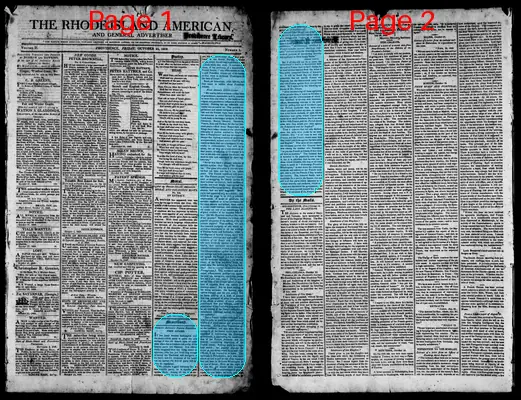
The Rhode Island American, And General Advertiser
Providence, Providence County, Rhode Island
What is this article about?
The Baltimore Federal Republican editorial quotes John Adams' letter to counter Democratic attacks on Federalists, highlighting a pro-French faction in the Democratic party that threatened Adams and Washington, urged neutrality, and swore to aid French invaders.
Merged-components note: This is a continuation of the same editorial article across pages 1 and 2, as the text flows directly from one component to the next with matching topic and sequential reading order.
Clippings
1 of 2
OCR Quality
Full Text
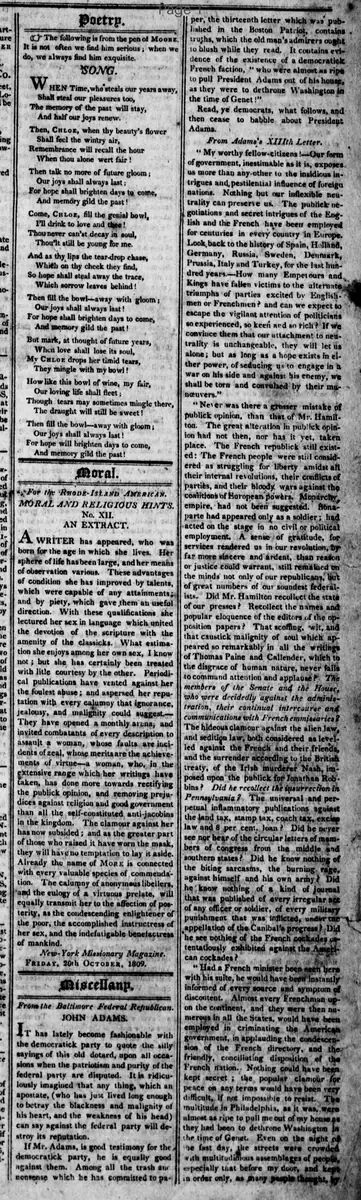
MISCELLANY
From the Baltimore Federal Republican.
JOHN ADAMS.
IT has lately become fashionable with
the democratick party to quote the silly
sayings of this old dotard, upon all occa-
sions when the patriotism and purity of the
federal party are disputed. It is ridicu-
lously imagined that any thing, which an
apostate, (who has just lived long enough
to betray the blackness and malignity of
his heart, and the weakness of his head)
can say against the federal party will de-
story its reputation.
If Mr. Adams, is good testimony for the
democratick party, he is equally good
against them. Among all the trash and
nonsense which he has committed to pa-
per, the thirteenth letter which was pub-
lished in the Boston Patriot, contains
truths, which the old man's admirers ought
to blush while they read. It contains evi-
dence of the existence of a democratick
French faction, "who were almost as ripe
to pull President Adams out of his house.
as they were to dethrone Washington in
the time of Genet!"
Read, ye democrats, what follows, and
then cease to babble about President
Adams.
From Adams's XIIIth Letter.
"My worthy fellow-citizens! Our form
of government, inestimable as it is, exposes.
us more than any other to the insidious in-
trigues and pestilential influence of foreign
nations. Nothing but our inflexible neu-
trality can preserve us. The publick ne-
gotiations and secret intrigues of the Eng-
lish and the French have been employed
for centuries in every country in Europe.
Look back to the history of Spain, Holland,
Germany, Russia, Sweden, Denmark,
Prussia, Italy and Turkey, for the last hun-
dred years.—How many Emperours and.
Kings have fallen victims to the alternate
triumphs of parties excited by English-
men or Frenchmen? and can we expect to
escape the vigilant attention of politicians
so experienced, so keen and so rich? If we
convince them that our attachment to neu-
trality is unchangeable, they will let us
alone; but as long as a hope exists in ei-
ther power, of seducing us to engage in a
war on his side and against his enemy, we
shall be torn and convulsed by their mu-
nouvers."
"Never was there a grosser mistake of
publick opinion, than that of Mr. Hamil-
ton. The great alteration in publick opin-
ion had not then, nor has it yet, taken
place. The French republick still exist-
ed: The French people were still consid-
ered as struggling for liberty amidst all
their internal revolutions, their conflicts of
parties, and their bloody wars against the
coalitions of European powers. Monarchy
empire, had not been suggested. Bona
parte had appeared only as a soldier; had
acted on the stage in no civil or political
employment. A sense of gratitude, for
services rendered us in our revolution, by
far more sincere and ardent, than reason
or justice could warrant, still remained on
the minds not only of our republicans, but
of great numbers of our soundest federal
ists. Did Mr. Hamilton recollect the state
of our presses? Recollect the names and
popular eloquence of the editors of the op-
position papers? That scoffing wit, and
that caustick malignity of soul which ap-
peared so remarkably in all the writings.
of Thomas Paine and Callender, which to
the disgrace of human nature, never fails
to command attention and applause? The
members of the Senate and the House.
who were decidedly against the adminis-
tration, their continual intercourse and
communications with French emissaries
The hideous clamour against the alien law
and sedition law, both considered as level-
led against the French and their friends.
and the surrender according to the British
treaty. of the Irish murderer Nash, im-
posed upon the publick for Jonathan Rob-
bins? Did he recollect the insurrection in
Pennsylvania? The universal and per-
petual inflammatory publications against
the land tax, stamp tax, coach tax, excis
e law and 8 per cent. loan? Did he never
see nor hear of the circular letters of mem-
bers of congress from the middle and
southern states? Did he know nothing of
the biting sarcasms, the burning rage,
against himself and his own army? Did
he know nothing of a kind of journal
that was published of every irregular act
of any officer or soldier, of every military
punishment that was inflicted, under the
appellation of the Cannibal progress? Did
he see nothing of the French cockades os.
tentatiously exhibited against the Ameri.
can cockades
"Had a French minister been seen here
with his suite, he would have been instantly
informed of every source and symptom of
discontent. Almost every Frenchman up-
on the continent, and they were then nu-
merous in all the States, would have been
employed in criminating the American
government, in applauding the condescen-
sion of the French directory, and the
friendly, conciliating disposition of the
French nation. Nothing could have been
kept secret; the popular clamour for
peace on any terms would have been very
difficult, if not impossible to resist. The
multitude in Philadelphia, as it was, were
almost as ripe to pull me out of my house as
they had been to dethrone Washington in
the time of Genet. Even on the night of
the fast day, the streets were crowded
with multitudinous assemblages of people
especially that before my door, and kept
in order only, as many people thought,
military parole, ordered, I believe by the
governour of Pennsylvania.
When the Chief Magistrate of the Union
could only send protection from the violence
of a democratick faction, in a military
guard, there is little room to bestow praise
upon a party which was led on by French
emissaries, "ostentatiously exhibited by
French cockades against American cock-
ades," and sent across the Atlantick for the
avowed purpose of introducing anarchy
and confusion in these happy States."
Adams' Letter.
But if all this will not do to prove the
existence of a faction in this country more
devoted to France than to the U. States, let
us read another extract from the letter of
this newly converted Oracle of democra-
cy. It will be found that the object of
contention was not merely France and
England, but the democratick party took
side with France against their own govern-
ment. So it appears by the following tes-
timony of Mr. Adams.
"After enumerating all these symptoms
of the popular bias, it would be frivolous to
'enlarge upon the conversations of which I
was informed at taverns and insurance-
offices, threatening violence to the presi-
dent by pulling him out of his chair, upon
the French cockades that were every
where paraded before my eyes, in opposi-
tion to the black cockade, or upon the de-
clarations and oaths, which I know were
made by no small numbers, that if we went
to war with France, and the French should
come here they would join them against
the Federalists and the English."
Thus it appears that not only declara-
tions, but oaths were made by no small
numbers, that "if we went to war with
France, and the French should come here
they would join them against the federalists
and English." The oaths of two respecta-
ble witnesses proved that General Smith
was among the number who threatened
"to join the French as friends if they land-
ed here as enemies." The General finds
it material to his popularity now to deny
it, but it is notorious that he was one of
those violent jacobins, who was at all times
'ready to assist in "dethroning President
Washington," to tear down the American
cockade, and substitute the French cock-
ade, and to join the French if they invaded
the country. Yes, General Smith, now a
Candidate for a seat in the Senate, was and
still is of that party which laboured to in-
troduce anarchy and confusion, which con-
vulsed and distracted the government, and
has ever since proved himself the faithful
friend and advocate of the French govern-
ment.
What sub-type of article is it?
What keywords are associated?
What entities or persons were involved?
Editorial Details
Primary Topic
Critique Of Democratic Party Using John Adams' Quotes To Expose French Faction
Stance / Tone
Strongly Pro Federalist And Anti Democratic
Key Figures
Key Arguments