Thank you for visiting SNEWPapers!
Sign up free
The Democratic Sentinel
Cadiz, Harrison County, Ohio
What is this article about?
In 1853, Ohio Judge Thomas L. Jewett rules in a habeas corpus case, discharging James Collier from federal custody. Collier, former California customs collector, was indicted for embezzling public funds in 1850. Jewett finds no applicable U.S. law in California at the time and no jurisdiction in the Northern District of California court.
Merged-components note: This is a continuation of the full narrative article on the Habeas Corpus case across pages 1 and 2, with sequential reading order and matching text content at the transition point.
Clippings
1 of 2
OCR Quality
Full Text
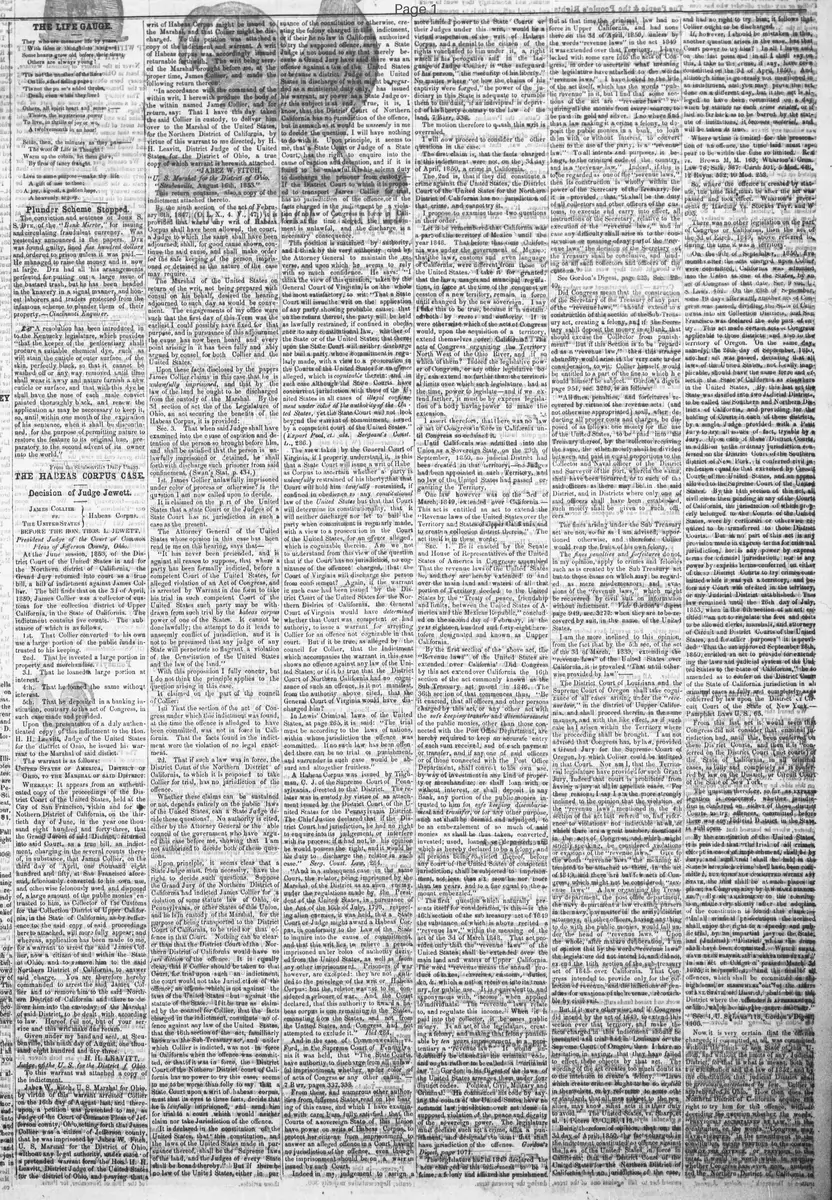
THE HABEAS CORPUS CASE
Decision of Judge Jewett.
James Collier vs. Habeas Corpus.
The United States
BEFORE THE HON. THOS. L. JEWETT
President Judge of the Court of Common Pleas of Jefferson County, Ohio, at the June session, 1853, of the District Court of the United States in and for the Northern District of California, the Grand Jury returned into court as a true bill, a bill of indictment against James Collier. The bill finds that on the 3d of April, 1850, James Collier was a collector of customs for the collection district of Upper California, in the State of California. The indictment contains five counts. The substance of which is as follows:
1st. That Collier converted to his own use a large portion of the public funds intrusted to his keeping.
2nd. That he invested a large portion in property and merchandise.
3rd. That he loaned a large portion at interest.
4th. That he loaned the same without interest.
5th. That he deposited in a banking institution, contrary to the act of Congress, in such case made and provided.
Upon the presentation of a duly authenticated copy of this indictment to the Hon. H. H. Leavitt, Judge of the United States for the District of Ohio, he issued his warrant to the Marshal of said district.
The warrant is as follows:
UNITED STATES OF AMERICA, DISTRICT OF OHIO, to The Marshal of said District:
Whereas: It appears from an authenticated copy of the proceedings of the District Court of the United States, held at the City of San Francisco, within and for the Northern District of California, on the thirtieth day of June, in the year one thousand eight hundred and fifty-three, that the Grand Jurors of said District, or returned into said Court, as a true bill, an indictment, charging in the several counts thereof, in substance, that James Collier, on the third day of April, one thousand eight hundred and fifty, at San Francisco aforesaid, feloniously converted to his own use and otherwise feloniously used, and disposed of, a large amount of the public monies intrusted to him, as Collector of the Customs for the Collection District of Upper California, in the State of California, as by reference to the said copy of said proceedings hereto attached, will more fully appear; and whereas, application has been made to me, for a warrant to arrest the said James Collier, now a citizen of and within the State of Ohio and to remove him to the said Northern District of California, to answer said charge, you are therefore hereby commanded to arrest the said James Collier and to remove him to the said Northern District of California, and there to deliver him into the custody of the Marshal of said District, to be dealt with according to law. Hereof fail not, but of your service and this writ make due return.
Given under my hand and seal, at Steubenville, this ninth day of August, one thousand eight hundred and fifty three.
H. H. LEAVITT
Judge of the U. S. for the District of Ohio
To this warrant was attached a copy of the indictment. Jabez W. Fitch, U. S. Marshal for Ohio, by virtue of this warrant arrested Collier on the 16th day of August last, and thereupon, a petition was presented to me, as Judge of the Court of Common Pleas of Jefferson county, Ohio, setting forth that James Collier was a citizen of Jefferson county, that he was imprisoned by Jabez W. Fitch U. S. Marshal for the District of Ohio without any legal authority, under color of a pretended warrant from the Hon. H. H. Leavitt, District Judge of the United States for the district of Ohio, and praying that a writ of Habeas Corpus might be issued to the Marshal, and that Collier might be discharged. To this petition was attached a copy of the indictment and warrant. A writ of Habeas Corpus was accordingly issued returnable forthwith. The writ being served, the Marshal brought before me, at the proper time, James Collier, and made the following return thereon:
"In accordance with the command of the within writ, I herewith produce the body of the within named James Collier, and for return, say: That I have this day taken the said Collier in custody, to deliver him over to the Marshal of the United States, for the Northern District of California, by virtue of this warrant to me directed, by H. H. Leavitt, District Judge of the United States for the District of Ohio, a true copy of which warrant is herewith attached.
JABEZ W. FITCH
U. S. Marshal for the District of Ohio.
Steubenville, August 16th, 1853."
This return contains, also, a copy of the indictment attached thereto.
By the ninth section of the act of February 8th, 1847, (5 L. X., 4. V., 47,) it is provided that where any writ of Habeas Corpus shall have been allowed, the court, or Judge to which the same shall have been returned, shall, for good cause shown, continue the said cause, and shall make order for the safe keeping of the person imprisoned or detained as the nature of the case may require.
The Marshal of the United States on return of the writ, not being prepared with counsel on his behalf, desired the hearing adjourned to such day as would be convenient. The engagements of my office were such that the first day of this term was the earliest I could possibly have fixed for that purpose, and in pursuance of this adjournment the cause has now been heard and every point arising in it has been fully and ably argued by counsel, for both Collier and the United States.
Upon these facts disclosed by the papers James Collier claims in this case that he is unlawfully imprisoned, and that by the law of the land he ought to be discharged from the custody of the Marshal. By the 3d section of act of the Legislature of Ohio, an act securing the benefits of the Habeas Corpus, it is provided:
Sec. 3. That when said Judge shall have examined into the cause of caption and detention of the person so brought before him, and shall be satisfied that the person is unlawfully imprisoned or detained, he shall forthwith discharge such prisoner from said confinement, (Swan’s Stat. p. 434.)
1st. Is James Collier unlawfully imprisoned under color of process or otherwise? is the question I am now called upon to decide.
It is claimed on the part of the United States that a state Court or the Judges of a State Court has no jurisdiction in such a case as the present.
The Attorney General of the United States whose opinion in this case has been read to me on this hearing, says that "It has never been pretended, and is against all reason to suppose, that where a party has been formally indicted, before a competent Court of the United States, for alleged violation of an Act of Congress, and is arrested by Warrant in due form to take his trial in such competent Court of the United States such party may be withdrawn from such trial by the habeas corpus power of one of the States. It cannot be done lawfully; the attempt to do it leads to unseemly conflict of jurisdiction, and it is not to be presumed that any judge of any State will perpetrate so flagrant a violation of the Constitution of the United States and the law of the land."
With this proposition I fully concur, but I do not think the principle applies to the question arising in this case.
It is claimed on the part of the counsel of Collier:
1st. That the section of the act of Congress under which this indictment was found, at the time the offence is alleged to have been committed, was not in force in California. That the facts found in the indictment were the violation of no legal enactment.
2d. That if such a law was in force, the District Court of the Northern District of California, to which it is proposed to take Collier for trial, has no jurisdiction of the offence.
Whether these claims can be sustained or not, depends entirely on the public laws of the United States, can a State Judge decide these questions? No authority is cited, either by the Attorney General or the able counsel of the government who have argued this case before me, showing that I am not authorized to decide both of these questions.
Upon principle, it seems clear that a State Judge must, from necessity, have the right to decide such questions. Suppose the Grand Jury of the Northern District of California had indicted James Collier for violation of some statute law of Ohio, or Pennsylvania, or other States of this Union, and he is in custody of the Marshal, for the purpose of being transported to the District Court of California, to be tried for that offence in that Court. Nothing can be clearer than that the District Court of the Northern District of California would have no jurisdiction of the offence. It is equally clear that if Collier should be taken to that Court, for trial upon such an indictment the court would not take jurisdiction of the offence, an offence which is not against the laws of the United States but against the statute of the State. If it be true as claimed by the Counsel for Collier, that the facts charged in the indictment, constitute no offence against any law of the United States, that the 16th section of the act, familiarly known as the Sub-Treasury act, and under which Collier is indicted, was not in force in California when the offence was committed, or that if it was in force, the District Court of the Northern District of California has no power to try this case; seems to me to be worse than folly to say that a State Court upon a writ of habeas corpus, must shut its eyes to these facts, decide that he is lawfully imprisoned, and send him for trial to a court which would neither claim nor take jurisdiction of the offence. It is declared in the constitution of the United States, that this constitution, and the laws of the United States made in pursuance thereof, shall be the "Supreme Laws of the land, and the Judges of every State shall be bound thereby." But if there be no law of the United States, either in pursuance of the constitution or otherwise, creating the felony charged in this indictment, or if there be no law in California authorized to try the supposed offence, surely a State Judge is not bound to say that merely because a Grand Jury have said there was an offence against a law of the United States or because a district Judge of the United States in discharge of what might be regarded as a ministerial duty only, has issued his warrant, my power as a State Judge over this subject is at end. True, it is, I know, that the District Court of Northern California has no jurisdiction of the offence, but inasmuch as it would be unseemly in me to decide the question, I will have nothing to do with it. Upon principle, it seems to me, that a State Court or Judge of a State Court, has the right to enquire into the cause of caption and detention, and if it is found to be unlawful it is his solemn duty to discharge the prisoner from custody. If the District Court to which it is proposed to transport James Collier for trial, has no jurisdiction of the offence, or if the facts charged in the indictment be a violation of no law of Congress in force in California at the time alleged, the imprisonment is unlawful, and the discharge, is a necessary consequence.
This position is sustained by authority, and I think by the very authority cited by the Attorney General to maintain the converse, and upon which, he seems to rely with so much confidence. He says: I think the view of this question, taken by the General Court of Virginia, is on the whole the most satisfactory, to wit: "That a State Court will issue the writ on the application of any party showing probable cause; that on the return thereof, the party will be held as lawfully restrained; if confined in obedience to any constitutional law, whether of the State or of the United States; that thereupon the State Court will neither discharge nor bail a party, whose commitment is regularly made, with a view to a prosecution in the Courts of the United States for an offence alleged, which is cognizable therein; and in such case although the State Courts have concurrent jurisdiction with those of the United States in all cases of illegal confinement under color of the authority of the United States, yet the State Court will not look beyond the warrant of commitment, issued by a competent court of the United States." (Ex parte Bollman, et al.) Sergeant’s Const. L., 286.
The view taken by the General Court of Virginia, if I properly understand it, is this that a State Court will issue a writ of Habeas Corpus to ascertain whether a party is unlawfully restrained of his liberty; that that Court will hold him lawfully restrained, if confined in obedience to any constitutional law of the United States but that that Court will determine its constitutionality, that it will neither discharge nor let to bail the party when commitment is regularly made, with a view to a prosecution in the Court of the United States, for an offence alleged, which is cognizable therein. Are we not to understand from this view of the question that if the Court has no jurisdiction, no cognizance of the offence charged, that the Court of Virginia will discharge the person from confinement? Again, if the warrant in such case had been issued by the District Court of the United States for the Northern District of California, the General Court of Virginia would have determined whether that Court was competent or had authority, to issue a warrant for arresting Collier for an offence not cognizable in that court. But if it be true, as alleged by the counsel for Collier, that the Indictment which accompanies the warrant in this case shows no offence against any law of the United States; or if it be true that the District Court of Northern California had no cognizance of such an offence, is it not manifest from the authority above cited, that the General Court of Virginia would have discharged him?
In Lewis’ Criminal laws of the United States, at page 265, it is said: "The trial must be according to the laws of nations, within whose jurisdiction the offence was committed. If no such law has been offended there can be no trial or punishment, and surrender in such case would be absurd and altogether fruitless."
A Habeas Corpus was issued by Tilghman, C. J. of the Supreme Court of Pennsylvania, directed to the Marshal. The relator was in custody by virtue of an attachment issued by the District Court of the United States for the Pennsylvania District. The Chief Justice declared that if the District Court had jurisdiction, he had no right to enquire into its judgement, or interfere with its process; if it had not, in his opinion he would possess the right, and it would be his duty to discharge the relator in such case. Serg. Const. Law, 284.
And in a subsequent case in the same Court, the relator, being imprisoned by the Marshal of the District as an alien enemy, under the regulations made by the President of the United States, in pursuance of the Act of the 16th of July 1798, respecting alien enemies, it was held that a State Court or Judge might award a Habeas Corpus, in conformity to the Law of the State to inquire into the cause of commitment and that this writ lies to relieve a person imprisoned under color of authority derived from the United States, as well as from any other imprisonment. Prisoners of war however, are excepted; they are not entitled to the privilege of the writ of Habeas Corpus; but the relator was not to be considered a prisoner of war. And the Court declared that this authority to award a habeas corpus is one remaining in the States, emanating from the States, and not from the United States and Congress has never attempted to exclude it. Ibid 284.
And in the case of Commonwealth vs. Ford, in the Supreme Court of Pennsylvania it was held that "The State Courts have authority to discharge from all unlawful imprisonment, whether under color of acts of Congress or any other cause. 7 Burr. pages 337, 338."
From these, and numerous other authorities from different States read on the hearing of this cause, and which I have examined with care I am fully satisfied that the Courts of a sovereign State of this Union have power on writs of Habeas Corpus, to protect her citizens from imprisonment to answer an alleged offence in a Court having no jurisdiction of the offence, even though the imprisonment should be on warrant issued by such Court.
Indeed in my judgement to assign more limited power to the State Courts or their Judges under this writ, would be a virtual suspension of the writ of Habeas Corpus, and a denial to the citizen of the rights vouchsafed to him under it, a right which is his prerogative and in the language of Judge Coulter, is "the safeguard of his person, the security of his liberty. No matter where, or how the chains of his captivity were forged," the power of the judiciary in this State is adequate to crumple them to the dust. If an individual is deprived of his liberty contrary to the law of the land, 7 Burr. 338.
The motion therefore to quash this writ is overruled.
I will now proceed to consider the other questions in the case.
The first claim is, that the facts charged in this indictment were not, on the 3d day of April, 1850, a crime in California.
The 2nd is, that if they did constitute a crime against the United States, the District Court of the United States for the Northern District of California has no jurisdiction of that crime, and cannot try it.
I propose to examine these two questions in their order.
Let it be remembered that California was a part of the territory of Mexico until the year 1848. That before that time California was under the government of Mexico; that the laws, customs and even language of California, were different from those of the United States. I take it for granted that the laws, usages and municipal regulations, in force at the time of the conquest or cession of a new territory, remain in force until changed by the new sovereign. I say I take this to be true, because it is sustained both by reason and authority. If it were otherwise which of the acts of Congress would, upon the acquisition of a territory, extend themselves over California? The acts of Congress organizing the Territory North West of the Ohio River, and if so which of them? Indeed the legislative power of Congress, or any other legislative body can extend no further than the territorial limits over which such legislature had at the time, power to legislate—and if we extend farther, it must be by express legislation of a body having power to make the extension so to do.
I assert therefore, that there was no law or act of Congress in force in California until Congress so ordained it. And until California was admitted into the Union as a Sovereign State, on the 29th of September, 1850, no judicial District had been created in that territory. No Judges had been appointed in such territory, and no law of the United States had passed organizing the Territory.
One law however was on the 3rd of March, 1849, extended over California.
This act is entitled an act to extend the Revenue laws of the United States over the Territory and State of Upper California and to create a collection district therein. The act itself is in these words:
Sec. 1. Be it enacted by the Senate and House of Representatives of the United States of America in Congress assembled That the revenue laws of the United States be, and they are hereby extended to and over the main land and waters of all that portion of Territory ceded to the United States by the "Treaty of peace, friendship and limits, between the United States of America and the Mexican Republic," concluded on the second day of February, in the year eighteen hundred and forty-eight, heretofore designated and known as Upper California.
By the first section of the above act, the Revenue laws of the United States are extended over California. Did Congress by this act extend over California the 16th section of the act commonly known as the Sub Treasury act passed in 1846. The 16th section of that commences thus, Be it enacted, that all officers and other persons charged by this act, or any other act with the safe keeping transfer and disbursement of the public monies, other than those connected with the Post Office Department, are hereby required to keep an accurate entry of each sum received, and of each payment or transfer, and if any one of said officers or of those connected with the Post Office Department, shall convert to his own use, by way of investment in any kind of property or merchandise, or shall loan with or without interest, or shall deposit in any Bank, any portion of the public monies intrusted to him for safe keeping disbursement and transfer, or for any other purpose such act shall be deemed and adjudged to be an embezzlement of so much of said monies as shall be thus taken, converted, invested, used, loaned or deposited, which is hereby declared to be a felony, and all persons being convicted thereof, before any court of the United States of competent jurisdiction, shall be subjected to imprisonment, not less than six months nor more than ten years, and to a fine equal to the amount embezzled.
The first question which naturally presents itself for consideration, is this is the 16th section of the sub treasury act of 1846 the substance of which is above recited "revenue law," within the meaning of the act of the 3d of March 1848. That act provides only that the "revenue laws of the United States shall be extended over the main land and waters of Upper California."
The word revenue means the annual produce of taxes, excises, customs, duties, &c, which a nation receives into its treasury for public use. It is equivalent to, and synonymous with, "income" when applied to individuals? The "revenue" laws relate to, and regulate this income. When it is paid into the collector, it becomes public money. Is an act of the legislature, creating a felony, and making that felony punishable by ten years imprisonment in the penitentiary a "revenue law?"
Undoubtedly be classed as the criminal code, and ought rather to be called a criminal law. Mr. Gordon in his Digest of the laws of the United States arranges them under four distinct codes. Political, Civil, Military and Criminal. He commences his code by saying in the courts of the United States have no common law jurisdiction over a criminal, in supposed violation of the peace and dignity of the sovereign power. The legislature must declare such act a crime, affix a punishment and designate the court that shall have jurisdiction of the offence. Gordon’s Digest, page 1071.
The Legislature had in 1846 declared the acts charged in this indictment to be a felony and affixed the punishment.
But at that time the criminal law had no force in Upper California, and had none there on the 3d of April, 1850, unless by the words "revenue laws" in the act 1849 it was extended over that Territory. I have looked with some care into the acts of Congress, in order to ascertain what meaning the legislature have attached to the words revenue laws. I have looked to the title of the act itself, which has the words "public revenue" in it, but I find that some sections of the act are "revenue laws" requiring all the monies from every source to be paid in gold and silver. I no where find that a law making it a crime a felony, to deposit the public monies in a bank, to loan them with or without interest, to convert them to the use of the party, is a "revenue law." To all intents and purposes, it belongs to the criminal code of the country, and is a "revenue law." Indeed, if this is to be regarded as one of the "revenue laws," then its construction is wholly within the power of the Secretary of the Treasury; for it is provided, that it shall be the duty of all collectors and other officers of the customs, to execute and carry into effect, all instructions of the Secretary, relating to the execution of the revenue laws, and in case any difficulty shall arise as to the construction or meaning of any part of the revenue laws the decision of the Secretary of the Treasury shall be conclusive, and binding on all such collectors and officers of the customs.
See Gordon’s Digest, page 823, Sec. 28-40.
Did Congress mean that the construction of the "revenue laws," should extend to a construction of this section of the Sub-Treasury act, creating a felony, and if the Secretary shall deposit the money in a Bank, that should excuse the Collector from punishment? But if this Section is to be "regarded as a revenue law, then this strange absurdity would arise; in the very case under consideration, to wit: Collier himself would be entitled to a part of the fine to which he would himself be subject. Gordon’s Digest page 951, sec. 3286, is as follows:
"All fines, penalties, and forfeitures recovered by virtue of the revenue acts (and not otherwise appropriated), shall, after deducting all proper costs and charges, be disposed of as follows: one moiety for the use of the United States, to be paid into the Treasury thereof, by the collector receiving the same, the other moiety shall be divided between, and paid in equal proportions to the Collector and Naval officer of the District and Surveyor of the port, wherein the same, shall have been incurred, or to such of the said officers as there may be in the said District, and in Districts where only one of said officers shall have been established, such moiety shall be given to such officer."
The fines arising under the Sub Treasury act are not, so far as I am advised, apportioned otherwise, and therefore be Collier would reap the fruits of his own felony.
The fines penalties and forfeitures do not in my opinion, apply to crimes and felonies such as is created by the Sub Treasury act but to those cases on which may be regarded as, mere misdemeanors and evasions of the "revenue laws," which might be recovered by civil suit on information without indictment. Vide Gordon’s Digest page 949, sec. 3277: when they are to be recovered by suit, in the name of the United States.
I am the more inclined to this opinion from the fact that by the 5th sec, of the act of the 3d of March, 1849, extending the "revenue laws" of the United States over California, it is provided "That until otherwise provided by law the District Court of Louisiana and the Supreme Court of Oregon shall take cognizance of all cases arising under the "revenue laws," in the district of Upper California, and shall proceed therein in the same manner, and with the like effect, as if such case had arisen within the Territory where the proceeding shall be brought. I am not advised that Congress has, by law, provided a Grand Jury for the Supreme Court of Oregon, by which Collier could be indicted in that Court. Nor am I that the Territorial legislature have provided for such Grand Jury. Indeed that court is prohibited from having a jury at all in appellate cases. For these reasons; I say I am the more strongly inclined, to the opinion that the violation of the "revenue laws" mentioned in, the 4th section of the act last referred to, had reference to violations not indictable and of which there are a great number, mentioned in other acts of Congress and which might strictly, speaking, be, considered violations or evasions of the "revenue laws."
Give to the words "revenue laws" the meaning attempted to be attached to them, in the act of 1849 and there are but few acts of Congress which might not be considered "revenue laws." A law organizing the Treasury department, the post office department the navy department a law creating purser in the navy, paymaster in the army, district attorneys, all other officers having anything to do with the public monies, would fall under the head of "revenue laws." Upon the whole, after mature deliberation, I am of opinion that by the words revenue laws the legislature did not intend to, and did not, extend the 16th section of the sub treasury act of 1846, over California. That Congress intended to provide only for the collection of revenue, and the inflictions of penalties for evasions of the revenue, recoverable by civil suit.
But if it were otherwise; and if Congress did intend by the act of 1849, to extend this section over that territory, and make the facts charged in this indictment a felony punishable by imprisonment in the penitentiary for ten years, still I am of opinion that they have failed to effect these objects by that act. The wording of the act creates too much doubt as to the intention to create a felony. Laws which create crimes ought to be so explicit in themselves, or by reference to some other standard, that all men subject to the penalties, may know what acts it is their duty to avoid. The United States, vs. Sharp. et al. 1 Peters C. C. R. is.
Being therefore of opinion, that on the 3d day of April 1850, the facts charged in the indictment constituted no offence against the laws of the United States in force in California: that the District Court of the United States for the Northern District of California had no jurisdiction of the case, and had no right to try him; it follows that Collier ought to be discharged.
If, however, I should be mistaken in this, another question arises in the case. Has that Court power to try him? In all I have said on the last point and in all I shall say of this, I take it for granted the crime, if any, was committed on the 3d of April, 1850. And although time is generally not mentioned in an indictment, and you may prove the act done on a different day, but in the act is alleged to have been committed on a day when by statute no such crime existed, or is laid so far back as to be barred, by the statute of limitations, it becomes material, and will be taken as true.
Where by law time is limited for the prosecution of an offence, the time laid must appear to be within the time so limited. Rex vs. Brown M. & M. 163; Wharton’s Crim. Law 76; Salk. 67: Carth 501; 5 Mod. 446, 12 Raym. 582; 10 Mod. 258.
So where the offence is created by statute, the time laid must be after the act was passed and took effect. Wharton’s precedents 8; Harding vs. Stockes Tayl. und w 605.
There was no other legislation on the part of Congress or, say, U. S. during the time, it was a territory to provide for the trial of crimes committed in California while it was a territory.
On the 9th of September 1850, five months after the acts charged upon Collier were committed, California was admitted into the Union as one of the States, by an act of Congress of that date, Sec. 9 vol. ix U. S. Laws 452. On the 28th of September so the 19 days afterward, another act of Congress was passed, dividing the State of California into six Collection Districts, and San Francisco was declared the sole port of entry. This act made certain acts of Congress applicable to those districts, and also to the territory of Oregon. On the same day namely the 28th day of September, 1850 another act was passed, declaring that all laws of the United States, not locally inapplicable, should have the same force and effect in the State of California as elsewhere in the United States. By this last act the State was divided into two Judicial Districts, to be called the Southern and Northern Districts of California; and providing for the holding of Courts in each of these districts, by a single Judge provided with a District Attorney, a Clerk and a Marshal. Upon each of these District Courts, in addition to the ordinary jurisdiction conferred upon the District Courts of the Southern district of New York, is conferred civil jurisdiction equal to that exercised by Circuit Courts of the United States, and an appeal allowed to the Supreme Court of the United States. By the 4th section of this act, all civil cases then pending in any of the Courts of California, the jurisdiction of which properly belonged to the Courts of the United States, were by certiorari or otherwise to be transferred to those District Courts. But in no part of this act is any provision made in express terms for criminal jurisdiction, nor is any power by express terms for criminal jurisdiction; nor is any power by express terms conferred on, either of these District Courts to try crimes committed while it was yet a territory, and before any Court was created in the territory or any Judicial District established. This law remained until the 26th day of July 1853, when in the 6th section of an act entitled "an act to regulate the fees and costs to be allowed clerks, marshals, and attorneys of Circuit and District Courts of the United States, and for other purposes" it is provided "That the act approved September 28th, 1850, entitled an act to provide for extending the laws and judicial system of the United States to the State of California," be so amended as to confer on the District Court of the State of California jurisdiction in all criminal cases as fully, and completely as is conferred by law upon the District or Circuit Court of the State of New York.
Pamphlet Laws U. S., 65.
From this last act it would seem that Congress did not consider that criminal jurisdiction had, until this, been conferred on the District Courts of the State of California, in all criminal cases.
The question therefore, so far as express legislation is concerned, whether jurisdiction is conferred on either of those District Courts, to try offences committed, before there was any judicial District in the State, is still open.
By the constitution of the United States it is provided that the trial of all crimes, except in cases of impeachment, shall be by Jury and such Trial shall be held in the State where such crimes shall have been committed, BUT WHEN NOT COMMITTED WITHIN ANY STATE, the trial shall be at such Place or Places as Congress may by law have directed.
By an AMENDMENT to the Constitution, made very shortly after the adoption of the constitution is found the clause: "In all criminal prosecutions the accused shall enjoy the right to a speedy and public trial, by an impartial jury of the State and district wherein the crime shall have been committed, which district shall have been previously ascertained by law."
In an act of Congress passed March 3d, 1825, it is provided that the trial of all offences, which shall be committed on the high seas, or within the jurisdiction of the United States on a n situs or district, shall be in the district where the offender is apprehended, or into which he may be first brought or delivered."
See. 14, U. S. Laws 118, Gordon’s Digest 106.
Now, it is very certain that the offence charged, if committed at all, was committed, without the limits of any State of this Union, and without the limits of any Judicial District, for that is what is meant, both by the Constitution and the law of 1825 and in the constitution that judicial District shall be previously ascertained by law. Collier was indicted in the Northern District of California, but that District had no right to try him for this offence, without deciding the question whether the words, "PREVIOUSLY ASCERTAINED BY LAW" in the constitution, or the words "Congress may have directed" in the amendment to the constitution, means previous to the commission of the offence. Or previous to the trial. It would be worthwhile to enquire whether Congress has, even now, authorized the Northern District of California, to try crimes committed before that District was created.
By Collier for an offence committed in no State, in no Judicial District.
It is claimed by the Attorney General that the law requiring this offence to be tried in Louisiana or Oregon is virtually repealed. It may be, although that proposition is anything but clear to my mind.
But suppose it is repealed, where then must he be tried? Why, says the Attorney General, in the District Court of the United States for the Northern District of California, which has jurisdiction of the Territorial District to which such offence was committed. But where is the law which says Collier or any other offender who has committed an offence without the limits of any State, or any Judicial District, shall be tried in the Northern or Southern District of California, or in any District. I have neither been able to find the law nor to comprehend the force of the reasoning on that subject. The learned District Attorney for the Western District of Pennsylvania, in the argument, claimed that Upper California or Oregon formed one judicial District by the act of 1848, for the trial of criminals. But the answer to that consists in the fact that the very reasons for making these offences committed in California triable in Louisiana or Oregon was that California formed no part of any Judicial District; it was without any State or any Judicial District; and here the place of trial was purposely ascertained by Congress, and was in the District Court of Louisiana or the Supreme Court of Oregon.
If Congress had said that all offences committed on the high seas or elsewhere, should be tried in Ohio would that make the high seas and every where else a part of the District of Ohio, or rather, would not the very legislation itself show that these places were without any Judicial District. I do not deem it important to decide whether the place of trial must be ascertained previous to the commission of the offence, or only to the trial, although I have a very decided opinion on the subject. It may be said if the place must be ascertained previous to the commission of the offence that a State comprising one or more Judicial Districts could not be further divided. Ohio is one Judicial District. A crime is committed in the State. The State is afterwards divided into two Districts—where shall the offender be tried. If he is tried in the State at all, he is tried within the limits of the Judicial District in which he committed the offence.
When the number of Districts in a State is lessened, then the question may be fairly made.
It is enough for the purpose of this decision to say that my opinion is that the law as it now stands does not authorize the trial of Collier in the Northern District of California and that that Court has no jurisdiction of his person.
Some other questions have been suggested on the hearing. Is this prosecution barred in two or five years? I do not feel at liberty to decide these questions, nor any other question which might be construed to be a trial of the guilt or innocence of the accused. With his guilt or innocence of the offence, I have nothing to do: nor will I at all consider whether the crime is great or small. My rule is to ascertain, if I can, what the law is, without regard to consequences, and decide accordingly.
I would gladly have avoided a decision of this case, but it was made my duty to decide. Having come to the conclusion that the law of 1849 did not extend the 16th section of the sub-treasury act over Northern California so as to make its violation a crime, that if it did, that the District Court of the United States for the Northern District of California had no jurisdiction over the offence committed on the 3d of April, 1850 and being fully satisfied that I have as a State Judge, on a writ of Habeas Corpus the right to look into these questions, nothing remains but to discharge the accused from the custody of the Marshal—which is now done—and I am the more satisfied with this decision, as it is subject to be reviewed by the highest tribunals in the country.
By the 10th section of the act passed February 9, 1847, amendatory to the act securing the benefit of the writ of Habeas Corpus, it is provided, "That the proceedings upon any writ of Habeas Corpus shall be recorded by the clerks respectively, and may be reviewed, by writs of error and certiorari, as in other cases now provided by law." 45 Ohio Laws, 45.
What sub-type of article is it?
What themes does it cover?
What keywords are associated?
What entities or persons were involved?
Where did it happen?
Story Details
Key Persons
Location
Jefferson County, Ohio; Northern District Of California
Event Date
June Session, 1853; 3d Of April, 1850
Story Details
Judge Jewett discharges James Collier from federal marshal's custody in a habeas corpus proceeding, ruling that the alleged embezzlement of public funds as California customs collector in 1850 was not a crime under U.S. law then in force in California, and the Northern District of California court lacks jurisdiction over the offense.