Thank you for visiting SNEWPapers!
Sign up free
Literary
December 25, 1810
The Enquirer
Richmond, Henrico County, Virginia
What is this article about?
An old bachelor recounts his escape from professional life to enjoy rural pleasures on his farm, describes his protective stone house built after his sister's death to safeguard her orphan children, details his niece Rosalie's musical talents and education, and expresses indignation at a critical review of American manners in the Edinburgh Review.
Clipping
OCR Quality
88%
Good
Full Text
The Enquirer.
RICHMOND DECEMBER 25, 1810.
FOR THE ENQUIRER.
THE OLD BACHELOR.
No. II.
Si natura negat, facit, indignatio versum
Juv. Sat. 1 v.79.
If nature does not, anger makes us write.
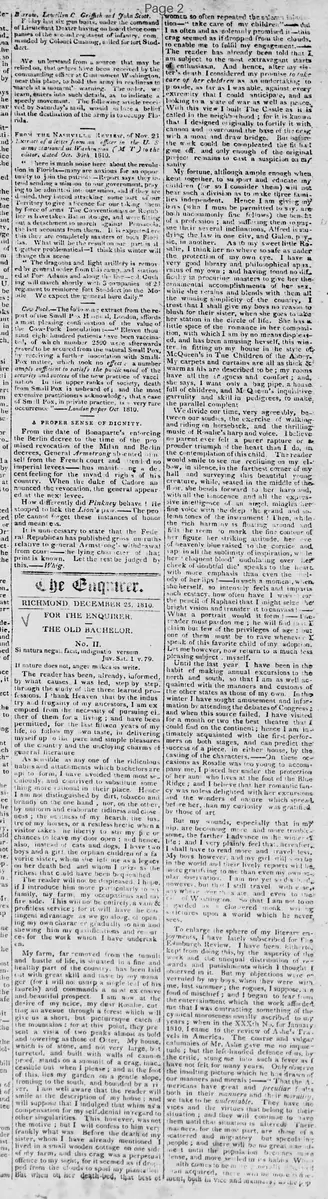
The reader has been, already, informed, by what causes, I was led, step by step, through the study of the three learned professions. I thank Heaven that by the industry and frugality of my ancestors, I am exempted from the necessity of pursuing either of them for a living; and have been permitted, for the last fifteen years of my life, to follow my own taste, in delivering myself up to the pure and simple pleasures of the country and the uncloying charms of general literature.
As sensible as any one of the ridiculous habits and attachments which bachelors are apt to form, I have avoided them most scrupulously, and contrived to substitute something more rational in their place. Hence I am not distinguished by dirt, tobacco and brandy on the one hand; nor, on the other, by uniform and elaborate tidiness and closeness; the neatness of my hearth, the lustre of my horses, or a restless hectic when a visitor takes the liberty to stir my fire or chances to leave my door open: and hence, also, instead of cats and dogs, I have two boys and a girl, the orphan children of a favorite sister, whom she left me as a legacy on her death bed and whom I prize as the richest that could have been bequeathed.
The reader will not be displeased, I hope, if I introduce him more particularly to my family, my farm, my occupations and my fire side. This will not be entirely a vain & profitless service; for it will have the contingent advantage as we go along, of opening my own character gradually to him and shewing him my qualifications and resources for the work which I have undertaken.
My farm, far removed from the tumult and bustle of life, is situated in a fine and healthy part of the country, has been laid out with great skill and taste by my manager (for I will not usurp a single leaf of his laurels) and commands a most extensive and beautiful prospect. I am now at the desire of my niece, my dear Rosalie, cutting an avenue through a forest which will give us a short, but picturesque catch of the mountains: for at this point, they present a vista of two peaks almost as bold and towering as those of Otter. My house, which is of stone, and not very large, but turreted, and built with walls of cannon proof, stands on a summit of a crag, inaccessible but when I please; and at the foot of this, lies my garden on a gentle slope, fronting to the south, and bounded by a river. I am well aware that the reader will smile at the description of my house; and will suppose that I indulged that whim as a compensation for my self-denial in regard to other singularities. This, however, was not the motive; but I will confess to him very frankly what was. Before the death of my sister, whom I have already mentioned I lived in a small wooden cottage on one side of my farm, and this crag was a perpetual offence to my sight, for it seemed as if dropped from the clouds to spoil my plantation. But when on her death-bed, that best of women so often repeated the solemn injunction—"take care of my children"—at that I as often and as solemnly promised it—this crag seemed as if dropped from the clouds, to enable me to fulfill my engagement.—
The reader has already been told that I am subject to the most extravagant starts of enthusiasm. And hence, after my sister's death, I considered my promise to take care of her children as an undertaking to provide, as far as I was able, against every extremity that I could anticipate, and as looking to a state of war as well as peace. With this view I built The Castle as it is called in the neighborhood; for it is known that I designed originally to fortify it with cannon and surround the base of the crag with a moat and draw bridge. But before the work could be completed the fit had gone off, and only enough of the original project remains to cast a suspicion on my sanity.
My fortune, although ample enough when kept together, to support and educate my children (for so I consider them) will not bear such a division as to make three families independent. Hence I am giving my boys (whom I must be permitted to say, are both uncommonly fine fellows) the benefit of a profession; and suffering them to pursue their several inclinations. Alfred is studying the law in one city, and Galen, physic, in another. As to my sweet little Rosalie, I think her no where so safe as under the protection of my own eye. I have a very good library and philosophical apparatus of my own; and having found no difficulty in procuring masters to give her the ornamental accomplishments of her sex, while she retains and blends with them all the winning simplicity of the country, I trust that I shall give my boys no reason to blush for their sister, when she goes to take her station in the circle of life. She has a little spice of the romance in her composition, with which I am by no means displeased, and has been amusing herself, this winter, in fitting up my house in the style of McQueen's in The Children of the Abbey. My carpets and curtains are all as thick & warm as his are described to be; my rooms have all the snugness and comfort; and, she says, I want only a bag pipe, a house full of children, and McQueen's inquisitive garrulity and skill in pedigrees, to make the parallel complete.
We divide our time, very agreeably, between our studies, the exercise of walking and riding on horseback, and the thrilling music of Rosalie's harp and voice. I believe no parent ever felt a purer rapture or a prouder triumph of the heart than I do, in the Contemplation of this child. The reader would smile to see me reclining on my elbow, in silence, in the farthest corner of my hall and surveying this beautiful young creature, while, seated in the middle of the floor, she bends forward to her harp and, with all the innocence and all the expressive intelligence of an angel, mingles her fine voice with the deep the grand and solemn tones of the instrument! Then, while the rich harmony is floating around and filling her form to mark the fine contour of her figure her striking attitude, her eye of heavenly blue raised to the cornice and rapt in all the sublimity of inspiration, while her 'eloquent blood' undulating over her cheek of doubtful die' speaks to the heart with more emphasis than even the eloquence of her lips!—In such a moment, when she herself, so intensely feels and imparts such ecstasy, how often have I wished for the pencil of Raphael that I might seize her bright vision and transfer it to canvass!--- What a portrait would it form!—The reader must pardon me; he will find as I claim but few of the privileges of age: but one of them must be to rave whenever I speak of this favorite child of my adoption.
Let me however, now return to a much less pleasing subject—myself.
Until the last year I have been in the habit of making annual excursions to the north and south, so that I am as well acquainted with the manners and customs of the other states as those of my own. In the winter I have sought amusement and information by attending the debates of Congress; and when this source failed, I have visited for a month or two the best theatre that I could find on the continent: hence I am intimately acquainted with the first performers on both stages, and can predict the success of a piece, in either house, by the casting of the characters.—On these occasions as Rosalie was too young to accompany me, I placed her under the protection of her aunt who lives at the foot of the Blue Ridge; and I believe that her romantic fancy was no less delighted with her excursions and the wonders of nature which spread before her, than my curiosity was gratified by those of art.
But my wounds, especially that in my hip, are becoming more and more troublesome, the farther I advance in the winter of life; and I very plainly feel that, hereafter, I shall have to read more and travel less. My boys, however, and my girl will soon be in the world and their lively reports will be, more gratifying to me than even my own ocular observation. I am not yet so disabled, however, but that I still travel with ease any where for this state and even to the city of Washington. So that I am not to be regarded as a cloistered monk writing strictures upon a world which he never sees.
To enlarge the sphere of my literary enjoyments, I have lately subscribed for the Edinburgh Review. I have been, hitherto, kept from doing this, by the asperity of the work and the unequal distribution of rewards and punishments which I thought I observed in it. But my objections were overruled by my boys, when they were with me, last summer; the rogues, I suppose, are fond of mischief: and I began to fear from the entertainment which the work afforded me that I was contracting something of the cynical moroseness usually ascribed to my years; when in the 18th No. for January 1810, I came to the review of Ashe's Travels in America. The coarse and vulgar calumnies of Mr. Ashe gave me no inquietude; but the left-handed defence of us, by the critic, stung me into such a fever as I have not felt for many years. Only observe the insulting picture which he has drawn of our manners and morals:-
“That the Americans have great and peculiar failings both in their manners and their morality, we take to be undeniable. They have the vices and the virtues that belong to their situation; and they will continue to have them until that situation is altered. Their manners, for the most part, are those of a scattered and migratory but speculating people; and there will be no great amendment until the population becomes more dense, and more settled in its habits. When wealth comes to be more evenly distributed an acquired, there will be more refinement, both in vice and manners, as she keeps pace with the progress of society.”
RICHMOND DECEMBER 25, 1810.
FOR THE ENQUIRER.
THE OLD BACHELOR.
No. II.
Si natura negat, facit, indignatio versum
Juv. Sat. 1 v.79.
If nature does not, anger makes us write.
The reader has been, already, informed, by what causes, I was led, step by step, through the study of the three learned professions. I thank Heaven that by the industry and frugality of my ancestors, I am exempted from the necessity of pursuing either of them for a living; and have been permitted, for the last fifteen years of my life, to follow my own taste, in delivering myself up to the pure and simple pleasures of the country and the uncloying charms of general literature.
As sensible as any one of the ridiculous habits and attachments which bachelors are apt to form, I have avoided them most scrupulously, and contrived to substitute something more rational in their place. Hence I am not distinguished by dirt, tobacco and brandy on the one hand; nor, on the other, by uniform and elaborate tidiness and closeness; the neatness of my hearth, the lustre of my horses, or a restless hectic when a visitor takes the liberty to stir my fire or chances to leave my door open: and hence, also, instead of cats and dogs, I have two boys and a girl, the orphan children of a favorite sister, whom she left me as a legacy on her death bed and whom I prize as the richest that could have been bequeathed.
The reader will not be displeased, I hope, if I introduce him more particularly to my family, my farm, my occupations and my fire side. This will not be entirely a vain & profitless service; for it will have the contingent advantage as we go along, of opening my own character gradually to him and shewing him my qualifications and resources for the work which I have undertaken.
My farm, far removed from the tumult and bustle of life, is situated in a fine and healthy part of the country, has been laid out with great skill and taste by my manager (for I will not usurp a single leaf of his laurels) and commands a most extensive and beautiful prospect. I am now at the desire of my niece, my dear Rosalie, cutting an avenue through a forest which will give us a short, but picturesque catch of the mountains: for at this point, they present a vista of two peaks almost as bold and towering as those of Otter. My house, which is of stone, and not very large, but turreted, and built with walls of cannon proof, stands on a summit of a crag, inaccessible but when I please; and at the foot of this, lies my garden on a gentle slope, fronting to the south, and bounded by a river. I am well aware that the reader will smile at the description of my house; and will suppose that I indulged that whim as a compensation for my self-denial in regard to other singularities. This, however, was not the motive; but I will confess to him very frankly what was. Before the death of my sister, whom I have already mentioned I lived in a small wooden cottage on one side of my farm, and this crag was a perpetual offence to my sight, for it seemed as if dropped from the clouds to spoil my plantation. But when on her death-bed, that best of women so often repeated the solemn injunction—"take care of my children"—at that I as often and as solemnly promised it—this crag seemed as if dropped from the clouds, to enable me to fulfill my engagement.—
The reader has already been told that I am subject to the most extravagant starts of enthusiasm. And hence, after my sister's death, I considered my promise to take care of her children as an undertaking to provide, as far as I was able, against every extremity that I could anticipate, and as looking to a state of war as well as peace. With this view I built The Castle as it is called in the neighborhood; for it is known that I designed originally to fortify it with cannon and surround the base of the crag with a moat and draw bridge. But before the work could be completed the fit had gone off, and only enough of the original project remains to cast a suspicion on my sanity.
My fortune, although ample enough when kept together, to support and educate my children (for so I consider them) will not bear such a division as to make three families independent. Hence I am giving my boys (whom I must be permitted to say, are both uncommonly fine fellows) the benefit of a profession; and suffering them to pursue their several inclinations. Alfred is studying the law in one city, and Galen, physic, in another. As to my sweet little Rosalie, I think her no where so safe as under the protection of my own eye. I have a very good library and philosophical apparatus of my own; and having found no difficulty in procuring masters to give her the ornamental accomplishments of her sex, while she retains and blends with them all the winning simplicity of the country, I trust that I shall give my boys no reason to blush for their sister, when she goes to take her station in the circle of life. She has a little spice of the romance in her composition, with which I am by no means displeased, and has been amusing herself, this winter, in fitting up my house in the style of McQueen's in The Children of the Abbey. My carpets and curtains are all as thick & warm as his are described to be; my rooms have all the snugness and comfort; and, she says, I want only a bag pipe, a house full of children, and McQueen's inquisitive garrulity and skill in pedigrees, to make the parallel complete.
We divide our time, very agreeably, between our studies, the exercise of walking and riding on horseback, and the thrilling music of Rosalie's harp and voice. I believe no parent ever felt a purer rapture or a prouder triumph of the heart than I do, in the Contemplation of this child. The reader would smile to see me reclining on my elbow, in silence, in the farthest corner of my hall and surveying this beautiful young creature, while, seated in the middle of the floor, she bends forward to her harp and, with all the innocence and all the expressive intelligence of an angel, mingles her fine voice with the deep the grand and solemn tones of the instrument! Then, while the rich harmony is floating around and filling her form to mark the fine contour of her figure her striking attitude, her eye of heavenly blue raised to the cornice and rapt in all the sublimity of inspiration, while her 'eloquent blood' undulating over her cheek of doubtful die' speaks to the heart with more emphasis than even the eloquence of her lips!—In such a moment, when she herself, so intensely feels and imparts such ecstasy, how often have I wished for the pencil of Raphael that I might seize her bright vision and transfer it to canvass!--- What a portrait would it form!—The reader must pardon me; he will find as I claim but few of the privileges of age: but one of them must be to rave whenever I speak of this favorite child of my adoption.
Let me however, now return to a much less pleasing subject—myself.
Until the last year I have been in the habit of making annual excursions to the north and south, so that I am as well acquainted with the manners and customs of the other states as those of my own. In the winter I have sought amusement and information by attending the debates of Congress; and when this source failed, I have visited for a month or two the best theatre that I could find on the continent: hence I am intimately acquainted with the first performers on both stages, and can predict the success of a piece, in either house, by the casting of the characters.—On these occasions as Rosalie was too young to accompany me, I placed her under the protection of her aunt who lives at the foot of the Blue Ridge; and I believe that her romantic fancy was no less delighted with her excursions and the wonders of nature which spread before her, than my curiosity was gratified by those of art.
But my wounds, especially that in my hip, are becoming more and more troublesome, the farther I advance in the winter of life; and I very plainly feel that, hereafter, I shall have to read more and travel less. My boys, however, and my girl will soon be in the world and their lively reports will be, more gratifying to me than even my own ocular observation. I am not yet so disabled, however, but that I still travel with ease any where for this state and even to the city of Washington. So that I am not to be regarded as a cloistered monk writing strictures upon a world which he never sees.
To enlarge the sphere of my literary enjoyments, I have lately subscribed for the Edinburgh Review. I have been, hitherto, kept from doing this, by the asperity of the work and the unequal distribution of rewards and punishments which I thought I observed in it. But my objections were overruled by my boys, when they were with me, last summer; the rogues, I suppose, are fond of mischief: and I began to fear from the entertainment which the work afforded me that I was contracting something of the cynical moroseness usually ascribed to my years; when in the 18th No. for January 1810, I came to the review of Ashe's Travels in America. The coarse and vulgar calumnies of Mr. Ashe gave me no inquietude; but the left-handed defence of us, by the critic, stung me into such a fever as I have not felt for many years. Only observe the insulting picture which he has drawn of our manners and morals:-
“That the Americans have great and peculiar failings both in their manners and their morality, we take to be undeniable. They have the vices and the virtues that belong to their situation; and they will continue to have them until that situation is altered. Their manners, for the most part, are those of a scattered and migratory but speculating people; and there will be no great amendment until the population becomes more dense, and more settled in its habits. When wealth comes to be more evenly distributed an acquired, there will be more refinement, both in vice and manners, as she keeps pace with the progress of society.”
What sub-type of article is it?
Essay
What themes does it cover?
Agriculture Rural
Nature
Social Manners
What keywords are associated?
Old Bachelor
Rural Life
Family
Farm
Castle
Literary Pursuits
American Manners
Literary Details
Title
The Old Bachelor. No. Ii.
Subject
Reflections Of An Old Bachelor On His Rural Life And Family
Form / Style
Personal Prose Essay
Key Lines
Si Natura Negat, Facit, Indignatio Versum
If Nature Does Not, Anger Makes Us Write.
Take Care Of My Children
The Castle As It Is Called In The Neighborhood
That The Americans Have Great And Peculiar Failings Both In Their Manners And Their Morality, We Take To Be Undeniable.