Thank you for visiting SNEWPapers!
Sign up free
Domestic News
June 19, 1930
The Ronan Pioneer
Ronan, Lake County, Montana
What is this article about?
United States Department of Agriculture article on vitamins, their discovery, functions in preventing deficiency diseases like beriberi and pellagra, and food sources rich in vitamin B.
Clipping
OCR Quality
98%
Excellent
Full Text
Some Facts About Vitamins
(Prepared by the United States Department of Agriculture.)
Our knowledge about vitamins has been undergoing constant expansion. It is still far from complete. First came recognition of the fact that in natural food materials there existed, in minute quantities, certain substances other than proteins, fats, carbohydrates and salts, which appeared to be essential for normal nutrition. Further investigation showed that these substances, or vitamins, also prevented various pathological conditions or "deficiency diseases."
Early in the work these separate vitamins were identified, and called A, B, and C. Each one had functions peculiar to itself. Several years later two more vitamins, D and E, were discovered. Comparatively recently it has been found that another vitamin, named G, occurs in a great many foods which are also rich in vitamin B. The identification of vitamin G was obscured for a long time because of this parallel occurrence.
The functions of the two vitamins differ. Vitamin B prevents beriberi, while vitamin G prevents pellagra. An abundance of both vitamins is essential for growth and well-being at all ages, but particularly necessary for nursing mothers and young children. As both occur to a large extent in the same foods and in a very wide variety of foods, a varied diet containing fruits and vegetables will usually be satisfactory in respect to these two factors.
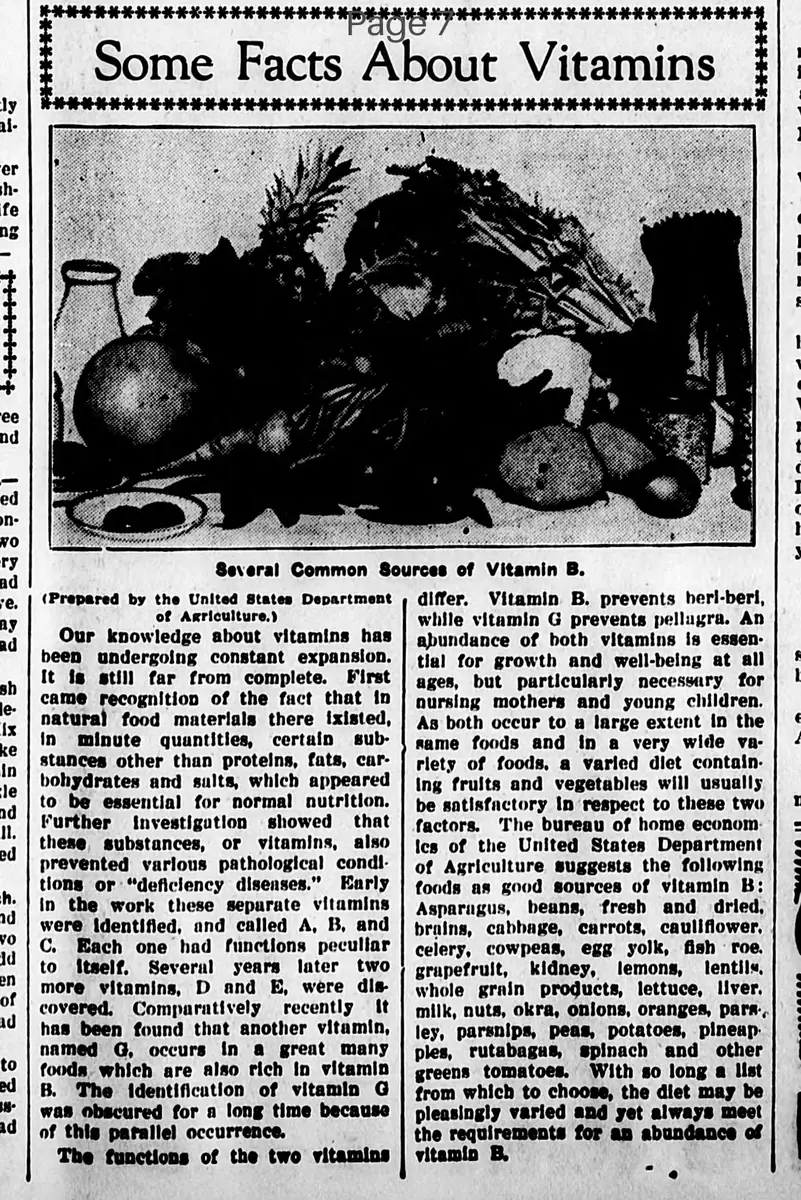
The bureau of home economics of the United States Department of Agriculture suggests the following foods as good sources of vitamin B: Asparagus, beans, fresh and dried, brains, cabbage, carrots, cauliflower, celery, cowpeas, egg yolk, fish roe, grapefruit, kidney, lemons, lentils, whole grain products, lettuce, liver, milk, nuts, okra, onions, oranges, parsley, parsnips, peas, potatoes, pineapples, rutabagas, spinach and other greens, tomatoes. With so long a list from which to choose, the diet may be pleasingly varied and yet always meet the requirements for an abundance of vitamin B.
(Prepared by the United States Department of Agriculture.)
Our knowledge about vitamins has been undergoing constant expansion. It is still far from complete. First came recognition of the fact that in natural food materials there existed, in minute quantities, certain substances other than proteins, fats, carbohydrates and salts, which appeared to be essential for normal nutrition. Further investigation showed that these substances, or vitamins, also prevented various pathological conditions or "deficiency diseases."
Early in the work these separate vitamins were identified, and called A, B, and C. Each one had functions peculiar to itself. Several years later two more vitamins, D and E, were discovered. Comparatively recently it has been found that another vitamin, named G, occurs in a great many foods which are also rich in vitamin B. The identification of vitamin G was obscured for a long time because of this parallel occurrence.
The functions of the two vitamins differ. Vitamin B prevents beriberi, while vitamin G prevents pellagra. An abundance of both vitamins is essential for growth and well-being at all ages, but particularly necessary for nursing mothers and young children. As both occur to a large extent in the same foods and in a very wide variety of foods, a varied diet containing fruits and vegetables will usually be satisfactory in respect to these two factors.
The bureau of home economics of the United States Department of Agriculture suggests the following foods as good sources of vitamin B: Asparagus, beans, fresh and dried, brains, cabbage, carrots, cauliflower, celery, cowpeas, egg yolk, fish roe, grapefruit, kidney, lemons, lentils, whole grain products, lettuce, liver, milk, nuts, okra, onions, oranges, parsley, parsnips, peas, potatoes, pineapples, rutabagas, spinach and other greens, tomatoes. With so long a list from which to choose, the diet may be pleasingly varied and yet always meet the requirements for an abundance of vitamin B.
What sub-type of article is it?
Nutrition Education
Health Information
What keywords are associated?
Vitamins
Deficiency Diseases
Beriberi
Pellagra
Vitamin B
Usda
Nutrition
Domestic News Details
Event Details
Article prepared by the United States Department of Agriculture explaining the history and functions of vitamins A, B, C, D, E, and G, their role in preventing deficiency diseases such as beriberi and pellagra, and listing foods rich in vitamin B including asparagus, beans, cabbage, carrots, and others.