Thank you for visiting SNEWPapers!
Sign up free
The Virginia Gazette
Richmond, Williamsburg, Richmond County, Virginia
What is this article about?
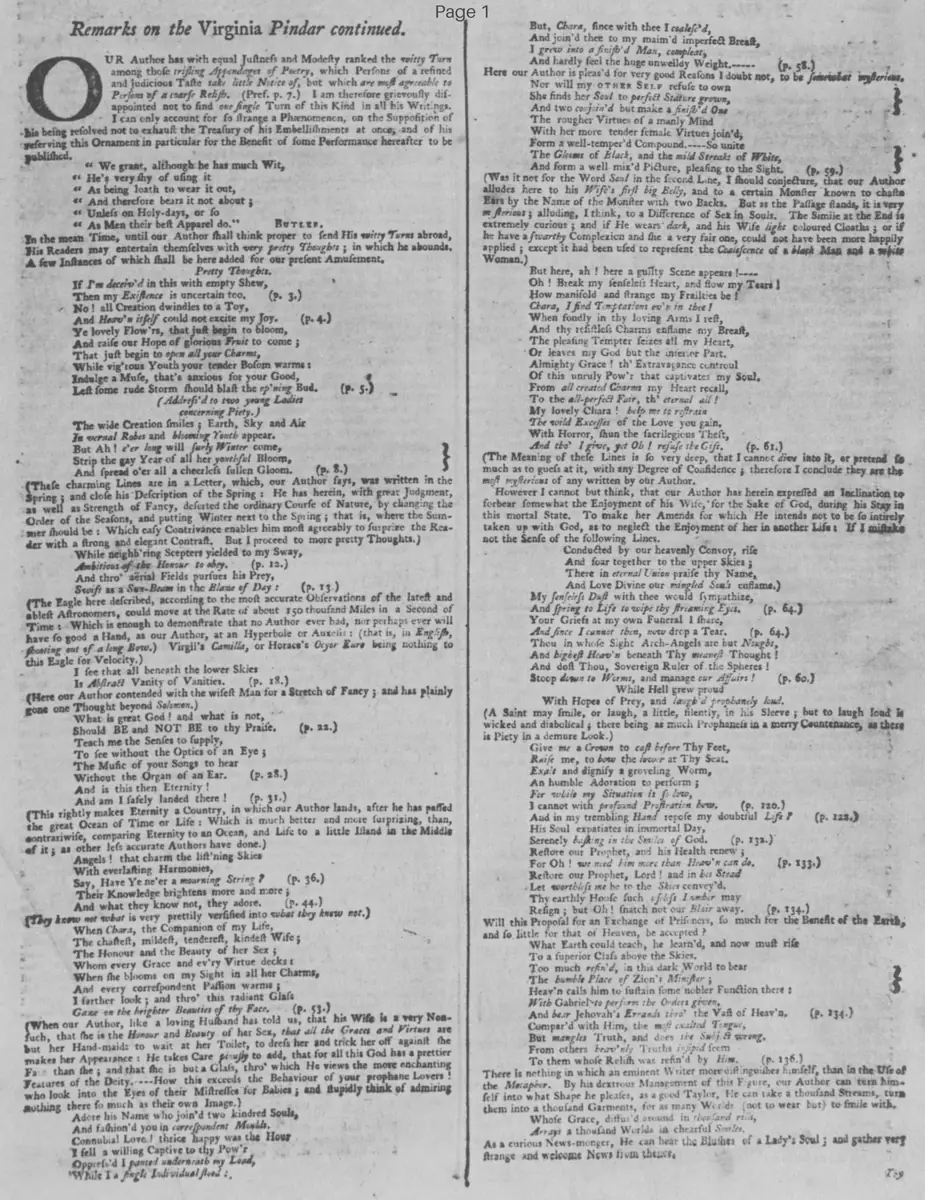
Continuation of satirical essay critiquing the poetry of the 'Virginia Pindar.' The author mocks the poet's lack of wit, quoting and ridiculing 'pretty thoughts' on nature, love, religion, eternity, and metaphors, with ironic commentary on his hyperbolic style and themes of marital and divine love.
Merged-components note: Merged the image with the two literary components due to spatial overlap of the image bbox with the first literary bbox and adjacent reading orders (1,2,3); the two literary texts are a direct continuation of the same essay on 'Remarks on the Virginia Pindar', ending with '[To be continued.]'. Resulting label is literary as it best describes the dominant textual content.
Clippings
1 of 2
OCR Quality
Full Text
Our Author has with equal Justice and Modesty ranked the witty Turn among those trifling Appendages of Poetry, which Persons of a refined and judicious Taste take little Notice of, but which are me agreeable to Persons of a coarse Relish. (Pref. p. 7.) I am therefore grievously disappointed not to find one single Turn of this Kind in all his Writings. I can only account for so strange a Phenomenon, on the Supposition of This being resolved not to exhaust the Treasury of his Embellishments at once, and of his reserving this Ornament in particular for the Benefit of some Performance hereafter to be Published.
"We grant, although he has much Wit,
He's very shy of using it."
"As being loath to wear it out,
And therefore bears it not about,
Unless on Holy-days, or so
As Men their best Apparel do,"
But I: In the mean Time, until our Author shall think proper to send His witty Turns abroad, His Readers may entertain themselves with very pretty Thoughts; in which he abounds. A few Instances of which shall be here added for our present Amusement,
Pretty Thoughts.
If I'm descried in this with empty Shew,
Then my Existence is uncertain too.
(p. 3.)
No! all Creation dwindles to a Toy,
And Harvest itself could not excite my Joy.
(p. 4)
Ye lovely Flow'rs, that just begin to bloom,
And raise our Hope of glorious Fruit to come;
That just begin to open all your Charms,
While vig'rous Youth your tender Bosom warms
Indulge a Muse, that's anxious for your Good,
Lest some rude Storm should blast the opening Bud,
(Address'd to two young Ladies concerning Poetry:)
The wide Creation smiles; Earth, Sky and Air
In vernal Robes and blossoming Youth appear,
But Ah! ere long will surly Winter come,
Strip the gay Year of all her youthful Bloom,
And spread o'er all a cheerless sullen Gloom.
(p. 8.)
Spring; and close his Description of the Spring: He has herein, with great Judgment, (These charming Lines are in a Letter, which, our Author says, was written in the as well as Strength of Fancy, deserted the ordinary Course of Nature, by changing the Order of the Seasons, and putting Winter next to the Spring; that is, where the Summer should be: Which gay Contrivance enables him most agreeably to surprize the Reader with a strong and elegant Contrast. But I proceed to more pretty Thoughts.)
While neighb'ring Scepters yielded to my Sway,
Ambitious of the Honour to obey.
(p. 12.)
And thro' aërial Fields pursues his Prey,
Swift as a Sun-Beam in the Blaze of Day:
(p. 13.)
(The Eagle here described, according to the most accurate Observations of the latest and blest Astronomers, could move at the Rate of about 150 thousand Miles in a Second of Time: Which is enough to demonstrate that no Author ever had, nor perhaps ever will have so good a Hand, as our Author, at an Hyperbole or Auxesis: (that is, in English, this Eagle for Velocity.) Shooting out of a long Bow.) Virgil's Camilla, or Horace's Ocyrhoe being nothing to
I see that all beneath the lower Skies
(Here our Author contended with the wisest Man for a Stretch of Fancy; and has plainly gone one Thought beyond Solomon.)
Is Abstract Variety of Vanities.
(p. 18.)
, 1
What is great God! and what is not,
Should BE and NOT BE to thy Praise.
(p. 22.)
Teach me the Senses to supply,
To see without the Optics of an Eye;
The Music of your Songs to hear
Without the Organ of an Ear.
(p. 28.)
And is this then Eternity!
And am I Safely landed there!
(p. 31.)
(This rightly makes Eternity a Country, in which our Author lands, after he has passed the great Ocean of Time or Life: Which is much better and more surprizing, than, contrariwise, comparing Eternity to an Ocean, and Life to a little Island in the Middle of it; as other less accurate Authors have done.)
Angels! that charm the list'ning Skies
With everlasting Harmonies,
Say, Have Ye ne'er a mourning String?
(p.36.)
Their Knowledge brightens more and more;
(They know not what is very prettily versified into what they knew not.)
And what they know not, they adore.
(p. 44.)
When Chara, the Companion of my Life,
The chastest, mildest, tenderest, kindest Wife;
The Honour and the Beauty of her Sex;
Whom every Grace and ev'ry Virtue decks
When she blooms on my Sight in all her Charms,
And every correspondent Passion warms:
I farther look; and thro' this radiant Glass
Gaze on the brighter Beauties of thy Face.
(p. 53.)
(When our Author, like a loving Husband has told us, that his Wife is a very such, that she is the Honour and Beauty of her Sex, that all the Graces and Virtues are but her Hand-maid: to wait at her Toilet, to dress her and trick her off against she makes her Appearance: He takes Care piously to add, that God has prettier Face than she; and that she is but a Glass, thro' which He views the more enchanting Features of the Deity. ---How this exceeds the Behaviour of your prophane Lovers who look into the Eyes of their Mistress for Babies; and stup idly think of admiring nothing there so much as their own Image.)
Adore his Name who join'd two kindred Souls,
And fashion'd you in correspondent Moulds.
Connubial Love! thrice happy was the Hour
I fell a willing Captive to thy Pow'r
Oppress'd I panted underneath my Load,
While I a single Individual stood:.
But, Chara, since with thee I coalesc'd,
And in thy---
joined the divided and imperfect Breast,
I grew into a finish'd Man, compleat,
And hardly feel the huge unwieldy Weight.-----
(p. 58.)
Here our Author is pleas'd for very good Reasons I doubt not, to be somewhat mysterious
Nor will my other Self refuse to own
She finds her Soul to perfect Stature grown,
And two conjoin'd but make a finish'd One
The rougher Virtues of a manly Mind
With her more tender female Virtues join'd;
Form a well-temper'd Compound.----So unite
The Gloums of Black, and the mild Streaks of White.
2
And form a well mix'd Picture, pleasing to the Sight.
(P. 59.)
(Was it not for the Word Soul in the second Line, I should conjecture, that our Author alludes here to his Wife's first big Belly, and to a certain Monster known to chaste Ears by the Name of the Monster with two Backs. But as the Passage stands, it is very serious; alluding, I think, to a Difference of Sex in Souls. The Simile at the End is extremely curious; and if He wears dark, and his Wife light coloured Cloaths; or if he have a swarthy Complexion and she a very fair one, could not have been more happily applied; except it had been used to represent the Coalescence of a black Man and a white Woman.)
But here, ah! here a guilty Scene appears!---
Oh! Break my Senseless Heart, and sow my Tears
How manifold and strange my Frailties be!
Chara, I find Infatuations ev'n in thee!
When fondly in thy loving Arms I rest,
And thy resistless Charms inflame my Breast,
The pleasing Tempter seizes all my Heart,
Or leaves my God but the interior Part,
Almighty Grace! th' Extravagance controul
Of this unruly Pow'r that captivates my Soul,
From all created Charms my Heart recall,
To the all-perfect Fair, th' eternal All!
By lovely Chara! help me to restrain
The wild Excesses of the Love you gain,
With Horror, shun the sacrilegious Theft,
And tho' I give, yet Oh! refuse the Gift."
(p. 61.)
(The Meaning of these Lines is so very deep, that I cannot dive into it, nor pretend so much as to guess at it, with any Degree of Confidence; therefore I conclude they are the most mysterious of any written by our Author. However I cannot but think, that our Author has herein expressed an Inclination to forbear somewhat the Enjoyment of his Wife, 'for the Sake of God, during his Stay in this mortal State. To make her Amends for which He intends not to be so intirely taken up with God, as to neglect the Enjoyment of her in another Life: If I mistake not the Sense of the following Lines.)
Conducted by our heavenly Convoy, rise
And soar together to the upper Skies;
There in eternal Union praise thy Name,
And Love Divine our mingled Souls enflame.)
My senseless Dust with thee would sympathize,
And spring to Life to wipe thy streaming Eyes.
(p. 64.)
Your Griefs at my own Funeral I share,
And since I cannot then, nor now drop a Tear.
(p. 64.)
Thou in whose Sight Arch-Angels are but Newbs,
And biggest Heav'n beneath Thine mean Thought!
And dost Thou, Sovereign Ruler of the Spheres!
Stoop down to Worms, and manage our Affairs!
(p. 60.)
While Hell grew proud
With Hopes of Prey, and laugh'd profanely loud.
(A Saint may smile, or laugh, a little, silently, in his Sleeve; but to laugh loud in is wicked and diabolical; there being as much Prophaneness in a merry Countenance, as there is Piety in a demure Look.)
Give me a Crown to cast before Thy Feet,
Raise me, to bow the lower at Thy Seat.
Exalt and dignify a groveling Worm,
And humble Adoration to perform;
For while my Situation is low,
I cannot with profound Prostration bow.
(p. 120.)
And in my trembling Hand repose my doubtful Life?
(p. 122.)
His Soul expatiates in immortal Day,
Serenely basking in the Smiles of God.
(p. 132.)
Restore our Prophet, and his Health renew;
For Oh! we need him more than Heav'n can do.
(p. 133.)
Restore our Prophet, Lord! and in his Stead
Let worthless me be to the Skies convey'd.
Thy earthly House such as I enter may
Reign; but Oh! match not our Blair away.
(p. 134.)
Will this Proposal for an Exchange of Prisoners, so much for the Benefit of the Earth, and so little for that of Heaven, be accepted?
What Earth could teach, he learn'd, and now must rise
To a superior Class above the Skies.
Too much refin'd, in this dark World to bear
The humble Place of Zion's Minister;
Heav'n calls him to attain some nobler Function there:
With Gabriel to perform the Orders given,
And bear Jehovah's Errands thro' the Vault of Heav'n.
(p. 234.)
Compar'd with Him, the most exalted Tongue,
But mangles Truth, and does the Subject wrong.
From others heav'nly Truths insipid seem
To them whose Relish was refin'd by His.
(p. 136.)
There is nothing in which an eminent Writer more distinguishes himself, than in the Use of the Metaphor. By his dextrous Management of this Figure, our Author can turn himself into what Shape he pleases, as a good Taylor, He can take a thousand Streams, turn them into a thousand Garments, for as many Worlds (not to wear but) to smile with Whose Grace, diffus'd around in thousand rills, Adorns a thousand Worlds in cheerful Smiles,
As a curious News-monger, He can hear the Blushes of a Lady's Soul; and gather very strange and unclean News from the pit,
Thy Soul that knew not what Dissembling meant
With modest soft Reluctance, blush'd Consent.
In Transport lost, the joyful News I heard.
As an understanding Mariner, and tender Husband, He can recommend Rock to his
Wife, as a Place of great and marvellous Security, in Case she should be overtaken in
a Storm.
Here will I rest: And here, my Charmer too,
Appears a Rock in ev'ry Sort for you.
(p. 66.)
As a skilful Physician, He can feel the Pulse of Immortality, and be thereby assured,
that the Constitution of his Patient is very good.
I feel the Pulse of Immortality
Beat, and assure me I must ever Be;
(p. 77.)
And as a learned Lawyer, He can make Death the Repealer of Matrimony.
A Solemn Rite the willing Contract seal'd,
To Stand, 'till Death dissolves, unrepeal'd.
(p. 60.)
Now a young Dabbler in the Law will be apt to say, that if Death be the Repealer of
Matrimony, He should be the Enactor too. That in comparing Marriage to an Act of
Parliament, a Divorce is properly a repealing of the Law; if the Contract comes to an
End by the Death of one of the Parties, the Act is expired: But all this is the Effect
of a cold Imagination; our Author is bless'd with a warmer and more prolific Fancy.
[To be continued.]
What sub-type of article is it?
What themes does it cover?
What keywords are associated?
Literary Details
Title
Remarks On The Virginia Pindar Continued.
Subject
Satirical Critique Of The Virginia Pindar's Poetry
Form / Style
Satirical Prose Essay With Quoted Verse Excerpts
Key Lines