Thank you for visiting SNEWPapers!
Sign up free
Gazette Of The United States And Daily Evening Advertiser
Philadelphia, Philadelphia County, Pennsylvania
What is this article about?
Autobiographical sketch by General Dumouriez, published in a late London paper, covering his birth in 1739, military career with 22 wounds and campaigns in Germany, Corsica, and Poland, diplomatic roles in Poland and Sweden, imprisonment, port developments at Cherbourg, and political involvement in the French Revolution up to his 1792 resignation as War Minister.
Clipping
OCR Quality
Full Text
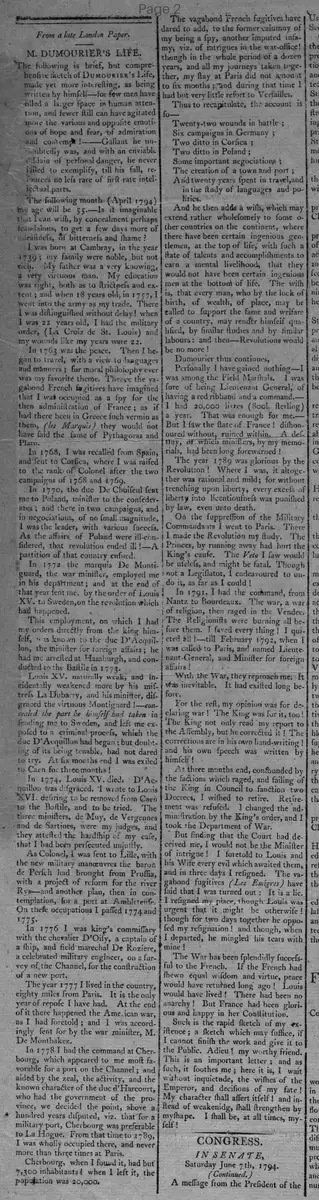
M. DUMOURIER'S LIFE.
The following is brief, but comprehensive sketch of Dumourier's Life, made yet more interesting, as being written by himself—for few men have filled a larger space in human attention, and fewer still can have agitated more the various and opposite emotions of hope and fear, of admiration and contempt!—Gallant he undoubtedly was, and with an enviable disdain of personal danger, he never failed to exemplify, till his fall, resources no less rare of first-rate intellectual parts.
The following month (April 1794) my age will be 55.—Is it imaginable that I can wish, by concealment perhaps scandalous, to get a few days more of uneasiness, of bitterness and shame?
I was born at Cambray, in the year 1739; my family were noble, but not rich. My father was a very knowing, a very virtuous man. My education was right, both as to strictness and extent: and when 18 years old, in 1757, I went into the army as my trade. There I was distinguished without delay! when I was 22 years old, I had the military order, (La Croix de St. Louis) and my wounds like my years were 22.
In 1763 was the peace. Then I began to travel, with a view to languages and manners; for moral philosophy ever was my favorite theme. Thence the vagabond French emigrates have imagined that I was occupied as a spy for the then administration of France; as if had there been in Greece such vermin as them, (les Marquis) they would not have said the same of Pythagoras and Plato.
In 1768, I was recalled from Spain; and sent to Corsica, where I was raised to the rank of Colonel after the two campaigns of 1768 and 1769.
In 1770, the duc De Choiseul sent me to Poland, minister to the confederates; and there in two campaigns, and in negotiations, of no small magnitude, I was the leader; with various success. As the affairs of Poland were ill-considered, that revolution ended ill! A partition of that country ensued.
In 1772 the marquis De Montiguard, the war minister, employed me in his department; and at the end of that year sent me, by the order of Louis XV. to Sweden, on the revolution which had happened.
This employment, on which I had my orders directly from the king himself, is known to the due D'Aquillon, the minister for foreign affairs; he had me arrested at Hamburgh, and conducted to the Bastile in 1773.
Louis XV. naturally weak, and incidentally weakened more by his mistress La Dubarry, and his minister, disgraced the virtuous Montiguard!—concealed the part he himself had taken in sending me to Sweden, and left me exposed to a criminal process, which the duc D'Aquillon had began; but doubting of its being tenable, had not dared to try. At six months end I was exiled to Caen for three months!
In 1774, Louis XV. died. D'Aquillon was disgraced. I wrote to Louis XVI. desiring to be removed from Caen to the Bastile, and to be tried. The three ministers, de Muy, de Vergennes and de Sartines, were my judges, and they attested the hardship of my case, that I had been persecuted unjustly.
As Colonel, I was sent to Lille, with the new military manoeuvres the baron de Perch had brought from Prussia, with a project of reform for the river Lys—and another plan, then in contemplation, for a port at Ambleteuse.
On these occupations I passed 1774 and 1775.
In 1776 I was king's commissary with the chevalier D'Oisy, a captain of a ship, and field marshal De Roziere, a celebrated military engineer, on a survey of the Channel, for the construction of a new port.
The year 1777 I lived in the country, eighty miles from Paris. It is the only year of repose I have had. At the end of it there happened the American war, as I had foretold; and I was accordingly sent for by the war minister, M. De Montbarey.
In 1778 I had the command at Cherbourg, which appeared to me most favorable for a port on the Channel; and aided by the zeal, the activity, and the known character of the duc d'Harcourt, who had the government of the province, we decided the point, above a hundred years disputed, viz. that for a military port, Cherbourg was preferable to La Hogue. From that time to 1789, I was wholly occupied there, and never more than three times at Paris.
Cherbourg, when I found it, had but 7,300 inhabitants! when I left it, the population was 20,000.
The vagabond French fugitives have dared to add, to the former calumny of my being a spy, another imputed infamy, viz. of intrigues in the war-office! though in the whole period of a dozen years, and all my journeys taken together, my stay at Paris did not amount to six months; and during that time I had but very little resort to Versailles.
Thus to recapitulate, the account is so—
Twenty-two wounds in battle;
Six campaigns in Germany;
Two ditto in Corsica:
Two ditto in Poland;
Some important negotiations;
The creation of a town and port;
And twenty years spent in travel, and in the study of languages and politics.
And he then adds a wish, which may extend rather wholesomely to some other countries on the continent, where there have been certain ingenious gentlemen, at the top of life, with such a state of talents and accomplishments to earn a mental livelihood, that they would not have been certain ingenious men at the bottom of life. The wish is, that every man, who by the luck of birth, of wealth, of place, may be called to support the fame and welfare of a country, may render himself qualified, by similar studies and by similar labours: and then—Revolutions would be no more!
Dumourier thus continues,
Personally I have gained nothing—I was among the Field Marshals. I was sure of being Lieutenant General, of having a red ribband and a command.—I had 20,000 livres (800l. sterling) a year. That was enough for me.
But I saw the state of France! dishonoured without, ruined within. A destiny, of which ministers, by my memorials, had been long forewarned!
The year 1789 was glorious by the Revolution! Where I was, it altogether was rational and mild; for without trenching upon liberty, every excess of liberty into licentiousness was punished by law, even unto death.
On the suppression of the Military Commandants I went to Paris. There I made the Revolution my study. The Princes, by running away had hurt the King's cause. The Veto I saw would be useless, and might be fatal. Though not a Legislator, I endeavoured to undo it, as far as I could!
In 1791, I had the command, from Nantz to Bourdeaux. The war, a war of religion, then raged in the Vendee. The Religionists were burning all before them. I saved every thing! I quieted all!—till February 1792, when I was called to Paris; and named Lieutenant-General, and Minister for foreign affairs!
With the War, they reproach me? It was inevitable. It had existed long before.
For the rest, my opinion was for declaring war! The King was for it, too! The King not only read my report to the Assembly, but he corrected it! The corrections are in his own hand-writing! and his own speech was written by himself!
At three months end, confounded by the factions which raged, and failing of the King in Council to sanction two Decrees, I wished to retire. Retirement was refused. I changed the administration by the King's order, and I took the Department of War.
But finding that the Court had deceived me, I would not be the Minister of intrigue! I foretold to Louis and his Wife every evil which awaited them, and in three days I resigned. The vagabond fugitives (Les Emigres) have said that I was turned out: It is a lie. I resigned my place, though Louis was urgent that it might be otherwise! though for two days together he opposed my resignation! and though, when I departed, he mingled his tears with mine!
The War has been splendidly successful to the French. If the French had shewn equal wisdom and virtue, peace would have returned long ago! Louis would have lived! There had been no anarchy! But France had been glorious and happy in her Constitution.
Such is the rapid sketch of my existence; a sketch which may suffice, if I cannot finish the work and give it to the Public. Adieu! my worthy friend.
This is an important letter; and as such, it soothes me; here it is, I wait without inquietude, the wishes of the Emperor, and decisions of my fate!
My character shall assert itself! and instead of weakening, shall strengthen by my shape. I shall be, at all times, myself!
What sub-type of article is it?
What keywords are associated?
What entities or persons were involved?
Where did it happen?
Foreign News Details
Primary Location
France
Event Date
Early 1794
Key Persons
Event Details
Autobiographical account of Dumouriez's life from birth in 1739 at Cambray, military service starting 1757 with 22 wounds and campaigns in Germany, Corsica, Poland; diplomatic missions to Poland and Sweden; imprisonment in 1773; engineering projects at Cherbourg increasing population from 7,300 to 20,000; involvement in 1789 Revolution, command in Vendee 1791, appointment as Lieutenant-General and Foreign Minister 1792, support for war declaration, resignation from War Department after three days.