Thank you for visiting SNEWPapers!
Sign up free
The Lexington Advertiser
Lexington, Holmes County, Mississippi
What is this article about?
T. M. Patterson, state AAA administrator, announced soil-building allowance rates for the 1942 farm program on Monday, similar to 1941 rates, to help farmers plan practices and earn payments for conservation and crop allotments.
Clipping
OCR Quality
Full Text
Under 1942 Program
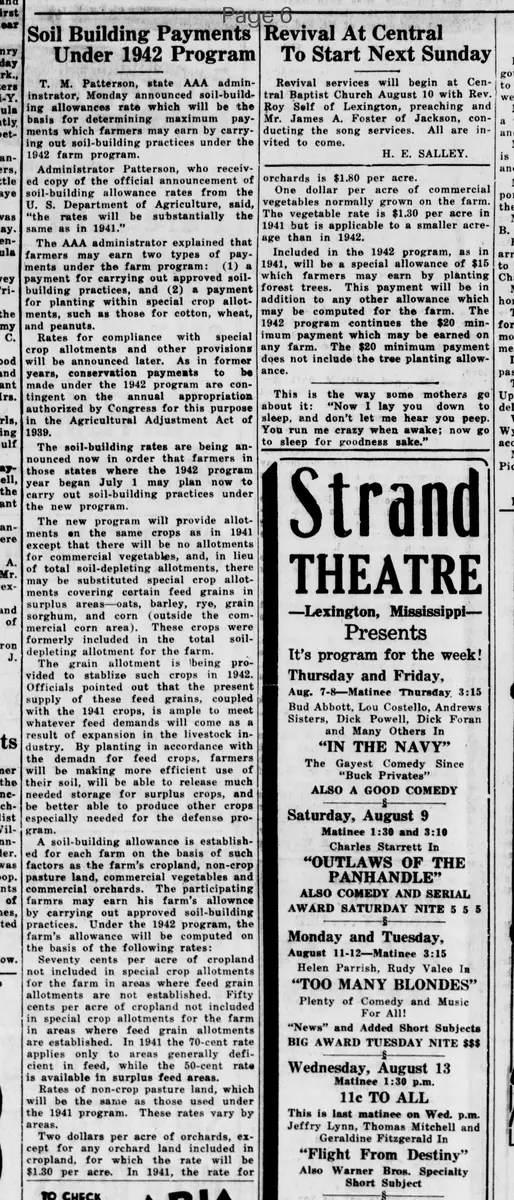
T. M. Patterson, state AAA administrator, Monday announced soil-building allowance rates which will be the basis for determining maximum payments which farmers may earn by carrying out soil-building practices under the 1942 farm program.
Administrator Patterson, who received copy of the official announcement of soil-building allowance rates from the U. S. Department of Agriculture, said, "the rates will be substantially the same as in 1941."
The AAA administrator explained that farmers may earn two types of payments under the farm program: (1) a payment for carrying out approved soil-building practices, and (2) a payment for planting within special crop allotments, such as those for cotton, wheat, and peanuts.
Rates for compliance with special crop allotments and other provisions will be announced later. As in former years, conservation payments to be made under the 1942 program are contingent on the annual appropriation authorized by Congress for this purpose in the Agricultural Adjustment Act of 1938.
The soil-building rates are being announced now in order that farmers in those states where the 1942 program year began July 1 may plan now to carry out soil-building practices under the new program.
The new program will provide allotments on the same crops as in 1941 except that there will be no allotments for commercial vegetables, and, in lieu of total soil-depleting allotments, there may be substituted special crop allotments covering certain feed grains in surplus areas—oats, barley, rye, grain sorghum, and corn (outside the commercial corn area). These crops were formerly included in the total soil-depleting allotment for the farm.
The grain allotment is being provided to stabilize such crops in 1942. Officials pointed out that the present supply of these feed grains, coupled with the 1941 crops, is ample to meet whatever feed demands will come as a result of expansion in the livestock industry. By planting in accordance with the demand for feed crops, farmers will be making more efficient use of their soil, will be able to release much needed storage for surplus crops, and be better able to produce other crops especially needed for the defense program.
A soil-building allowance is established for each farm on the basis of such factors as the farm's cropland, non-crop pasture land, commercial vegetables and commercial orchards. The participating farmers may earn his farm's allowance by carrying out approved soil-building practices. Under the 1942 program, the farm's allowance will be computed on the basis of the following rates:
Seventy cents per acre of cropland not included in special crop allotments for the farm in areas where feed grain allotments are not established. Fifty cents per acre of cropland not included in special crop allotments for the farm in areas where feed grain allotments are established. In 1941 the 70-cent rate applies only to areas generally deficient in feed, while the 50-cent rate is available in surplus feed areas.
Rates of non-crop pasture land, which will be the same as those used under the 1941 program. These rates vary by areas.
Two dollars per acre of orchards, except for any orchard land included in cropland, for which the rate will be $1.30 per acre. In 1941, the rate for orchards is $1.80 per acre.
One dollar per acre of commercial vegetables normally grown on the farm. The vegetable rate is $1.30 per acre in 1941 but is applicable to a smaller acreage than in 1942.
Included in the 1942 program, as in 1941, will be a special allowance of $15 which farmers may earn by planting forest trees. This payment will be in addition to any other allowance which may be computed for the farm. The 1942 program continues the $20 minimum payment which may be earned on any farm. The $20 minimum payment does not include the tree planting allowance.
What sub-type of article is it?
What keywords are associated?
What entities or persons were involved?
Domestic News Details
Event Date
Monday
Key Persons
Outcome
farmers may earn payments including 70 cents per acre for certain cropland, 50 cents for others, $2 per acre for orchards, $1 per acre for commercial vegetables, $15 for tree planting, and a $20 minimum payment.
Event Details
T. M. Patterson announced soil-building allowance rates for the 1942 farm program, similar to 1941, based on cropland, pasture, orchards, and vegetables; includes special crop allotments for feed grains in surplus areas and tree planting incentives.