Thank you for visiting SNEWPapers!
Sign up free
Edwardsville Spectator
Edwardsville, Madison County, Illinois
What is this article about?
Rev. John M. Peck delivers an 1823 Independence Day address to the St. Clair Society for the Prevention of Slavery in Illinois, celebrating American liberty from British rule while decrying domestic slavery as a contradiction to the Declaration of Independence's ideals of equality and unalienable rights, and calling for its abolition and prevention in the state.
Merged-components note: This is a continuous anti-slavery address by Rev. John M. Peck spanning pages 1 and 2; relabeled from 'literary' to 'editorial' due to its opinionated and partisan tone on slavery and independence.
Clippings
1 of 2
OCR Quality
Full Text
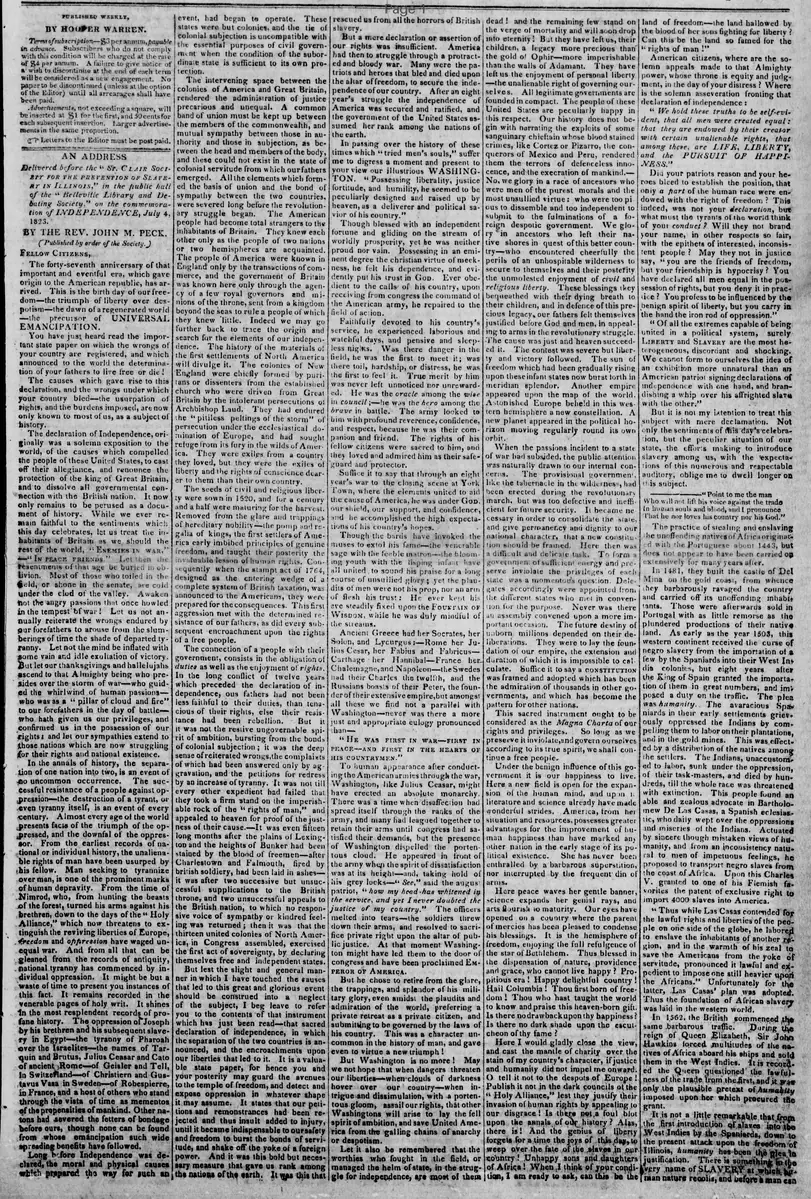
Delivered before the "St. Clair Society for the Prevention of Slavery in Illinois," in the public hall of the "Belleville Library and Debating Society," on the commemoration of INDEPENDENCE, July 4, 1823.
BY THE REV. JOHN M. PECK.
(Published by order of the Society.)
Fellow Citizens:
The forty-seventh anniversary of that important and eventful era, which gave origin to the American republic, has arrived. This is the birthday of our freedom—the triumph of liberty over despotism—the dawn of a regenerated world—the precursor of UNIVERSAL EMANCIPATION.
You have just heard read the important state paper on which the wrongs of your country are registered, and which announced to the world the determination of your fathers to live free or die! The causes which gave rise to this declaration, and the wrongs under which your country bled—the usurpation of rights, and the burdens imposed, are now only known to most of us, as a subject of history.
The declaration of Independence, originally was a solemn exposition to the world, of the causes which compelled the people of these United States, to cast off their allegiance, and renounce the protection of the king of Great Britain, and to dissolve all governmental connection with the British nation. It now only remains to be perused as a document of history. While we ever remain faithful to the sentiments which this day celebrates, let us treat the inhabitants of Britain as we should the rest of the world, "Enemies In WAR," "In PEACE FRIENDS." Let then the resentments of that age be buried in oblivion. Most of those who toiled in the field, or shone in the senate, are cold under the clod of the valley. Awaken not the angry passions that once howled in the tempest of war! Let us not annually reiterate the wrongs endured by our forefathers to arouse from the slumberings of time the shade of departed tyranny. Let not the mind be inflated with some vain and idle exultation of victory. But let our thanksgivings and hallelujahs ascend to that Almighty being who presides over the storm of war—who guided the whirlwind of human passions—who was as a "pillar of cloud and fire" to our forefathers in the day of battle—who hath given us our privileges, and confirmed us in the possession of our rights: and let our sympathies extend to those nations which are now struggling for their rights and national existence.
In the annals of history, the separation of one nation into two, is an event of no uncommon occurrence. The successful resistance of a people against oppression—the destruction of a tyrant, or even tyranny itself, is an event of every century. Almost every age of the world presents facts of the triumph of the oppressed, and the downfall of the oppressor. From the earliest records of national or individual history, the unalienable rights of man have been usurped by his fellow. Man seeking to tyrannize over man, is one of the prominent marks of human depravity. From the time of Nimrod, who, from hunting the beasts of the forest, turned his arms against his brethren, down to the days of the "Holy Alliance," which now threatens to extinguish the reviving liberties of Europe, freedom and oppression have waged unequal war. And from all that can be gleaned from the records of antiquity, national tyranny has commenced by individual oppression. It might be but a waste of time to present you instances of this fact. It remains recorded in the venerable pages of holy writ. It shines in the most resplendent records of profane history. The oppression of Joseph by his brethren and his subsequent slavery in Egypt—the tyranny of Pharaoh over the Israelites—the names of Tarquin and Brutus, Julius Caesar and Cato of ancient Rome—of Geisler and Tell in Switzerland—of Christian and Gustavus Vasa in Sweden—of Robespierre, in France, and a host of others who stand through the vista of time as mementos of the propensities of mankind. Other nations had severed the fetters of bondage before ours, though none can be found from whose emancipation such wide spreading benefits have followed.
Long before Independence was declared, the moral and physical causes which prepared the way for such an event, had began to operate. These states were but colonies, and the tie of colonial subjection is incompatible with the essential purposes of civil government when the condition of the subordinate state is sufficient to its own protection.
The intervening space between the colonies of America and Great Britain, rendered the administration of justice precarious and unequal. A common band of union must be kept up between the members of the commonwealth, and mutual sympathy between those in authority and those in subjection, as between the head and members of the body, and these could not exist in the state of colonial servitude from which our fathers emerged. All the elements which formed the basis of union and the bond of sympathy between the two countries, were severed long before the revolutionary struggle began. The American people had become total strangers to the inhabitants of Britain. They knew each other only as the people of two nations or two hemispheres are acquainted.
The people of America were known in England only by the transactions of commerce, and the government of Britain was known here only through the agency of a few royal governors and minions of the throne, sent from a kingdom beyond the seas to rule a people of which they knew little. Indeed we may go further back to trace the origin and search for the elements of our independence. The history of the materials of the first settlements of North America will divulge it. The colonies of New England were chiefly formed by Puritans or dissenters from the established church who were driven from Great Britain by the intolerant persecutions of Archbishop Laud. They had endured the "pitiless peltings of the storm" of persecution under the ecclesiastical domination of Europe, and had sought refuge from its fury in the wilds of America. They were exiles from a country they loved, but they were the exiles of liberty and the rights of conscience dearer to them than their own country.
The seeds of civil and religious liberty were sown in 1620, and for a century and a half were maturing for the harvest. Removed from the glare and trappings of hereditary nobility the pomp and regalia of kings, the first settlers of America early imbibed principles of genuine freedom, and taught their posterity the invaluable lesson of human rights. Consequently when the stamp act of 1764, designed as the entering wedge of a complete system of British taxation, was announced to the Americans, they were prepared for the consequences. This first aggression met with the determined resistance of our fathers, as did every subsequent encroachment upon the rights of a free people.
The connection of a people with their government, consists in the obligation of duties as well as the enjoyment of rights. In the long conflict of twelve years which preceded the declaration of independence, our fathers had not been less faithful to their duties, than tenacious of their rights, else their resistance had been rebellion. But it was not the restless ungovernable spirit of ambition, bursting from the bonds of colonial subjection; it was the deep sense of reiterated wrongs, the complaints of which had been answered only by aggravation, and the petitions for redress by an increase of tyranny. It was not till every other expedient had failed that they took a firm stand on the imperishable rock of the "rights of man," and appealed to heaven for proof of the justice of their cause.—It was even fifteen long months after the plains of Lexington and the heights of Bunker had been stained by the blood of freemen—after Charlestown and Falmouth, fired by British soldiery, had been laid in ashes—it was after two successive but unsuccessful supplications to the British throne, and two unsuccessful appeals to the British nation, to which no responsive voice of sympathy or kindred feeling was returned; then it was that the thirteen united colonies of North America, in Congress assembled, exercised the first act of sovereignty, by declaring themselves free and independent states.
But lest the slight and general manner in which I have touched the causes that led to this great and glorious event should be construed into a neglect of the subject, I beg leave to refer you to the contents of that instrument which has just been read—that sacred declaration of independence, in which the separation of the two countries is announced, and the encroachments upon our liberties that led to it. It is a valuable state paper, for hence you and your posterity may guard the avenues to the temple of freedom, and detect and expose oppression in whatever shape it may assume. It states that our petitions and remonstrances had been rejected and thus insult added to injury, until it became indispensable to our safety and freedom to burst the bonds of servitude, and shake off the yoke of a foreign power. And it was this bold but necessary measure that gave us rank among the nations of the earth. It was this that rescued us from all the horrors of British slavery.
But a mere declaration or assertion of our rights was insufficient. America had then to struggle through a protracted and bloody war. Many were the patriots and heroes that bled and died upon the altar of freedom, to secure the independence of our country. After an eight years' struggle the independence of America was secured and ratified, and the government of the United States assumed her rank among the nations of the earth.
In passing over the history of these times which "tried men's souls," suffer me to digress a moment and present to your view our illustrious WASHINGTON. "Possessing liberality, justice fortitude, and humility, he seemed to be peculiarly designed and raised up by heaven, as a deliverer and political savior of his country."
Though blessed with an independent fortune and gliding on the stream of worldly prosperity, yet he was neither proud nor vain. Possessing in an eminent degree the Christian virtue of meekness, he felt his dependence, and evidently put his trust in God. Ever obedient to the calls of his country, upon receiving from Congress the command of the American army, he repaired to the field of action.
Faithfully devoted to his country's service, he experienced laborious and watchful days, and pensive and sleepless nights. Was there danger in the field, he was the first to meet it; was there toil, hardship, or distress, he was the first to feel it. True merit by him was never left unnoticed nor unrewarded. He was the oracle among the wise in council;—he was the hero among the brave in battle. The army looked to him with profound reverence, confidence, and respect, because he was their companion and friend. The rights of his fellow citizens were sacred to him, and they loved and admired him as their safeguard and protector.
Suffice it to say that through an eight years' war to the closing scene at York Town, where the elements united to aid the cause of America, he was under God, our shield, our support, and confidence, and he accomplished the high expectations of his country's hopes.
Though the bards have invoked the muses to extol his name—the venerable sage with the feeble matron—the blooming youth with the lisping infant have all united, to sound his praise for a long course of unsullied glory; yet the plaudits of men were not his prop, nor an arm of flesh his trust: He ever kept his eye steadily fixed upon the Fountain of Wisdom, while he was duly mindful of the streams.
Ancient Greece had her Socrates, her Solon, and Lycurgus—Rome her Julius Caesar, her Fabius and Fabricius—Carthage her Hannibal—France her Charlemagne, and Napoleon—the Swedes had their Charles the twelfth, and the Russians boast of their Peter, the founder of their extensive empire, but amongst all these we find not a parallel with Washington—never was there a more just and appropriate eulogy pronounced than—
"HE WAS FIRST IN WAR—FIRST IN PEACE—AND FIRST IN THE HEARTS OF HIS COUNTRYMEN."
To human appearance after conducting the American armies through the war, Washington, like Julius Caesar, might have erected an absolute monarchy. There was a time when disaffection had spread itself through the ranks of the army, and many had leagued together to retain their arms until Congress had satisfied their demands, but the presence of Washington dispelled the portentous cloud. He appeared in front of the army when the spirit of dissatisfaction was at its height—and, taking hold of his grey locks "See," said the august patriot, "how my head has whitened in the service, and yet I never doubted the justice of my country." The officers melted into tears—the soldiers threw down their arms, and resolved to sacrifice private right upon the altar of public justice. At that moment Washington might have led them to the door of Congress and have been proclaimed EMPEROR OF AMERICA.
But he chose to retire from the glare, the trappings, and splendor of his military glory, even amidst the plaudits and admiration of the world, preferring a private retreat as a private citizen, and submitting to be governed by the laws of his country. This was a character uncommon in the history of man, and gave even to virtue a new triumph!
But Washington is no more! May we not hope that when dangers threaten our liberties—when clouds of darkness hover over our country—when intrigue and dissimulation, with a portentous gloom, assail our rights, that other Washingtons will arise to lay the fell spirit of ambition, and save United America from the galling chains of anarchy or despotism.
Let it also be remembered that the worthies who fought in the field, or managed the helm of state, in the struggle for independence, are most of them dead! and the remaining few stand on the verge of mortality and will soon drop into eternity! But they have left us, their children, a legacy more precious than the gold of Ophir—more imperishable than the walls of adamant. They have left us the enjoyment of personal liberty—the unalienable right of governing ourselves. All legitimate governments are founded in compact. The people of these United States are peculiarly happy in this respect. Our history does not begin with narrating the exploits of some sanguinary chieftain whose blood stained crimes, like Cortez or Pizarro, the conquerors of Mexico and Peru, rendered them the terrors of defenceless innocence, and the execration of mankind.—No, we glory in a race of ancestors who were men of the purest morals and the most unsullied virtue: who were too pious to dissemble and too independent to submit to the fulminations of a foreign despotic government. We glory in ancestors who left their native shores in quest of this better country—who encountered cheerfully the perils of an inhospitable wilderness to secure to themselves and their posterity the unmolested enjoyment of civil and religious liberty. These blessings they bequeathed with their dying breath to their children, and in defence of this precious legacy, our fathers felt themselves justified before God and men, in appealing to arms in the revolutionary struggle. The cause was just and heaven succeeded it. The contest was severe but liberty and victory followed. The sun of freedom which had been gradually rising upon these infant states now burst forth in meridian splendor. Another empire appeared upon the map of the world. Astonished Europe beheld in this western hemisphere a new constellation. A new planet appeared in the political horizon moving regularly round its own orbit.
When the passions incident to a state of war had subsided, the public attention was naturally drawn to our internal concerns. The provisional government, like the tabernacle in the wilderness, had been erected during the revolutionary march, but was too defective and inefficient for future security. It became necessary in order to consolidate the state, and give permanency and dignity to our national character, that a new constitution should be framed. Here then was a difficult and delicate task. To form a government of sufficient energy and preserve inviolate the privileges of each state was a momentous question. Delegates accordingly were appointed from the different states who met in convention for the purpose. Never was there an assembly convened upon a more important occasion. The future destiny of unborn millions depended on their deliberations. They were to lay the foundation of our empire, the extension and duration of which it is impossible to calculate. Suffice it to say a constitution was framed and adopted which has been the admiration of thousands in other governments, and which has become the pattern for other nations.
This sacred instrument ought to be considered as the Magna Charta of our rights and privileges. So long as we preserve it inviolate, and govern ourselves according to its true spirit, we shall continue a free people.
Under the benign influence of this government it is our happiness to live. Here a new field is open for the expansion of the human mind, and upon literature and science already have made wonderful strides. America, from her situation and resources, possesses greater advantages for the improvement of human happiness than have marked any other nation in the early stage of its political existence. She has never been enthralled by a barbarous superstition, nor interrupted by the frequent din of arms. Here peace waves her gentle banner, science expands her genial rays, and arts flourish to maturity. Our eyes have opened on a country where the parent of mercies has been pleased to condense his blessings. It is the hemisphere of freedom, enjoying the full refulgence of the star of Bethlehem. Thus blessed in the dispensation of nature, providence and grace, who cannot live happy? Propitious era! Happy delightful country! Hail Columbia! Thou first born of freedom! Thou who hast taught the world to know and praise this heaven-born gift.
Is there no drawback upon thy happiness? Is there no dark shade upon the escutcheon of thy fame? Here I would gladly close the view, and cast the mantle of charity over the stain of my country's character, if justice and humanity did not impel me onward. (O tell it not to the despots of Europe! Publish it not in the dark councils of the "Holy Alliance," lest they justify their invasion of human rights by appealing to our disgrace! Is there not a foul blot upon the annals of our history? Alas, there is! And the genius of liberty forgets for a time the joys of this day, to weep over the fate of the slaves in our country! Unhappy sons and daughters of Africa! When I think of your condition, I am ready to ask, can this be the land of freedom—the land hallowed by the blood of her sons fighting for liberty? Can this be the land so famed for the "rights of man!"
American citizens, where are the solemn appeals made to that Almighty power, whose throne is equity and judgment, in the day of your distress? Where is the solemn asseveration fronting that declaration of independence:
"We hold these truths to be self-evident, that all men were created equal: that they are endowed, by their creator with certain unalienable rights, that among these, are LIFE, LIBERTY and the PURSUIT OF HAPPINESS."
Did your patriots reason and your heroes bleed to establish the position, that only a part of the human race were endowed with the right of freedom? This indeed, was not your declaration, but what must the tyrants of the world think of your conduct? Will they not brand your name, in other respects so fair, with the epithets of interested, inconsistent people? May they not in justice say, "you are the friends of freedom, but your friendship is hypocrisy? You have declared all men equal in the possession of rights, but you deny it in practice? You profess to be influenced by the benign spirit of liberty, but you carry in the hand the iron rod of oppression."
"Of all the extremes capable of being united in a political system, surely LIBERTY and SLAVERY are the most heterogeneous, discordant and shocking. We cannot form to ourselves the idea of an exhibition more unnatural than an American patriot signing declarations of independence with one hand, and brandishing a whip over his affrighted slave with the other."
But it is not my intention to treat this subject with mere declamation. Not only the sentiments of this day's celebration, but the peculiar situation of our state, the efforts making to introduce slavery among us, with the expectations of this numerous and respectable auditory, oblige me to dwell longer on this subject.
"Point to me the man
Who will not lift his voice against the trade
In human souls and blood, and I pronounce
That he nor loves his country nor his God."
The practice of stealing and enslaving the unoffending natives of Africa originated with the Portuguese about 1443, but does not appear to have been carried on extensively for many years after. In 1481, they built the castle of Del Mina on the gold coast, from whence they barbarously ravaged the country and carried off its unoffending inhabitants. Those were afterwards sold in Portugal with as little remorse as the plundered productions of their native land. As early as the year 1503, this western continent received the curse of negro slavery from the importation of a few by the Spaniards into their West India colonies, but eight years after the King of Spain granted the importation of them in great numbers, and imposed a duty on the traffic. The plea was humanity. The avaracious Spaniards in their early settlements grievously oppressed the Indians by compelling them to labor on their plantations, and in the gold mines. This was effected by a distribution of the natives among the settlers. The Indians, unaccustomed to labor, sunk under the oppression of their task-masters, and died by hundreds, till the whole race was threatened with extinction. This people found an able and zealous advocate in Bartholomew De Las Casas, a Spanish ecclesiastic, who daily wept over the oppressions and miseries of the Indians. Actuated by sincere though mistaken views of humanity, and from an inconsistency natural to men of impetuous feelings, he proposed to transport negro slaves from the coast of Africa. Upon this Charles V. granted to one of his Flemish favorites the patent of exclusive right to import 4000 slaves into America.
"Thus while Las Casas contended for the lawful rights and liberties of the people on one side of the globe, he labored to enslave the inhabitants of another region, and in the warmth of his zeal to save the Americans from the yoke of servitude, pronounced it lawful and expedient to impose one still heavier upon the Africans." Unfortunately for the latter, Las Casas' plan was adopted. Thus the foundation of African slavery was laid in the western world.
In 1562, the British commenced the same barbarous traffic. During the reign of Queen Elizabeth, Sir John Hawkins forced multitudes of the natives of Africa aboard his ships and sold them in the West Indies. It is recorded the Queen questioned the lawfulness of the trade from the first, and it was only the plausible pretext of humanity imposed upon her which procured the grant.
It is not a little remarkable that from the first introduction of slaves into the West Indies by the Spaniards, down to the present attack upon the freedom of Illinois, humanity has been the plea in justification. There is something in the very name of SLAVERY at which human nature recoils, and before a man can reconcile his mind to it, he must find some apology for his conduct.
have the face to appear its advocate, he must impose upon the dictates of conscience in his own breast, and the revoltings of every good man, by the specious guise of humanity.
Doubtless Las Casas was actuated by real, though mistaken views of humanity. He panted to relieve the Indians from their toils, and fully expected that his project would bring the degenerated sons of Africa to the possession of invaluable privileges. But subsequent events have shown his mistake. The infamous Hawkins cared nought for humanity or justice, but it was necessary to impose upon the good nature of Elizabeth and the English nation. When the subject of the abolition of the slave-trade was under discussion for twenty years in the British parliament, humanity was the constant plea for its continuance. The arguments employed in Congress in favor of the Missouri question were a reiteration of the same plea, and now humanity is the "burden of the song" of the slave party in Illinois. From such humanity may the world soon be delivered!
Negro slavery was introduced into North America by the Dutch. In 1619 one of their Guinea ships touched at Jamestown, in Virginia, and a part of the unnatural cargo was purchased by the settlers. From this time all the commercial nations of Europe eagerly pursued the trade until 1807, when it was abolished on the part of the British, and the following year (the constitutional limitation having expired) it was prohibited by the United States. Now it has become the execration of the civilized world, as doubtless slavery itself will in less than a century from this time.
The Friends or Quakers appear to have the honor of the first religious people who stood forth in a body to protest against every species of cruelty and oppression. They commenced this noble career of benevolence from their first existence as a society, though multitudes of their members held slaves in Pennsylvania, New-Jersey and other states, in the first part of the eighteenth century. But in 1758 the society came to a final resolution to expel from membership such as should continue to hold their fellow creatures in bondage after gospel admonition against the unjust practice. Had every religious society at that period adopted and rigidly enforced the same rule, slavery would have been extremely limited if not extinct in these United States. About that time many advocates for the oppressed slaves appeared, whose pious endeavors for their emancipation were blessed with considerable success, but since the revolutionary war the ardor of liberty which characterizes the age in which we live, has spread with unexampled rapidity. Where solitary individuals once wept over the suffering negroes, numerous societies are now established to befriend the enslaved and let the oppressed go free, and unless the clamors of self-interest and mistaken policy can silence the groans of distress and obliterate the dictates of humanity, decisive measures must be adopted to abolish a system of cruelty and oppression, which has deeply stained the annals of three centuries with robbery and murder. From this brief sketch we may perceive that African slavery commenced in a system of injustice, oppression and hypocrisy. Its plea was humanity, but its motives were the basest and most diabolical that ever swayed the heart of man. Indeed the whole civilized world now unite in execrating a practice so direful as the slave trade, for it is now pursued only by a set of outlaws, who are about to be hunted from the ocean by the combined fleets of Europe and America.
So abhorrent from the sentiments of our nature is the practice of stealing, buying, selling, and enslaving immortal creatures, that it is difficult to describe and define this wretched degradation of man.
A slave is a rational, responsible being, with an abject mind and broken heart—a will bound in fetters—one on whose understanding the genial rays of science never pour their expansive influence—a moral agent, and yet prohibited in his obedience to moral duties—a parent, brother, son, or husband, and yet the ties of relationship he can never enjoy—its duties he can never fulfill. He has a conscience, but its dictates he cannot follow. He is a candidate for eternity, and yet for that eternity he cannot prepare. In short he is possessed of all the attributes of a man—has all the affections, passions and sympathies of a man, and yet all these are purloined from him by a tyrant, and he is placed lower than a brute.
That the inhuman policy which introduced slaves into America was a disgrace to the nation which sanctioned it, a dishonor to the colonies which supported it, and a scandal to human nature, I need not at this enlightened period, labor to prove.
But what perceptible difference is there between the traffic in human flesh and blood, on the coast of Africa, or in the interior of America? Why is it more unjust to make a descent on Congo and transport a whole ship load of slaves to the United States, than to purchase and remove the same number from the waters of the Atlantic to the shores of the Mississippi? Are we told that those in America are in bondage already, and that a removal will not affect their circumstances? Many of the Africans are slaves in their own country, and the same argument has been but too successfully employed in prolonging the slave-trade. Is it said the condition of these unfortunate beings would be alleviated by a removal? This was a prominent argument in support of the foreign trade. In a word, every reason which can be alleged against the African slave-trade, either in respect to the immutable principles of justice, or to the condition of the negroes themselves, would apply to the domestic slave trade, but more especially would it bear against the legality of claiming the progeny of slaves. No real distinction exists between him who steals a child at the birth from its parents in America, and him who lands on the shores of Guinea and kidnaps one there. Would the same act be a climax of injustice on the equator, and innocent in the United States? Or would not the same principle which appropriates to itself all the children in the family immediately as they enter the world, make a voyage to the Gold Coast and kidnap a whole ship load? I sincerely wish it were in my power to impart my feelings and views to all who bear me—nay, to all United America. They would then acknowledge, that expediency and prudence might permit the master to retain his slave till prepared for manumission, but would give him no right over the unborn posterity. They would then feel that the continuance of slavery to future generations where it is, or extending it where it is not, is repugnant to every principle of humanity—an everlasting stigma upon our government—an act of unequalled barbarity, without the color of pretext to justify it. Let us not limit our views to the short period of this life, let us extend them along the continuous line of endless generations to come. How distracting the thought that the millions which now teem in the womb of futurity, the present laws of the slave states doom to perpetual bondage! The ingenuous mind that has adequate ideas of the inherent rights of man, and knows the value of them, must feel his indignation rise against the shameful project to pollute this state with the foul stain of involuntary servitude, and to render it a nursery for wretches stripped of every privilege which heaven intended for rational creatures and reduced to a level with—nay, become themselves the goods and chattels of an imperious master.
By the eternal principles of natural justice, no master in the United States has a right to hold his slave in bondage for a single hour, though for the safety of the whites, and even till previous steps have been taken to prepare the blacks, prudence and expediency, and even humanity may forbid instantaneous manumission; but against a gradual abolition no insuperable difficulty can arise.
Let it be remembered that in England a slave cannot exist. The very moment a negro sets his foot on the British soil, by the constitution of the country, he is FREE. Even in the age of feudal barbarity, when the minds of men were unexpanded by that liberality of sentiment which springs from civilization and refinement—such was the antipathy in England against private bondage, that the courts of law would liberate by construction. If, for instance, a man brought an action against his villain, or servant, it was presumed he designed to manumit him, and upon that ground alone bondmen were declared free. Talk no more then about the oppression of the British government while you have slavery in your own—a slavery worse than the most absolute unconditional servitude that England ever knew in the early stages of its government. The tyrannical policy of the Danes, the feudal tenure of the Saxons, or the pure villainage of the Normans, were not half so oppressive as the slavery of the Africans among us.
Let the question come home to ourselves as citizens of America, and the professed friends of liberty.
"After Providence crowned our efforts in the cause of general freedom with success, and led us on to independence through a myriad of dangers, and in defiance of obstacles crowding thick upon each other, we should not forget so soon the principles upon which we fled to arms, and lose all sense of the interposition of heaven, by which alone we could have been saved from the grasp of arbitrary power.
"We may talk of liberty in our public councils, and fancy that we feel a reverence for its dictates—we may declaim with all the vehemence of animated rhetoric against oppression, and flatter ourselves that we hate the ugly monster—but so long as we continue to cherish the poisonous weed of slavery amongst us, the world will doubt our sincerity. With what face can we call ourselves the friends of equal freedom and the inherent rights of our species, when we wantonly support laws inimical to each—when we reject every opportunity of destroying by slow and safe degrees the horrid fabric of individual bondage—a bondage reared by the mercenary hands of those in whose breasts the sacred flame of liberty never glowed."
But while I would draw in glowing colors the unhappy condition of those states where slavery receives the sanction and support of constitutions and laws, and the still more wretched circumstances of the slaves themselves, suffer me to exhort you, my fellow citizens, to that cool, deliberate, determined opposition, unhesitatingly, and perseveringly, which, under the blessing of that Divinity who rules the destinies of states and nations, may prevent the anticipated evil, and defeat the machinations of those who would roll the flood of desolation over our land. Let not passion and violence usurp the place of reason and order. Be firm and decided. It remains for the electors of Illinois to enter the lists, arrest the future growth of the slave principle, and provide for its final extermination from our soil. Bear this for your motto—"UNITED WE STAND—DIVIDED WE FALL."—act according to its genuine spirit—give your suffrages to no man who will not declare unequivocally, his determination of arresting the march of slavery, and providing for its future death! Give up all minor considerations and sacrifice upon the altar of universal liberty, every private partiality and local prejudice to the great and noble cause of human rights, and you have nothing to fear. Guard against an undue excitement of passion. Act with moderation, dignified with firmness and decision. The passions of the people are dangerous engines of faction or ambition. They are capable of being aroused to a destructive fury, by dark insinuations, or the fanaticism of mistaken liberty. And when the passions of the multitude are once excited, it is impossible to mark the point beyond which they shall not rise.
Finally, let us all continue to revere, love, and cherish the sentiments of which this day's celebration reminds us. And as citizens of United America, let us guard against those principles which proved the ruin of ancient republics. It was jealousy, party spirit, intrigue, and individual oppression, together with a general declension of morals, that eventually accomplished the downfall of ancient Greece. Ambitious men, that they might acquire influence at home, and bring themselves into notice, impelled the people to resist the laws and decrees of government. The several states with which the republic was composed, were alternately infested with internal broils and discords, till finally they fell an easy prey to their enemies; and the whole republic became the mere tool of a Tyrant by whom they were enslaved. It was in this manner that Julius Caesar by his art, accustomed men, free born, to bear with slavery, till at last he erected an absolute despotism upon the ruins of the ancient Roman commonwealth.
History is replete with examples, that the nations which have been brought to ruin, have fallen a prey to their own follies, by cherishing in their bosoms the poisonous serpent that accomplished their own destruction. In the old Testament the affecting apostrophe was uttered to the ancient Jews—"O Israel thou hast destroyed thyself," till the Almighty breathed over their depravity the very sigh of despair, and pronounced them incurably corrupt—and gave them up "to eat of the fruit of their own ways, and to be filled with their own devices."
In the economy of nature there exists an indissoluble connection between virtue and happiness. And by turning the tables there is no truth more certain than that vice, licentiousness, and misery, go hand in hand. Unaided by religion, the whole fabric of public morals, of social order, and human felicity, would tumble in ruins.
Learn from these facts the importance of public virtue, and the influence of religion for the preservation of every government. Thus shall we continue to be that people whose God is the Lord. Thus may we hope he will avert from us the calamities which other nations have felt, and which we have reason to fear.
By a firm resistance of every encroachment upon liberty and the rights of man—by a steadfast adherence to the great truths and duties of religion—and by the dissemination of pure knowledge through all ranks of the community, may we hope to preserve the blessings for which our fathers toiled and bled, and transmit to posterity our rights undiminished and our freedom unimpaired.
With the ken of prophecy I look over the future pages of history's eventful volume, and behold Columbia's name recorded, with her future glory and happiness: and on the same book stands enrolled the end of tyranny and oppression—man restored to his inherent rights—SLAVERY, war, and every dire calamity finished—and justice and righteousness in the exultation of victory. This eventful struggle will shortly be finished. The tottering thrones of despots will quickly fall—the fetters of African slavery will soon be severed forever!
"Then peace on earth shall hold her gentle sway,
And man forget his brother man to slay.
To martial arts, shall milder arts succeed,
Who blesses most shall gain the immortal meed,
The eye of pity shall be pained no more,
With vict'ry's crimson banners stained with gore.
Thou glorious era come! Hail blessed time!
When full orb'd freedom shall unclouded shine;
When bounteous Ceres shall direct her car,
O'er fields now blasted with the fires of war,
And Angels view, with joy and wonder join'd
The golden age return'd to bless mankind."
What sub-type of article is it?
What keywords are associated?
What entities or persons were involved?
Editorial Details
Primary Topic
Anti Slavery Exhortation Tied To American Independence Principles
Stance / Tone
Strongly Anti Slavery And Pro Universal Emancipation, Exhortative And Moralistic
Key Figures
Key Arguments