Thank you for visiting SNEWPapers!
Sign up free
Editorial
December 23, 1809
The Enquirer
Richmond, Henrico County, Virginia
What is this article about?
This editorial concludes a series advocating reforms to Virginia's Court of Appeals, proposing to limit appeals to cases over $500, replace unlimited appeals with writs of error or supersedeas, and use written evidence for disputes like mills and wills to enhance efficiency and prevent backlog from trivial cases.
Clipping
OCR Quality
95%
Excellent
Full Text
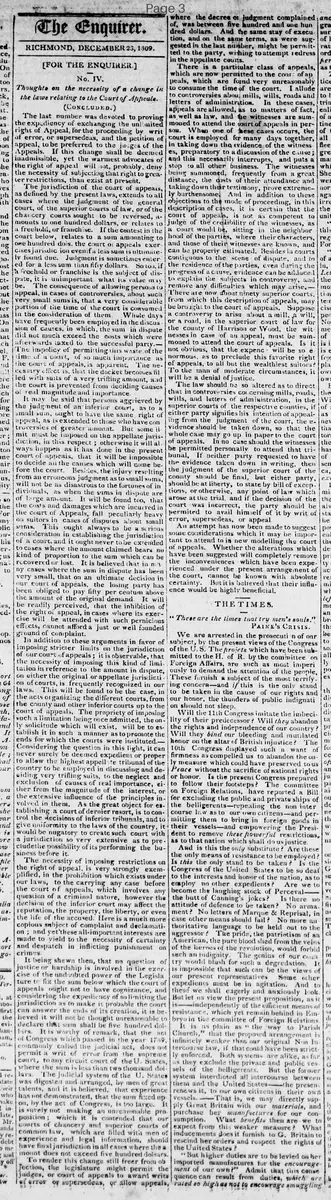
The Enquirer.
RICHMOND, DECEMBER 23, 1809.
[FOR THE ENQUIRER.]
No. IV.
Thoughts on the necessity of a change in the laws relating to the Court of Appeals.
(CONCLUDED.)
The last number was devoted to proving the expediency of exchanging the unlimited right of Appeal, for the proceeding by writ of error, or supersedeas, and the petition of appeal, to be preferred to the judges of the Appeals. If this change shall be deemed inadmissible, yet the warmest advocates of the right of appeal will not, probably, deny the necessity of subjecting that right to greater restrictions, than exist at present.
The jurisdiction of the court of appeals, as defined by the present laws, extends to all cases where the judgment of the general court, of the superior courts of law, or of the chancery courts sought to be reversed, amounts to one hundred dollars, or relates to a freehold, or franchise. If the contest in the court below, relates to a sum amounting to one hundred dolls. the court of appeals exercises jurisdiction even if a less sum is ultimately found due. Judgment is sometimes entered for a less sum than fifty dollars. So too, if a freehold or franchise is the subject of dispute, it is unimportant what its value may be. The consequence of allowing persons to appeal, in cases of controversies, about such very small sums is, that a very considerable portion of the time of the court is consumed in the consideration of them. Whole days have frequently been employed in the discussion of causes, in which, the sum in dispute did not much exceed the costs which were afterwards taxed to the successful party.
The impolicy of permitting this waste of the time of a court, of so much importance as the court of appeals, is apparent. The necessary effect is, that the docket becomes filled with suits of a very trifling amount, and the court is prevented from deciding causes of real magnitude and importance.
It may be said that persons aggrieved by the judgment of an inferior court, as to a small sum, ought to have the same right of appeal, as is extended to those who have controversies of greater amount. But some limit must be imposed on the appellate jurisdiction, in this respect; otherwise it will always happen as it has done in the present court of appeals, that it will be impossible to decide all the causes which will come before the court. Besides, the injury resulting from an erroneous judgment as to small sums, will not be as disastrous to the fortunes of individuals, as when the sums in dispute are of large amount. It will be found too, that the costs and damages which are incurred in the court of Appeals, fall peculiarly heavy on suitors in cases of disputes about small sums. This ought always to be a serious consideration in establishing the jurisdiction of a court, and it ought never to be extended to cases where the amount claimed bears no kind of proportion to the sum which can be recovered or lost. It is believed that in many cases where the sum in dispute has been very small, that on an ultimate decision in our court of appeals, the losing party has been obliged to pay fifty per centum above the amount of the original demand. It will be readily perceived, that the inhibition of the right of appeal, in cases where its exercise will be attended with such pernicious effects, cannot afford a just or well founded ground of complaint.
In addition to these arguments in favor of imposing stricter limits on the jurisdiction of our court of appeals; it is observable, that the necessity of imposing this kind of limitation in reference to the amount in dispute, on either the original or appellate jurisdiction of courts, is frequently recognized in our laws. This will be found to be the case, in the acts of organizing the different courts, from the county and other inferior courts up to the court of appeals. The propriety of imposing such a limitation being once admitted, the only solicitude which will exist, will be to establish it in such a manner as to promote the ends for which the courts were instituted.
Considering the question in this light, it can never surely be deemed expedient or proper to allow the highest appellate tribunal of the country to be employed in discussing and deciding very trifling suits, to the neglect and exclusion of causes of real importance, either from the magnitude of the interest, or the extensive influence of the principles involved in them. As the great object for establishing a court of dernier resort, is to control the decisions of inferior tribunals, and to give uniformity to the laws of the country, it would be nugatory to create such court with a jurisdiction so very extensive as to preclude the possibility of its performing the business before it.
The necessity of imposing restrictions on the right of appeal, is very strongly exemplified, in the prohibition which exists under our laws, to the carrying any case before the court of appeals, which involves any question of a criminal nature, however the decision of the inferior court may affect the reputation, the property, the liberty, or even the life of the accused. Here is a much more copious subject of complaint and declamation; and yet these all-important interests are made to yield to the necessity of certainty and despatch in inflicting punishment on crimes.
It being shewn then, that no question of justice or hardship is involved in the exercise of the undoubted power of the Legislature to fix the sum below which the court of appeals ought not to have cognizance, and considering the expediency of so limiting the jurisdiction as to make it probable the court can answer the ends of its creation, it is believed it will not be thought unreasonable to declare that sum shall be five hundred dollars. It is worthy of remark, that the act of Congress which passed in the year 1789, commonly called the judicial act, does not permit a writ of error from the supreme court, to any circuit court of the U. States, where the sum is less than two thousand dollars. The judicial system of the U. States was digested and arranged, by men of great talents, and it is believed, that experience has not demonstrated, that the sum fixed upon, by the act of Congress, is too large. It is surely not making an unreasonable proposition: which it is contended that our courts of chancery and superior courts of common law, which are filled with men of experience and legal information, should have final jurisdiction in all cases where the amount does not exceed five hundred dollars.
To render this change still freer from objection, the legislature might permit the judges, or court of appeals to award writs of error or supersedeas, or allow appeals, where the decree or judgment complained of, was between five hundred and one hundred dollars. And the same stay of execution, and on the same terms, as were suggested in the last number, might be permitted to the party, wishing to attempt redress in the appellate courts.
There is a particular class of appeals, which are now permitted to the court of appeals, which are found very unreasonably to consume the time of the court. I allude to controversies about mills, wills, roads and letters of administration. In these cases, appeals are allowed, as to matters of fact, as well as law, and the witnesses are summoned to attend the court of appeals in person. When one of these cases occurs, the court is employed for many days together, in taking down the evidence of the witnesses, preparatory to a discussion of the cause; and this necessarily interrupts, and puts a stop to all other business. The witnesses being summoned, frequently from a great distance, the costs of their attendance and taking down their testimony, prove extremely burdensome. And in addition to these objections to the mode of proceeding, in this description of cases, it is certain that the court of appeals, is not as competent to judge of the credibility of the witnesses, as a court would be, sitting in the neighborhood of the parties, where their characters, and those of their witnesses are known, and can be properly estimated. Besides in courts contiguous to the scene of dispute, and to the residence of the parties, even during the progress of a cause, evidence can be adduced to explain the subjects in controversy, and remove any difficulties which may arise.
There are now about ninety superior courts, from which this description of appeals, may be brought to the court of appeals. Suppose a controversy to arise about a mill, a will, or a road, in the superior court of law for the county of Harrison or Wood, the witnesses in case of an appeal, must be summoned to attend the court of appeals. Is it not obvious, that the expense will be so enormous, as to preclude this favorite right of appeals, to all but the wealthiest suitors? To the man of moderate circumstances, it will be a denial of justice.
The law should be so altered as to direct that in controversies concerning mills, roads, wills, and letters of administration, in the superior courts of the respective counties, if either party signifies his intention of appealing from the judgment of the court, the evidence should be taken down, so that the whole case may go up in paper to the court of appeals. In no case should the witnesses be permitted personally to attend that tribunal. If neither party requested to have the evidence taken down in writing, then the judgment of the superior court of the county should be final, but either party, should be at liberty, to state by bill of exceptions, or otherwise, any point of law which arose at the trial, and if the decision of the court was incorrect, the party should be permitted to avail himself of it by writ of error, supersedeas, or appeal.
An attempt has now been made to suggest some considerations which it may be important to attend to in new modelling the court of appeals. Whether the alterations which have been suggested will completely remove the inconveniences which have been experienced under the present arrangement of the court, cannot be known with absolute certainty. But it is believed that their influence would be highly beneficial.
RICHMOND, DECEMBER 23, 1809.
[FOR THE ENQUIRER.]
No. IV.
Thoughts on the necessity of a change in the laws relating to the Court of Appeals.
(CONCLUDED.)
The last number was devoted to proving the expediency of exchanging the unlimited right of Appeal, for the proceeding by writ of error, or supersedeas, and the petition of appeal, to be preferred to the judges of the Appeals. If this change shall be deemed inadmissible, yet the warmest advocates of the right of appeal will not, probably, deny the necessity of subjecting that right to greater restrictions, than exist at present.
The jurisdiction of the court of appeals, as defined by the present laws, extends to all cases where the judgment of the general court, of the superior courts of law, or of the chancery courts sought to be reversed, amounts to one hundred dollars, or relates to a freehold, or franchise. If the contest in the court below, relates to a sum amounting to one hundred dolls. the court of appeals exercises jurisdiction even if a less sum is ultimately found due. Judgment is sometimes entered for a less sum than fifty dollars. So too, if a freehold or franchise is the subject of dispute, it is unimportant what its value may be. The consequence of allowing persons to appeal, in cases of controversies, about such very small sums is, that a very considerable portion of the time of the court is consumed in the consideration of them. Whole days have frequently been employed in the discussion of causes, in which, the sum in dispute did not much exceed the costs which were afterwards taxed to the successful party.
The impolicy of permitting this waste of the time of a court, of so much importance as the court of appeals, is apparent. The necessary effect is, that the docket becomes filled with suits of a very trifling amount, and the court is prevented from deciding causes of real magnitude and importance.
It may be said that persons aggrieved by the judgment of an inferior court, as to a small sum, ought to have the same right of appeal, as is extended to those who have controversies of greater amount. But some limit must be imposed on the appellate jurisdiction, in this respect; otherwise it will always happen as it has done in the present court of appeals, that it will be impossible to decide all the causes which will come before the court. Besides, the injury resulting from an erroneous judgment as to small sums, will not be as disastrous to the fortunes of individuals, as when the sums in dispute are of large amount. It will be found too, that the costs and damages which are incurred in the court of Appeals, fall peculiarly heavy on suitors in cases of disputes about small sums. This ought always to be a serious consideration in establishing the jurisdiction of a court, and it ought never to be extended to cases where the amount claimed bears no kind of proportion to the sum which can be recovered or lost. It is believed that in many cases where the sum in dispute has been very small, that on an ultimate decision in our court of appeals, the losing party has been obliged to pay fifty per centum above the amount of the original demand. It will be readily perceived, that the inhibition of the right of appeal, in cases where its exercise will be attended with such pernicious effects, cannot afford a just or well founded ground of complaint.
In addition to these arguments in favor of imposing stricter limits on the jurisdiction of our court of appeals; it is observable, that the necessity of imposing this kind of limitation in reference to the amount in dispute, on either the original or appellate jurisdiction of courts, is frequently recognized in our laws. This will be found to be the case, in the acts of organizing the different courts, from the county and other inferior courts up to the court of appeals. The propriety of imposing such a limitation being once admitted, the only solicitude which will exist, will be to establish it in such a manner as to promote the ends for which the courts were instituted.
Considering the question in this light, it can never surely be deemed expedient or proper to allow the highest appellate tribunal of the country to be employed in discussing and deciding very trifling suits, to the neglect and exclusion of causes of real importance, either from the magnitude of the interest, or the extensive influence of the principles involved in them. As the great object for establishing a court of dernier resort, is to control the decisions of inferior tribunals, and to give uniformity to the laws of the country, it would be nugatory to create such court with a jurisdiction so very extensive as to preclude the possibility of its performing the business before it.
The necessity of imposing restrictions on the right of appeal, is very strongly exemplified, in the prohibition which exists under our laws, to the carrying any case before the court of appeals, which involves any question of a criminal nature, however the decision of the inferior court may affect the reputation, the property, the liberty, or even the life of the accused. Here is a much more copious subject of complaint and declamation; and yet these all-important interests are made to yield to the necessity of certainty and despatch in inflicting punishment on crimes.
It being shewn then, that no question of justice or hardship is involved in the exercise of the undoubted power of the Legislature to fix the sum below which the court of appeals ought not to have cognizance, and considering the expediency of so limiting the jurisdiction as to make it probable the court can answer the ends of its creation, it is believed it will not be thought unreasonable to declare that sum shall be five hundred dollars. It is worthy of remark, that the act of Congress which passed in the year 1789, commonly called the judicial act, does not permit a writ of error from the supreme court, to any circuit court of the U. States, where the sum is less than two thousand dollars. The judicial system of the U. States was digested and arranged, by men of great talents, and it is believed, that experience has not demonstrated, that the sum fixed upon, by the act of Congress, is too large. It is surely not making an unreasonable proposition: which it is contended that our courts of chancery and superior courts of common law, which are filled with men of experience and legal information, should have final jurisdiction in all cases where the amount does not exceed five hundred dollars.
To render this change still freer from objection, the legislature might permit the judges, or court of appeals to award writs of error or supersedeas, or allow appeals, where the decree or judgment complained of, was between five hundred and one hundred dollars. And the same stay of execution, and on the same terms, as were suggested in the last number, might be permitted to the party, wishing to attempt redress in the appellate courts.
There is a particular class of appeals, which are now permitted to the court of appeals, which are found very unreasonably to consume the time of the court. I allude to controversies about mills, wills, roads and letters of administration. In these cases, appeals are allowed, as to matters of fact, as well as law, and the witnesses are summoned to attend the court of appeals in person. When one of these cases occurs, the court is employed for many days together, in taking down the evidence of the witnesses, preparatory to a discussion of the cause; and this necessarily interrupts, and puts a stop to all other business. The witnesses being summoned, frequently from a great distance, the costs of their attendance and taking down their testimony, prove extremely burdensome. And in addition to these objections to the mode of proceeding, in this description of cases, it is certain that the court of appeals, is not as competent to judge of the credibility of the witnesses, as a court would be, sitting in the neighborhood of the parties, where their characters, and those of their witnesses are known, and can be properly estimated. Besides in courts contiguous to the scene of dispute, and to the residence of the parties, even during the progress of a cause, evidence can be adduced to explain the subjects in controversy, and remove any difficulties which may arise.
There are now about ninety superior courts, from which this description of appeals, may be brought to the court of appeals. Suppose a controversy to arise about a mill, a will, or a road, in the superior court of law for the county of Harrison or Wood, the witnesses in case of an appeal, must be summoned to attend the court of appeals. Is it not obvious, that the expense will be so enormous, as to preclude this favorite right of appeals, to all but the wealthiest suitors? To the man of moderate circumstances, it will be a denial of justice.
The law should be so altered as to direct that in controversies concerning mills, roads, wills, and letters of administration, in the superior courts of the respective counties, if either party signifies his intention of appealing from the judgment of the court, the evidence should be taken down, so that the whole case may go up in paper to the court of appeals. In no case should the witnesses be permitted personally to attend that tribunal. If neither party requested to have the evidence taken down in writing, then the judgment of the superior court of the county should be final, but either party, should be at liberty, to state by bill of exceptions, or otherwise, any point of law which arose at the trial, and if the decision of the court was incorrect, the party should be permitted to avail himself of it by writ of error, supersedeas, or appeal.
An attempt has now been made to suggest some considerations which it may be important to attend to in new modelling the court of appeals. Whether the alterations which have been suggested will completely remove the inconveniences which have been experienced under the present arrangement of the court, cannot be known with absolute certainty. But it is believed that their influence would be highly beneficial.
What sub-type of article is it?
Legal Reform
What keywords are associated?
Court Of Appeals Reform
Appellate Jurisdiction Limits
Writ Of Error
Supersedeas
Judicial Efficiency
Virginia Courts
Small Claims Appeals
Procedural Changes
What entities or persons were involved?
Court Of Appeals
Legislature
Superior Courts
General Court
Chancery Courts
Congress
Editorial Details
Primary Topic
Reform Of Court Of Appeals Jurisdiction And Procedures
Stance / Tone
Advocacy For Stricter Limits On Appellate Jurisdiction And Procedural Changes
Key Figures
Court Of Appeals
Legislature
Superior Courts
General Court
Chancery Courts
Congress
Key Arguments
Replace Unlimited Right Of Appeal With Writ Of Error Or Supersedeas And Petition To Judges.
Impose Restrictions On Appeals For Sums Under $500 To Prevent Docket Overload.
Current Jurisdiction Allows Appeals For $100 Or Freehold/Franchise, Wasting Court Time On Trifles.
Costs And Damages In Appeals Disproportionately Burden Small Sum Cases.
Limit Appeals In Criminal Cases Already Exists For Certainty And Despatch.
Reference To U.S. Judicial Act Of 1789 Limiting Writs To $2000.
For Mills, Wills, Roads, Letters Of Administration, Use Written Evidence Instead Of Live Witnesses.
Allow Writs Of Error For Points Of Law Even If No Full Appeal.