Thank you for visiting SNEWPapers!
Sign up free
Farmers' Gazette, And Cheraw Advertiser
Cheraw, Chesterfield County, South Carolina
What is this article about?
On January 25, 1843, in the U.S. Senate, Mr. McDuffie of South Carolina delivered a speech opposing the bill for occupying and settling the Oregon Territory. He advocated for peaceful negotiation with Britain, questioned the territory's value and feasibility of settlement, and urged postponement due to financial and political uncertainties.
Merged-components note: Continuation of Senate debate on Oregon bill across pages; relabeled second component from story to domestic_news
Clippings
1 of 2
OCR Quality
Full Text
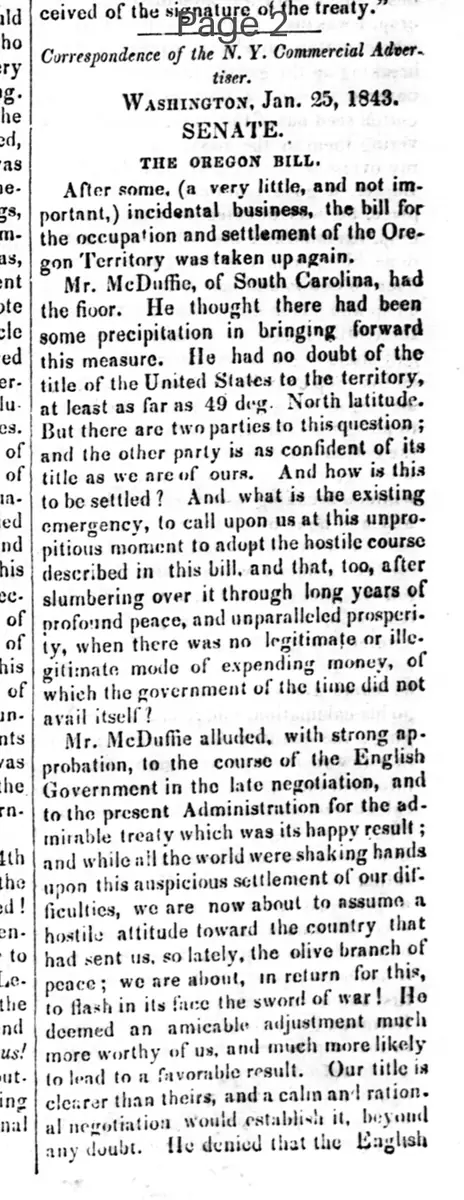
WASHINGTON, Jan. 25, 1843.
SENATE.
THE OREGON BILL.
After some, (a very little, and not important,) incidental business, the bill for the occupation and settlement of the Oregon Territory was taken up again.
Mr. McDuffie, of South Carolina, had the floor. He thought there had been some precipitation in bringing forward this measure. He had no doubt of the title of the United States to the territory, at least as far as 49 deg. North latitude. But there are two parties to this question: and the other party is as confident of its title as we are of ours. And how is this to be settled? And what is the existing emergency, to call upon us at this unpropitious moment to adopt the hostile course described in this bill, and that, too, after slumbering over it through long years of profound peace, and unparalleled prosperity, when there was no legitimate or illegitimate mode of expending money, of which the government of the time did not avail itself?
Mr. McDuffie alluded, with strong approbation, to the course of the English Government in the late negotiation, and to the present Administration for the admirable treaty which was its happy result: and while all the world were shaking hands upon this auspicious settlement of our difficulties, we are now about to assume a hostile altitude toward the country that had sent us, so lately, the olive branch of peace; we are about, in return for this, to flash in its face the sword of war! He deemed an amicable adjustment much more worthy of us, and much more likely to lead to a favorable result. Our title is clearer than theirs, and a calm and rational negotiation would establish it, beyond any doubt. He denied that the English
Government had ever done an act that could be construed into an assertion of her claims to the soil. And he replied with much earnestness and particularity to the arguments of those who had assumed the opposite position.
Mr. McDuffie, in a very impressive manner, animadverted upon the effect that the perusal of late Senate proceedings upon this subject would produce in England. The government of that country would judge of American feeling by the speeches delivered here. He alluded to the state of English feeling toward America, when, a few years ago, he visited that country. There was a deep-seated sentiment of joy that peaceful relations existed, and were likely to exist between the two nations; and the feeling was so general, too, that nothing but bad government, on the part of the administration of one or both, could ever break up those relations. He said he believed so too. He had no fear—he had no misgivings of the courage of his countrymen—but he did believe that a little patience would settle this and all other matters amicably.
But what do we want of this territory? What are we to do with it? Is it anything more than a mere scheme of colonization? Does any man seriously, and in his senses, believe that any settlement formed at the mouth of the Columbia river can ever become a state of this Union?
He had no such belief in the spread of this government. And here he considered the position and nature of the soil; its mountainous character, its separation from the already settled parts of the country by immense chains of mountains, &c.; and commented upon Mr. Woodbury's eulogium upon 'steam' as an auxiliary in bringing about this great result. How is this agent to be brought to bear to this end? By tunnelling the Rocky Mountains, as the Londoners have the Thames?
Are the representatives from Oregon to come hither, to the capital, by 'steam'? And is the American Congress to sit here, with an empty treasury, and devise such impracticable schemes as these? Will there never be an end of such moonshine legislation?
And for whose benefit is this scheme projected? Who will avail himself of it? For himself he wished we did not own the territory. He would not advise a man in whom he had any interest whatever to go thither—although were there any within the circle of his acquaintance fit for Botany Bay alone, he would say 'Go—in Heaven's name, go!' And he then proceeded to show how impossible was the hope that the settlement of Oregon could ever produce one cent of benefit to the revenue of the United States. On the other hand he made a startling statement of the necessary cost of making the proposed settlement.
It could never be in any way valuable as an agricultural country. The fur trade is rapidly deteriorating. Let them alone, and the English fur traders would soon be all gone. The lapse of time itself would soon throw the territory undisputed into our lap. But he would not have it occupied by actual settlements. He thanked God that He had in His mercy placed the Rocky Mountains between us and that country. Were it not for them, we should have reached the Pacific, and he deprecated such an undue spread of colonization from the more civilized and populated parts of the land. We are not so pent up, so unable to breathe, so starving for food, and so distressed for means of production, as to render such acquisition of new territory desirable. Embarrassed we certainly are, but not on either of these grounds. Production is over abundant, and every article of consumption is cheap and almost given away.
As to the value of the fur trade, he had seen no proofs of it, except perhaps the fortune made by John Jacob Astor: and he employed Indians and half-breeds in the work; no citizens of the U. States had been any the better for it all.
Mr. McDuffie could not think that this spirit of emigration was one to be encouraged; and on this point he dwelt with much force and feeling.
But had gentlemen considered the ways and means for carrying into effect this magnificent project? The Senator from New Hampshire (Mr. Woodbury) had made a sort of allusion to the present state of the finances, but he had still hoped they would be better, and that the work would go on.
While Secretary of the Treasury, that Senator had been used to framing expedients to meet desperate exigencies, while the Treasury had nothing in it, and therefore it was all in keeping for him now to meet this emergency in the same hopeful way. But Mr. McDuffie would look a little into this matter. What is the condition of the country at this moment? Who rules? Who is responsible? Nobody! We are in a state of interregnum. Let us postpone such measures as these until somebody is responsible. And here he took a view of the relative position of the different parties to each other, and deprecated any action on this subject until a more proper time shall arrive for its arrangement. He begged the Senate, emphatically and earnestly, to pause before they adopted a measure like this.
What sub-type of article is it?
What keywords are associated?
What entities or persons were involved?
Where did it happen?
Domestic News Details
Primary Location
Washington
Event Date
Jan. 25, 1843
Key Persons
Outcome
no immediate outcome; mcduffie urges the senate to pause and postpone the bill for amicable negotiation with britain and due to financial and political uncertainties.
Event Details
In the U.S. Senate, Mr. McDuffie of South Carolina spoke against the bill for the occupation and settlement of the Oregon Territory, asserting U.S. title up to 49 degrees North latitude but advocating for peaceful settlement with Britain instead of hostile action. He criticized the timing amid recent treaty successes, questioned the territory's practicality for settlement due to geography and costs, dismissed benefits to revenue or agriculture, and highlighted the deteriorating fur trade. He opposed encouraging emigration there and called for postponement until political stability returns.