Thank you for visiting SNEWPapers!
Sign up free
Editorial
October 5, 1836
Morning Star
Limerick, York County, Maine
What is this article about?
The editorial challenges the Episcopalian dogma of apostolic succession as a basis for ministerial authority, arguing it stems from a debatable church government preference. It asserts nonconformists inherit valid ordination from the establishment and favors a higher view of succession through truth, piety, faithfulness, and Holy Spirit influence rather than lineage.
Clipping
OCR Quality
98%
Excellent
Full Text
Apostolic Succession.
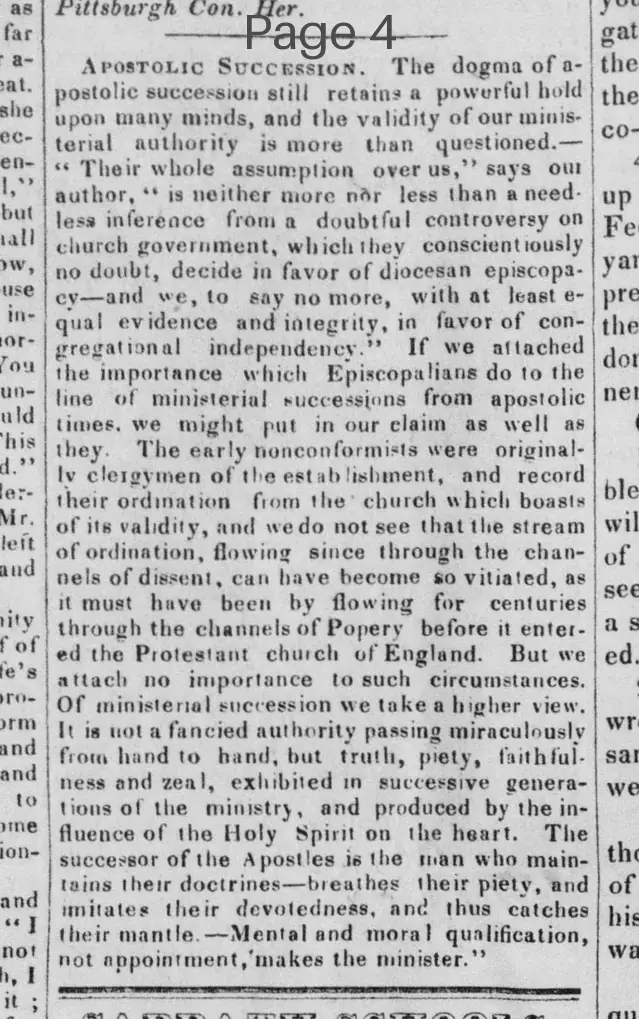
The dogma of apostolic succession still retains a powerful hold upon many minds, and the validity of our ministerial authority is more than questioned.—"Their whole assumption over us," says our author, "is neither more nor less than a needless inference from a doubtful controversy on church government, which they conscientiously no doubt, decide in favor of diocesan episcopacy—and we, to say no more, with at least equal evidence and integrity, in favor of congregational independency." If we attached the importance which Episcopalians do to the line of ministerial successions from apostolic times, we might put in our claim as well as they. The early nonconformists were originally clergymen of the establishment, and record their ordination from the church which boasts of its validity, and we do not see that the stream of ordination, flowing since through the channels of dissent, can have become so vitiated, as it must have been by flowing for centuries through the channels of Popery before it entered the Protestant church of England. But we attach no importance to such circumstances.
Of ministerial succession we take a higher view. It is not a fancied authority passing miraculously from hand to hand, but truth, piety, faithfulness and zeal, exhibited in successive generations of the ministry, and produced by the influence of the Holy Spirit on the heart. The successor of the Apostles is the man who maintains their doctrines—breathes their piety, and imitates their devotedness, and thus catches their mantle.—Mental and moral qualification, not appointment, makes the minister.
The dogma of apostolic succession still retains a powerful hold upon many minds, and the validity of our ministerial authority is more than questioned.—"Their whole assumption over us," says our author, "is neither more nor less than a needless inference from a doubtful controversy on church government, which they conscientiously no doubt, decide in favor of diocesan episcopacy—and we, to say no more, with at least equal evidence and integrity, in favor of congregational independency." If we attached the importance which Episcopalians do to the line of ministerial successions from apostolic times, we might put in our claim as well as they. The early nonconformists were originally clergymen of the establishment, and record their ordination from the church which boasts of its validity, and we do not see that the stream of ordination, flowing since through the channels of dissent, can have become so vitiated, as it must have been by flowing for centuries through the channels of Popery before it entered the Protestant church of England. But we attach no importance to such circumstances.
Of ministerial succession we take a higher view. It is not a fancied authority passing miraculously from hand to hand, but truth, piety, faithfulness and zeal, exhibited in successive generations of the ministry, and produced by the influence of the Holy Spirit on the heart. The successor of the Apostles is the man who maintains their doctrines—breathes their piety, and imitates their devotedness, and thus catches their mantle.—Mental and moral qualification, not appointment, makes the minister.
What sub-type of article is it?
Moral Or Religious
What keywords are associated?
Apostolic Succession
Ministerial Authority
Episcopacy
Congregational Independency
Holy Spirit
Nonconformists
What entities or persons were involved?
Episcopalians
Nonconformists
Apostles
Protestant Church Of England
Popery
Editorial Details
Primary Topic
Critique Of Apostolic Succession And Ministerial Authority
Stance / Tone
Supportive Of Nonconformist View On Spiritual Qualifications Over Episcopal Lineage
Key Figures
Episcopalians
Nonconformists
Apostles
Protestant Church Of England
Popery
Key Arguments
Apostolic Succession Is A Needless Inference From A Doubtful Church Government Controversy
Nonconformists Have Valid Ordination From The Establishment, Not Vitiated By Dissent
Ministerial Succession Is Based On Truth, Piety, Faithfulness, And Zeal Via Holy Spirit
Successor Of Apostles Maintains Doctrines, Breathes Piety, Imitates Devotedness
Mental And Moral Qualifications, Not Appointment, Make The Minister